Stationary phases and support materials
McReynolds constants
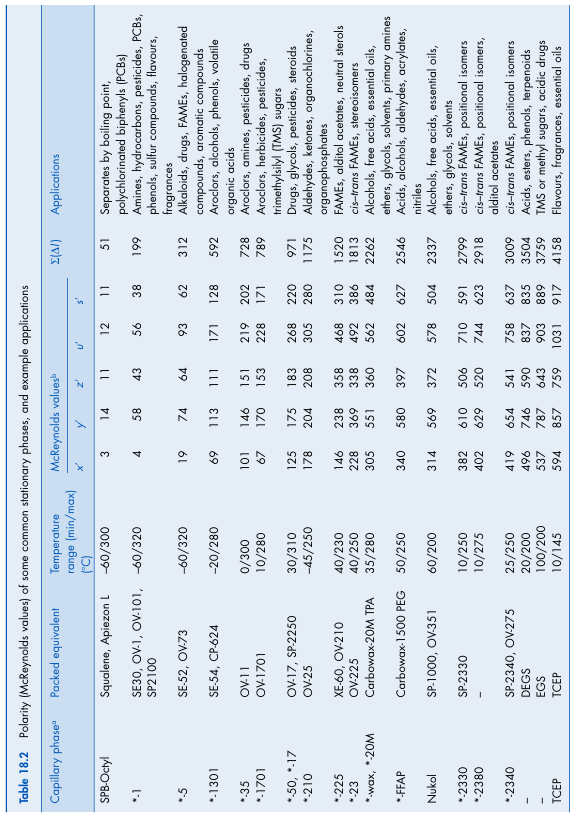
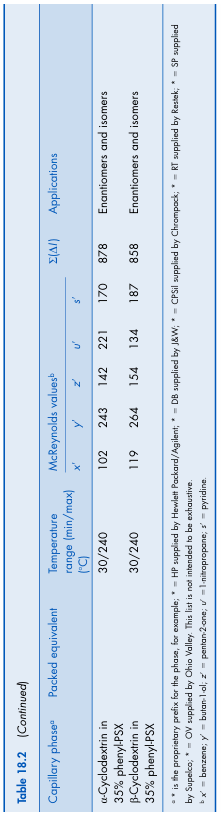
The retention behaviour of probe compounds has been used traditionally to classify stationary phases in terms of their polarity. Lutz Rohr Schneider in 1966 pioneered this type of classification using five probe compounds, followed closely by McReynolds (1970). McReynolds increased the number of probe compounds to ten but the following five compounds are considered as the most import ant: benzene, butanol, pentan-2-one, nitro propane and pyridine. The retention indices of each of these five reference compounds are measured on the stationary phase being tested, and then compared to those obtained under the same conditions on squalene (a standard nonpolar stationary phase). The differences in the retention indices between the two phases (DI) for the five probe compounds are added together to give a constant, known as the McReynolds constant, which is used to compare the ability of stationary phases to separate different classes of compounds. Phases that provide McReynolds values of 4 can be substituted freely for each other as they should give similar retention and specificity; those differing by ±10 units generally yield similar separations but may show some greater differences in terms of retention and elution order. Phases with McReynolds values below 100 are considered nonpolar, those above 400 indicate a highly polar phase and values between 100 and 400 indicate intermediate polarity. Table 18.2 shows the McReynolds constants, operating tempera ture range, the relationship between capillary and packed column nomenclature and example applications for the most popular stationary phases. ∆I values for individual probes indicate the deviation from boiling point order and consequently represent the contribution of forces other than dispersion to elution for that probe. The probes are chosen to represent different functional groups as follows:
• benzene for aromatics and olefins (p-type interactions)
• butan-1-ol for alcohols, nitriles, carboxylic acids and diols (electron-attracting effect) • pentan-2-one for ketones, ethers, aldehydes, esters, epoxides and dimethylamino derivatives (dipole–dipole effect)
• nitropropane for nitro and nitrile derivatives (electron-donating effect)
• pyridine for bases (nonbonding electron attraction and hydrogen-bonding effects).
• butan-1-ol for alcohols, nitriles, carboxylic acids and diols (electron-attracting effect)
• pentan-2-one for ketones, ethers, aldehydes, esters, epoxides and dimethylamino derivatives (dipole–dipole effect)
• nitropropane for nitro and nitrile derivatives (electron-donating effect)
• pyridine for bases (nonbonding electron attraction and hydrogen-bonding effects).
Moffat et al. (1974a) devised a system to assess the effectiveness of liquid stationary phases by calculating the discriminating power, and examined a number of phases commonly used in toxicology (Moffat et al. 1974b). Contrary to popular belief, it was shown that one column could be used to elute all the drugs studied, and that for screening purposes a single column, either SE-30 or OV-17 (100% dimethyl-PSX or 5% phenyl PSX capillary equivalents), was sufficient for the reliable identification of drugs.