Detection of drugs in sweat
Sweating (perspiration) is primarily a means of temperature regulation. Evaporation of sweat from the skin surface has a cooling effect. In hot conditions or during exercise, muscles heat up due to exertion and more sweat is produced. Sweating can be significantly increased by nervousness and decreased by cold.
The composition of sweat is similar to that of plasma except that sweat does not contain proteins. The exact mechanism of sweat secretion is not well known. Sweat is a filtrate of plasma that contains electrolytes (such as potassium, sodium and chloride) and metabolic waste products such as urea and lactic acid. It also contains odorants such as 2-methylphenol and 4-methylphenol. Production of sweat takes place in sweat glands. As shown in Figure 6.12, in humans there are two kinds of sweat glands: eccrine sweat glands (Fig. 1A) and apocrine glands (Fig. 1B). There are approximately 2–3 million sweat glands in the skin of humans. An adult person produces from 100 mL of sweat to as much as 10 L in one day. The eccrine sweat glands are the common type and they are distributed over the entire body, particularly on the palms of the hands, soles of the feet and forehead. They are smaller and are active from birth. Apocrine sweat glands develop during puberty and are mainly present in armpits and the anal-genital area. They produce sweat that contains fatty materials. Apocrine glands typically end in hair follicles rather than pores. The sweat glands are controlled by sympathetic cholinergic nerves which are controlled by the hypothalamus. Because sweat resembles a filtrate of plasma, water-soluble chemicals such as some drugs and metal ions are found in sweat. The mechanism of the appearance of a drug in sweat is not fully understood. It is believed that the primary mech anism is passive diffusion from blood into sweat glands and transdermal migration of drugs to the skin surface where drugs are dissolved in sweat. Sweat can be collected on sweat wipes or with a sweat patch. There are a few commercially available patches but only one has been approved in the USA as a collecting device (PharmChem Laboratories, Inc., Fort Worth, TX, USA). The main part of a sweat patch is a gauze pad covered by a protective membrane similar to that of an adhesive dressing strip. The membrane has an adhesive perimeter that sticks tightly to the test subject’s skin. The sweat patch is usually placed on the subject’s upper arm. Sweat patches can be worn for extended periods, they are waterproof and are difficult to tamper with (when removed, the patch cannot be reattached), and they are
usually very well tolerated by patients. There are some concerns associated with the use of sweat patches:
• false positives through environmental contamination
• false positives through skin storage
• false positives during application and removal
• no dose–response relationship
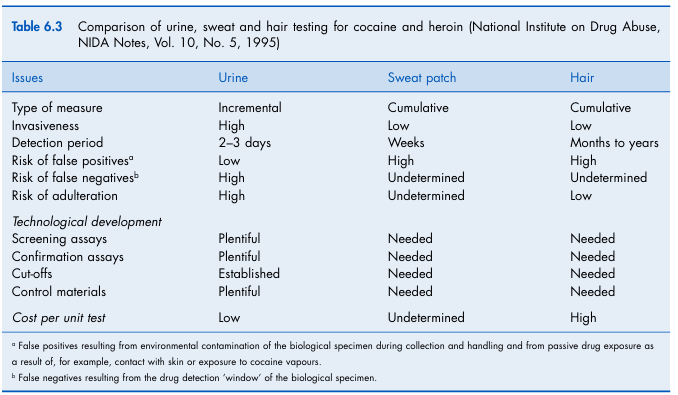
• patch wear problems. It is recommended that the skin be washed with soap and cool water or with a disposable towelette. Then the skin where the patch will be worn is thoroughly cleaned with alcohol wipes prior to patch application. The use of sweat patches detects drug use that occurred just before patch application and while the device remains attached to the skin. Primarily the parent drugs are detected in sweat; however, some drug metabolites can also be found. Drugs of abuse or metabolites detected in sweat include THC, amfetamine, methamfetamine, codeine, morphine, 6-MAM, heroin, PCP, cocaine, benzoylecgonine, ecgonine methyl ester and cocaethylene. Comparison of urine, sweat and hair testing for cocaine and heroin is presented in Table 6.3. Currently sweat testing is used in the private sector for monitoring drug use during substance abuse treatment and in the criminal justice system, as well as for return-to-duty and follow up testing for workplace testing.
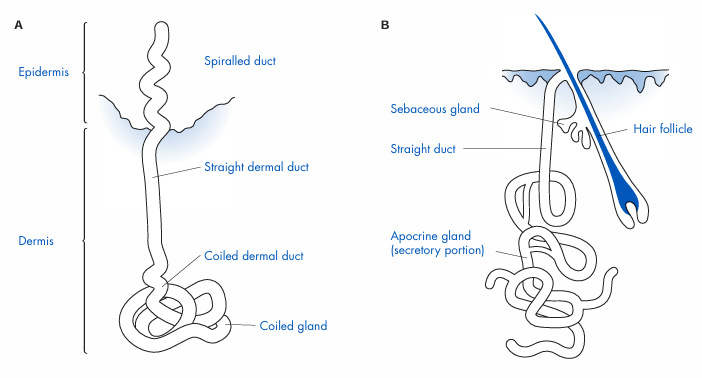
Figure 1 Two types of sweat glands: (A) an eccrine sweat gland; (B) an apocrine sweat gland