Stationary phases and support materials
Solute–stationary phase interactions
For liquid stationary phases, three major types of interaction between the stationary phase and the solute determine chromatographic elution: dispersion, dipole and hydrogen bonding. The volatility of a substance is the most important factor defining its separation in GC. The more volatile the compound (the lower its boiling point), the more likely it is to be in the mobile phase and so the faster it elutes from the column. Although this holds true for groups of compounds with similar functional groups or within homologous series, it cannot be applied universally. In general, a difference of 30C in boiling point is sufficient to predict and maintain elution order, but differences of less than 10C can be overturned by the influence of other interactions.
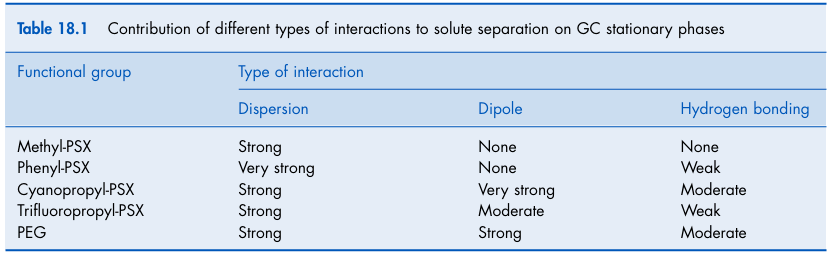
Table 18.1 shows the contribution of each of these interactions for the common types of liquid stationary phases. It should be remembered that hydrogen-bonding interactions are considerably stronger than dipole–dipole inter actions, which are themselves stronger than dispersion interactions. Thus, although the dispersion interaction between the various stationary phases is listed as strong or very strong, and the hydrogen-bonding interactions as weak or moderate, if the analyte has functional groups that can undergo hydrogen bonding with the particular stationary phase employed, the hydrogen-bonding interaction is likely to be stronger than interaction by dispersion, unless the analyte also has a high proportion of groups in its molecular structure that can participate in dispersion interactions, as would be the case for example, for long-chain fatty acids.
Dipole interactions of PEG phases and the cyanopropyl- and trifluoro propyl-substituted PSXs enable these phases to separate solute molecules that have different dipole moments. Such solutes are those with positional isomers of electronegative groups, such as pesticides, halo carbons and many pharmaceuticals.
Functional groups of solutes that exhibit strong hydrogen bonding include alcohols, carboxylic acids and amines. Aldehydes, esters and ketones generally have less effect; hydro carbons, halocarbons and ethers produce negligible hydrogen bonding. Moderate hydrogen bonding is exhibited by PEGs and cyanopropyl-substituted PSXs, with less marked effects shown by phenyl- and trifluropropyl substituted PSXs. Although the amount of separation obtained through dipole interactions or through hydrogen bonding can be difficult to predict, resolution of compounds with smaller differences in dipoles or in hydrogen bonding strengths requires larger percentages of siloxane substitution in order that solute–stationary phase interaction via dispersion forces can be exploited to bring about separation.