Stationary phases and support materials
Chiral phases
Second-generation chiral phases are based on cyclodextrins (toroidal shaped structures formed by a14 linkages of multiple glucose units). The enzyme cyclodextrin glucosyl transferase is used to cleave partially digested starch, and link the glucose units into three forms, referred to as a, b, and c, that have six, seven and eight glucose units, respectively. The mouth of the cyclodextrin molecule has a larger circumference than the base and is linked to secondary hydroxyl groups of the C2 and C3 atoms of each glucose unit. The primary hydroxyl groups are located at the base of the torus, on the C6 atoms. The number of glucose units thus determines the cavity size and electrophilic orientation (see Fig. 1), and affects the order of the enantiomeric forms. The hydroxyl groups can be functionalised selectively to provide various physical properties and inclusion selectivities. Six different cyclodextrin derivatives are manufactured: permethylated hydroxypropyl (PH), dialkylated (DA), trifluoro acetylated (TA), propionylated (PN), butyryl ated (BP) and permethylated (PM). Changes in elution order can be seen between the different derivatives, and also between cyclodextrin cavity sizes. Unlike the cyclodextrins used in high performance liquid chromatography (HPLC), these phases separate both aromatic and nonaromatic enantiomers of a wide range of chemicals, including saturated alcohols, amines, carboxylic acids, epoxides, diols, lactones, amino alcohols, amino acids, esters, pyrans and furans. Derivatised cyclodextrins are thermally stable, highly crystalline and virtually insoluble in most organic solvents. Chiral phases are fragile, however, and unless chemically bonded or cross linked, they cannot be washed with solvent or taken to temperatures outside the 0 to 225C range. A subsequent development has been the embedding of PM cyclodextrins (usually 10% or 20% by volume) into columns that contain standard liquid stationary phases of intermediate polarity, such as 35% phenyl-PSX. Silyl substituted cyclodextrins, such as 2,3-di-O methyl-6-O-t-butyldimethylsilyl are also available embedded (usually 25–35% by weight) in 20% phenyl-PSX, another intermediate polarity stationary phase. These columns are useful for separating positional isomers (phenols, xylenes, etc.), as well as enantiomers.
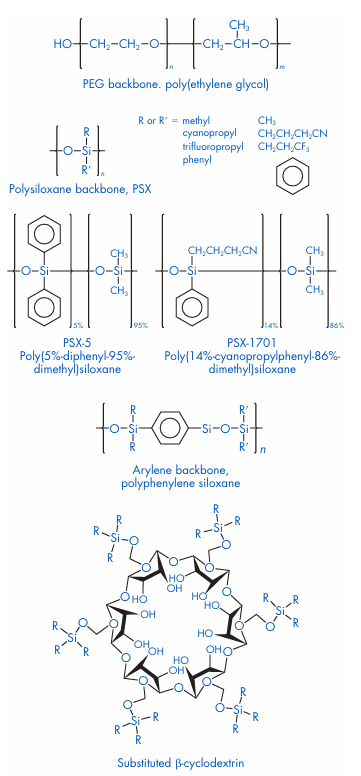
Figure 1 Structures of some common capillary GC stationary phases.








