Expansion
While complement and adverbial subordinate clauses differ in their structures, we will treat them together in this section since the mechanism of expansion operates in much the same way in both. In accordance with (2a), expansion is based on a conceptual strategy whereby clausal (propositional) participants are treated like nominal participants, and the strategy has the effect that—over time—nominal structures acquire the properties of sub ordinate clauses.6 There do tend to be some nominal properties that survive this process, however, such as the following (but see also below):
(3) Structural properties commonly found on subordinate clauses arising via expansion
a. The marker of subordination resembles a grammatical form associated with noun phrase structure, such as a marker of case, gender, definiteness, or an adposition.
b. The verb of the subordinate clause is frequently non-finite, encoded like an infinitival, gerundival, participial, or a nominalized constituent and takes the case marking of a corresponding nominal participant.
c. The arguments of the subordinate clause are encoded in a form that tends to differ from that of the main clause.
d. The agent or notional subject takes a genitive/possessive or other case form, typically having the appearance of a genitival modifier of the subordinate verb.
e. The patient or notional object may also take a genitive/possessive or other case form.
f. There are severe restrictions on distinctions such as tense, aspect, modality, negation, etc. that can be expressed—in fact, such dis tinctions may be absent altogether.
Note that these are not definitional but rather diagnostic properties meant to identify instances of expansion, and not all of the properties are necessarily present in a given case. To be sure, nominal encodings such as the ones listed in (3) are in no way restricted to specific languages; rather, they are found in some way in quite a number of languages. For example, English He witnessed the enemy’s destruction of the city largely corresponds to (3), being a nominal version of the largely equivalent sentence, He witnessed that the enemy destroyed the city.
Expansion from noun to complement clause Givo ´n (2006: 12) describes this channel as one where ‘‘the complement-clause event is treated analogically as a nominal object of the main clause.’’ Complement clauses arising via expansion are not uncommonly restricted to a limited spectrum of main clause (matrix) verbs, most of all speech-act, cognition, and/or verbs of volition. These verbs typically take both clausal and propositional complements, such verbs being for example ‘see’, ‘hear’, ‘feel’, ‘want’, ‘finish’, ‘start’, ‘know’, ‘tell’, ‘remember’, ‘say’, etc. Furthermore, this structure may be confined to complement clauses where the subject of the complement clause is coreferential with that of the main clause subject. We will now look at a few examples illustrating the effects of expansion (for further examples, see Givo̒n 2006).
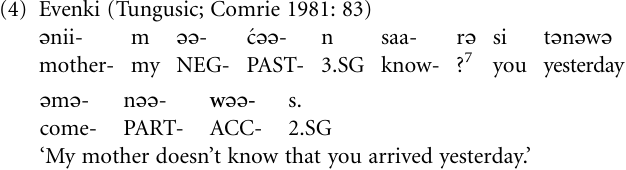
In the following example from the Tungusic language Evenki, the complementizer is an accusative case marker (ACC), that is, the complement clause is introduced by a case suffix, in accordance with (3a), the verb @m@ ‘come’ of the complement clause is presented in the resultative participle (PART), cf. (3b), and the agent of the complement clause appears as a possessor suffix (-s ‘your’) on the participle form of the verb (cf. (3d)).
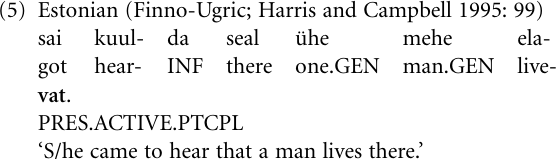
A similar structure is exhibited by the Estonian example in (5), which illustrates one of the two ways in which complement clauses having speech-act or mental-state verbs as main verbs are expressed in this language: The verb is non-finite, constructed in the present tense of the active participle (3b), and the subject/agent appears in the genitive case (GEN) (3d):
Similarly, in the Ik language of northeastern Uganda, the complement verb ‘eat’ in (6) is non-finite and appears in the accusative case (ACC) (3b) and the patient ‘food’ of the complement clause in the genitive case (GEN) (3e).

With regard to (3f), expansion may entail that the complement clause may not be able to express grammatical distinctions commonly found in other clauses. For example, in the Ik complement clause illustrated in (6) no tense–aspect distinction can be expressed, and in the Chibchan language Jacaltec, complement clauses ‘‘of the gerund type’’ cannot be negated while finite complement clauses can (Craig 1977: 242).
Expansion from noun to finite clause But there is a second variety of the expansion strategy whereby the subordinate clause is also treated like a nominal participant but instead of a non-finite structure it takes the form of a fully-fledged finite clause. Accordingly, instances of this variety conform to property (3a) but not to the other properties—that is, the structure of the subordinate clause does not differ dramatically from that of the main clause—other than taking a marker of subordination that is homophonous with, or similar to, a nominal case or other marker. The following examples illustrate this variety.
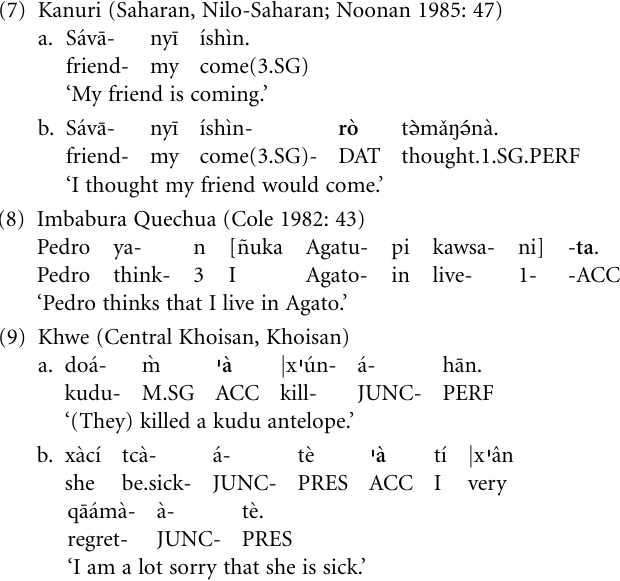
In the Nigerian language Kanuri, the dative case suffix (or enclitic)-rò (DAT) is attached to the finite clause in (7a) to form complement clauses (7b), and in the Andean language Quechua (8) and the Khwe language of Namibia (9) it is the accusative case marker (ACC), cf. (9a), which is attached to the finite complement clause (9b).
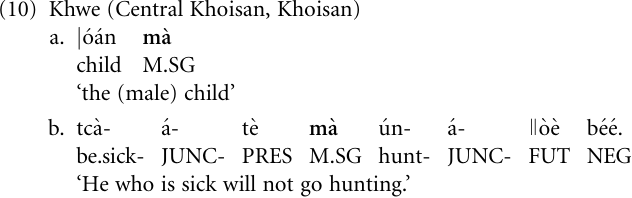
The expansion strategy, whereby a clausal proposition is treated like a noun, is found in headless relative clauses in some languages, where the clausal proposition receives a marker otherwise reserved for nouns; almost invariably, this marker is a definite article. In the Khwe language just mentioned this is a person-gender-number marker, which is used primarily to signal that a noun or noun phrase is referential or definite (10a), but whose use has also been extended to present relative clauses (10b).
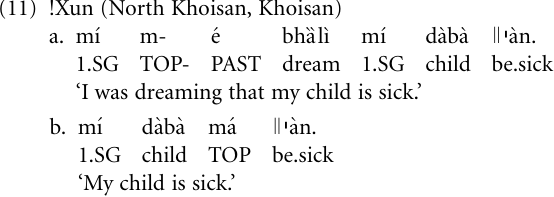
In languages lacking formal means of marking nouns, expansion can simply mean that a complement noun phrase is replaced by a clause, and in such cases it remains unclear whether there is in fact clause expansion, or else integration (5.3). For example, in the Khoisan language !Xun, one way of forming complement clauses after cognition verbs is by simply using a clause instead of a complement noun phrase. Thus, in example (11a), mı̒ dàbà ǀǀˡàn ‘my child is sick’ has the form of a main clause. That it is a subordinate clause can be seen in the fact that it lacks the topic marker ma̒, which is an obligatory part of the main clause, as in (11b).
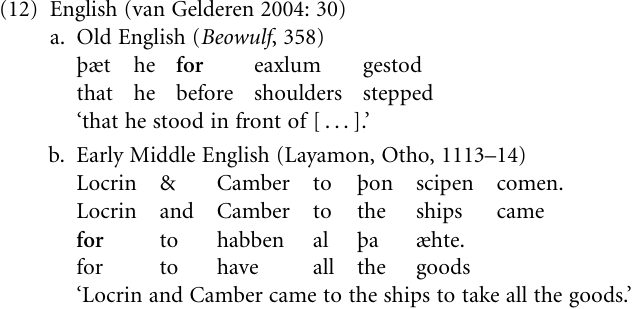
Adverbial clauses Expansion from noun to finite clause is particularly common in the rise of adverbial clauses, to which we now turn (see also “Treating events like objects”). An incipient stage in the development where an adposition or case marker is used via the extension mechanism to also mark adverbial clauses is provided by the following English example volunteered by Hopper and Traugott (2003: 184–5). They observe that, fairly recently, the prepositional phrases on the basis (of) and in terms of have come to be used to link clauses together, for example, They’re a general nuisance in terms of they harass people trying to enjoy the park. A fully grammaticalized English example—which we briefly touched upon earlier—can be seen in the development of for, which was a preposition of location and purpose in Old English, cf. (12a), but came to be used as a purpose clause subordinator (and a complementizer) by early Middle English, cf. (12b) (van Gelderen 2004: 30).
Presumably this is an example of a development leading straight from adposition (or case marker) to clause subordination. But perhaps more common is a development as sketched in (13), where there is an intermediate stage where the complement is neither a noun phrase nor a clause but rather a verb having some nominalizing morphology on it, such as an infinitive, participle, or nominalization marker.

There is a wealth of data dealing with the process leading from prepositions or postpositions, being heads of noun phrases, to adverbial clause markers, that is, heads of adverbial clauses. The mechanism involved is described by Genetti for Bodic languages of Tibeto-Burman in the following way:
In Tibeto-Burman languages it is common for case postpositions, markers of concrete spatial or social relationship between entities, to develop into adverbial subordinators, markers of temporal and logical relationships between propositions. The syntactic mechanism by which such a development occurs is nominalization, which allows for verbs to be inflected with nominal morphology. (Genetti 1991: 227)
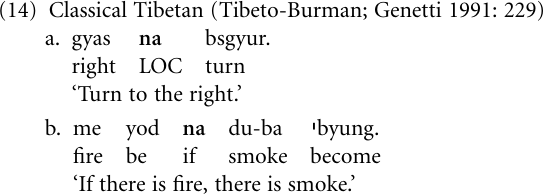
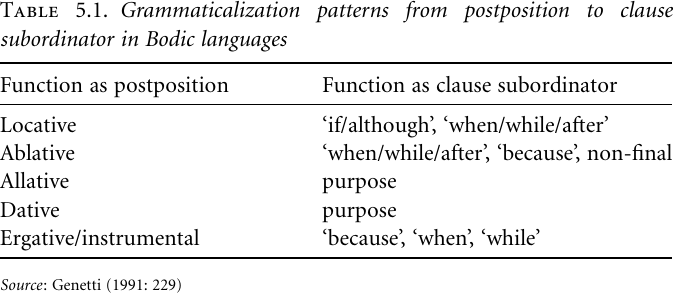
Example (14) illustrates the extension from locative postposition (LOC), cf. (14a), to conditional subordinator (14b) in Classical Tibetan, and Table 5.1 lists the main channels of grammaticalization.
In the Kathmandu dialect of the Tibeto-Burman language Newari, the development of postpositions into subordinators occurred repeatedly over the last several centuries and ‘‘the morphosyntactic mechanism by which the development occurred was nominalization, followed by a reanalysis of originally nominal morphology as verbal morphology, via the reanalysis of unmarked deverbal nominals as erstwhile finite verbs’’ (Genetti 1991: 228).
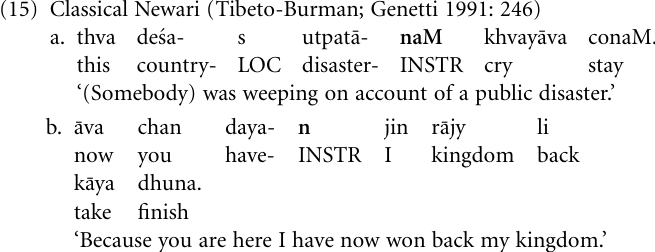
As we observed above, in the transition from adposition to clause subordinator there tends to be an intermediate stage where the relevant form can be interpreted with reference to both. The following example from Classical Newari exhibits this intermediate stage: (15a) illustrates the postposition stage with a clearly nominal morphology suffixed to a noun; (15b) shows the intermediate stage, where the instrumental morpheme (INSTR) is ambiguous, in that the clause can be analyzed either as a nominal clause marked with a case suffix, or as a finite verb followed by a causal subordinator.
For a similar example from the Omotic language Maale, see “Treating events like objects”. Further examples from Laz, a South Caucasian language of the Kartvelian family, are provided by Harris and Campbell (1995: 291–3): the genitive case marker -s̆i and several adpositions are also used to present subordinate clauses. That this situation is the result of a unidirectional process is suggested by the diachronic criterion (5.1): In their nominal uses the genitive marker and the adpositions can be reconstructed back to earlier stages of Kartvelian while this is not possible in the case of their subordinator functions.
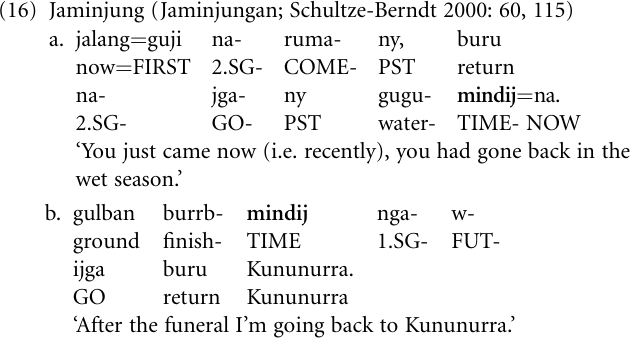
While the development from adposition or case marker to subordinator has given rise in many languages to finite subordinate clauses, it was restricted to non-finite subordinate clauses in other languages. In the Jaminjung language of Northern Australia, the TIME case marker-mindij may be added to finite (inflecting) verbs to form temporal subordinate clauses, but otherwise the use of the case suffixes (or clitics) of this language, including-mindij, is extended only to non-finite clauses. Thus, in (16a), -mindij heads a noun where as in (16b) it heads a non-finite subordinate clause.
To conclude, there is appropriate evidence showing that adpositions or case markers may give rise to adverbial clause subordinators while it is hard to find examples of an opposite directionality, that is, where a clause subordinator developed into a preposition or postposition. Since adpositions are frequently derived from nouns (or noun phrases), various developments discussed in this section can eventually be traced back to nouns (see “The noun channel”). A paradigm example is provided by the Old English noun phrase [in stede + genitive] ‘in the place of’, which developed into a preposition and later on into the clause connective instead of (Traugott 2003).
6 Grammaticalization frequently involves a reduction of structure (Fritz Newmeyer, p.c.), as is suggested by the parameters proposed in “Grammaticalization”, which, except for one, involve loss of properties. In cases such as the present, where there is expansion from nominal to clausal structures, the formal exponents include the loss of nominal meaning (desemanticization) and cardinal nominal morphosyntactic properties (decategorialization); we will return to this issue below.
7 No gloss is provided by the author.








