Discussion Clause subordination
Grammaticalization is unidirectional but there are exceptions, even if they are fairly rare and idiosyncratic—that is, they do not show the crosslinguistic pattern regularity characteristic of grammaticalization processes. With regard to clause combining, one notable exception is provided by Japanese, where there is evidence for the development from hypotaxis to parataxis in adverbial clause constructions (Matsumoto 1998). Newmeyer (1998a: 274–5) takes this case as one out of two examples to claim that there is directionality from hypotactic to paratactic constructions. His second example concerns a case discussed by Harris and Campbell (1995: 284–5), according to which the original English relative marker ðe, historically derived from a demonstrative (in accordance with the channel described in “The demonstrative channel” above), was gradually replaced by markers derived from question pronouns such as who, which, where, while there is no indication that the relative clause itself developed from questions. While we agree with Newmeyer on his first example, we do not think that his second example really is in support of his claim. First, it does not concern a change from hypotaxis to parataxis but rather from question word to relative marker. Second, this change— rather than contradicting the unidirectionality principle—is in support of it: It is an instance of a canonical grammaticalization that we described in “The interrogative channel”.
But this last example concerns an issue that we mentioned, namely what Harris and Campbell (1995: 284) call ‘‘the Marker/Structure Fallacy,’’ according to which the historical sources of subordination markers do not necessarily reflect the sources of the structures of which these markers are a part; accordingly, the etymology of the subordinator does not always reveal the structure of the syntactic source. There are indeed a number of attested cases where, in a situation of language contact, one language just adds an appropriate subordinator replicated on the model of another language to an already existing construction of subordination (see Heine and Kuteva 2005, 2006 for examples). The main argument adduced by Harris and Campbell is that, at least in the history of English, there is no historical evidence for the marker-plus-structure hypothesis:
If relative clauses that make use of relative pronouns that derive from Q-words developed from independent questions, we would expect to find these questions in attested forms of English during this change. But there is no evidence that questions were involved in this change; rather, the facts suggest that the Q-words began to replace the demonstratives and particles found in the existing relative clause structure. (Harris and Campbell 1995: 284–5)
Furthermore, these authors question the hypothesis that subordination commonly develops out of coordinated structures. In fact, as we saw in “Clause subordination”, there is an alternative development, namely expansion (see (2a)); nevertheless, we side with Hopper and Traugott (2003) in hypothesizing that—in accordance with the integration mechanism of (2b)—a major source of clause subordination can be seen in the development from a structure consisting of two independent main clauses1 to another structure where one of the main clauses turns into a subordinat clause—rather than assuming, for example, that a new subordination marker was simply grafted onto an old subordinate clause. An indication that this is unlikely to have been the case can be seen in the following diachronic fact. It is as early as Old English, in English translations from Latin—with the latter language believed to have been the triggering factor for the interrogative > relative development in English (Bergs and Stein 2001, among others)—that we come across examples where the erstwhile relative marker þæt is not replaced but is followed by an interrogative form in the English translation of a Latin (headless) relative clause (which can also be interpreted as a complementizer clause):
Latin non legistis quid fecerit David.
Old English ne rǣdde ge þæt hwæt David dyde.
‘Have ye not read what David did?’(Lockwood1968:245–6)
Now, a usage pattern like this—which in Middle English (Mustanoja 1960: 191; Romaine 1982: 61) may well have been strengthened by French influence, whereby the old þæt marker was felt to be more and more unnecessary until it disappeared entirely—is compatible with a scenario of coordinating two independent clauses. In accordance with Mustanoja (1960: 191) as well as Heine and Kuteva (2006: 232), one may hypothesize that the development from interrogative to relative clause marker is the result of a strategy whereby recurrent interpersonal communication structures used for questions become the conceptual templates for expressing relations between clauses. In other words, the starting point of this development could well have been a declarative clause followed by an interrogative clause. At the first stage of the development, an interrogative structure is used as a template to express the relationship between a main clause and a complement clause, where the WH-word expresses an indefinite complement clause. At the following stage, the WH-word introduces a definite complement, which can also be interpreted as a headless relative clause. At the final stage, the erstwhile interrogative has acquired the function of a relative pronoun with a noun phrase as its head.
Another reason for hesitating to adopt the marker-minus-structure hypothesis proposed by Harris and Campbell, and for maintaining that coordination is an important source for subordination is the following. Harris and Campbell show that yes–no questions are like subordinate clauses in not expressing an assertion, and they conclude:
We hypothesize that it is this non-assertion marking that is extended to the function of marking (certain) subordinate clauses. If this is correct, then we might expect that in a language a specific question-marking device would always be extended to marking those subordinate clauses that are non-assertions in that language, before it is extended to marking those subordinate clauses that are assertions. (Harris and Campbell 1995: 303–4)
As the detailed discussion by Harris and Campbell (1995: 298–303) suggests, their primary concern is with the classification of types of English subordinate clauses with reference to the notions of assertion and presupposition: They do not deal with how these clauses relate to the markings used for their expression. The only reasonable conclusion that one may draw from this discussion is that the extension from question to subordination involved either clauses (or propositions) plus their markings or only clauses without markings.2
Another observation suggesting that there is evidence for a development from a combination of two independent sentences to clause subordination concerns the rise of complementizers out of verbs for ‘say’ that we discussed in “The verb channel”. On the basis of crosslinguistic data, some of which are discussed in “The verb channel”, this development is likely to involve the stages distinguished in (73). The source structure is a direct-speech construction (a). In a number of languages, a verb for ‘say’ is introduced as a quotative marker (‘saying’)3 (b), the construction is extended from direct to indirect speech (c), and the quotative marker may gradually develop into a complementizer (d). As commonly happens in the transition from coordination to subordination, the subordinator starts out as a constituent of the matrix clause but is later reanalyzed as introducing the complement clause. This overall process is strongly suggestive of a development that initially involved a combination of two independent sentences but ends up in a main clause—complement clause construction.
A third observation relates to the nature of context-induced inferencing that characterizes grammaticalization. Take the following example discussed by Harris and Campbell:
A clear example involving extension from a coordinating, rather than subordinating, conjunction is found in Mingrelian. The marker da, which forms conditional clauses, comes from the coordinating conjunction ‘‘and’’; it always occurs in clause-final position, as do several others in the language. (Harris and Camp bell 1995: 290)
While the authors present solid diachronic evidence to establish that Mingrelian da in fact served coordination before its use was extended to mark subordination, there is no evidence to show whether this process was restricted to this marker or, alternatively, whether da was part of a coordinated clause that developed into a conditional clause. But it would seem that there is circumstantial evidence to suggest that the latter hypothesis is to be preferred. There is a crosslinguistically widespread invited inference to the effect that in appropriate contexts a sequence of two consecutive events [X and then Y] is reinterpreted as implying a conditional proposition [If there is X then Y follows]; for example, English Do it again and I’ll take you to court! may be taken as implying a conditional schema (paraphrasable by If you do it again I’ll take you to court!). On this account, it is possible that in Mingrelian a coordinating structure was reinterpreted and grammaticalized as a conditional structure.
Such a hypothesis is supported by the following observations. All the cases discussed in “Integration” concern the evolution of linguistic substance, that is, morphological expressions that are recruited to encode clause subordination. However, this is not the only way in which clause subordination arises; it can arise without involving any formal linkage; what happens simply is that sentences (or propositions) S1 and S2 that are juxtaposed are reinterpreted as one complex sentence (or utterance) where S1 is the main clause and S2 a subordinate clause (or vice versa). Basically, this strategy is used in many languages without attaining any degree of grammaticalization; consider the following English examples.
(74) English
a. Mary is driving to New York. She wants to visit her daughter.
b. I have a sister. She likes music a lot.
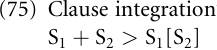
The two examples in (74) each consist of two independent propositions juxtaposed to one another. In specific contexts, however, they can be interpreted as being conceptually linked, in that the second proposition is interpreted as providing information that can be paraphrased by means of a subordinate clause. Such paraphrases for (74a) would be in terms of a purpose clause (Mary is driving to New York in order to visit her daughter) or a cause clause (Mary is driving to New York because she wants to visit her daughter), and in (74b) in terms of a relative clause (I have a sister who likes music a lot). In some languages, such paratactic structures lacking any formal linkage have been grammaticalized to constructions of clause subordination, in accordance with (2b), reprinted here for convenience as (75).
 4
4
The following example from Chinese may illustrate this process. The utterance in (76a) is roughly equivalent in meaning and structure to the English utterance in (74b). In the course of the eighteenth–nineteenth centuries, the structure in (76a) was grammaticalized to a construction where the second proposition is subordinate to the first proposition, as in (76b). This construction is called ‘‘The Descriptive Clause’’ in Chinese grammar, which is similar to a relative clause but contrasts both semantically and morphosyntactically with the relative construction of Chinese (Li 2002: 92).
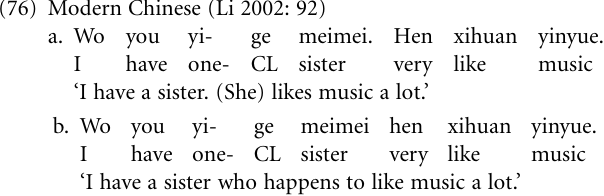
As the examples in (76) show, both constructions coexist in Modern Chinese. That (76b) is a grammaticalized form of (76a) is suggested by the following: In (76a), each of the utterances has the full intonation pattern of a declarative sentence, and there is typically a relatively long pause between the two utterances, marking the beginning of a new intonation unit, while in (76b) the boundary between the two propositions is lost and it now forms one intonation unit (Li 2002: 93).
1 We refer to this structure in short as ‘‘coordination’’, even if the structure may take a variety of different forms of clause linkage, not all of which are commonly described as coordination.
2 Note also the following generalization by Harris and Campbell (1995: 293): ‘‘We suggest here that extension from questions is likewise responsible for the development of question-like structures in subordinate clauses.’’
3 The ‘say’-verb may take a non-finite form, such as an infinitival or gerundival form, as in our scenario, or a finite form (e.g. ‘he says’).
4 The ordering of constituents presented is the one expected in verb-initial (VSO) and verb-medial (SVO) languages, while verb-final (SOV) languages are likely to exhibit the reverse order.








