Clause subordination Introduction
Selection of the data to be discussed below was guided by the question that is central: What can insights on documented language change reveal about early language? We will once more adopt a reductionist perspective, leaving aside all the fascinating conceptual and pragmatic processes that have jointly contributed over centuries to the crystallization of new grammatical structures; in accordance with this reductionist perspective, we will not deal in any detail with syntax per se but will focus on its formal exponents, more precisely on the markers of clause subordination; for a comprehensive syntactic analysis, see Givo̒n (2006). Harris and Campbell (1995: 284) maintain that the historical sources of such markers do not necessarily imply the sources of the structures of which these markers are a part; however, it would seem that, as a rule, they do; we will return to this issue in “Clause subordination Discussion”.
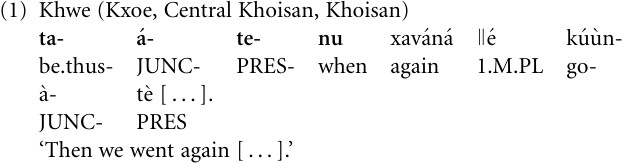
Following other treatments of this subject we will distinguish between coordination, involving two (or more) relatively independent clauses, and subordination, that is a combination of two (or more) clauses where one can be defined as being the main (or matrix, or nucleus) clause and the other as being subordinate to (or dependent on) the main clause on the basis of morphosyntactic properties. As has been pointed out by many authors, and as will also become obvious in subsequent sections, the boundary between the two kinds of clauses is not really neat. In our treatment we will ignore cases where two clauses are reduced to one. This process can be the result of at least two different kinds of processes. One concerns the loss of a main clause whereby the subordinate clause is reinterpreted as the new main clause. Paradigm cases are provided by cleft constructions [It is X that S], where the copular main clause [It is X] is grammaticalized to a focus (and sometimes further to a subject) noun phrase and the subordinate clause [that S] turns into the new main clause, as has happened in a number of languages (see e.g. Heine and Reh 1984: 147–82; Harris and Campbell 1995: 151–68). Another kind concerns subordinate clauses that are grammaticalized (or lexicalized) to adverbials, conjunctions, or parenthetical markers within the main clause. For example, in the Central Khoisan language Khwe (Kxoe) of Namibia, the temporal adverbial clause in (1), meaning roughly ‘when it is like that’, has developed into the temporal conjunction taa̒tenu ‘then’, which has become one of the most frequently used discourse markers of the language. Other cases concern clausal structures that assume functions as modal or evidential markers (see Hopper and Traugott 2003: 207–9; Thompson and Mulac 1991). Such cases concern situations where there already exists an established form of clause subordination, while our interest is with situations where new forms of subordination arise.
On methodology We argue that clause subordination is the product of grammaticalization of non-subordinate sentence structures. The crucial question that this hypothesis raises is the following: What is the evidence in support of this hypothesis?
As may have become clear, there are two kinds of evidence on which our reconstruction work is based. The first is historical in nature: Since grammaticalization theory rests on generalizations on historical processes, its hypotheses must be verifiable, or falsifiable, by means of historical data. For example, if we hypothesize that the English complementizer that or its German equivalent dass are grammaticalized products of the demonstrative that or das, respectively, then we need to demonstrate—as has in fact been done (see e.g. Hopper and Traugott 1993: 185–9)—that at some stage in the history of English there was a demonstrative that but no complementizer that, and that the latter is historically derived from the former. Consequently, we need to demonstrate that there was a situation in earlier forms of English where there were no complement clauses introduced by that (or dass in German). We will refer to this component of our methodology as the diachronic criterion.
But our methodology has a second component. Since grammaticalization is a regular process, instances of it can also be identified by means of structural properties—that is, properties that bear witness to the process concerned. We will refer to this as the structural criterion: Grammaticalized expressions differ from their non-grammaticalized counterparts with reference to the four parameters distinguished in “Methodology”: These expressions are the result of extension, desemanticization, decategorialization, and erosion—hence, they can be identified in terms of these parameters.1 Accordingly, we also need to demonstrate that, for example, the complementizer that differs from the demonstrative that with reference to these parameters.
With regard to the present example, the structural criterion yields the following outcome: Extension means that the use of that was extended to a new context where it came to be used preceding complement clauses— with the result that a new function emerged, namely that of expressing a syntactic relation. Desemanticization had the effect that the item lost a central semantic property that the demonstrative had, namely expressing spatial deixis. Effects of decategorialization can be seen, for example, in the fact that whereas the demonstrative that is sensitive to number (taking the plural form those) and spatial deixis (distal that vs. proximal this), and can be used either as a nominal determiner (that story) or a pronoun (I know that), the complementizer lacks such morphosyntactic properties, and it also lacks the ability to have participant status that the pronoun that has, as in I know that. Additional effects characteristic of decategorialization can be seen in the German equivalent of English that: As a demonstrative (das), it is sensitive to gender, number, and case, while as a complementizer (dass) it is an invariable particle. Finally, erosion means that that as a complementizer lacks a phonetic property that the demonstrative has: It has lost the ability to receive stress.
To conclude, both the diachronic and the structural criteria lead to the same conclusion, namely that that as a complementizer is the product of grammaticalization of the demonstrative. Ideally, both criteria should apply in order to prove cases of grammaticalization. But, as we will see below, in many cases there is no appropriate historical data to draw on the diachronic criterion, and in such cases we will be confined to the structural criterion. It goes without saying that a reconstruction based on both criteria is empirically stronger than one based on only one criterion.
Is this process necessarily unidirectional? The answer is essentially yes: There are quite a number of languages where a change from demonstrative to complementizer has been documented, while we are not aware of any language where a complementizer changed into a demonstrative. Nevertheless, a few cases have been adduced where subordinate structures gave rise to non-subordinate ones (see Hopper and Traugott 1993: 184–5; Harris and Campbell 1995); however, such cases are not only uncommon but also idiosyncratic, that is, they do not seem to correspond to any crosslinguistically regular pattern of grammatical change. Accordingly, provided that the structural criterion applies, we will henceforth assume that the unidirectionality principle is observed.
Two channels As we argue, there are crosslinguistically two main ways in which clause subordination arises: Either via expansion, that is, the reinterpretation of a nominal as a clausal (propositional) participant, or via the integration of two independent sentences within one sentence; the two ways are sketched in (2).2 This argument entails a strong claim, namely that clause subordination is historically derived from non-subordinate sentences. The same claim has been made independently by Givo ´n (2006): Analyzing a wide range of languages of worldwide distribution, he concludes that there are two main diachronic sources or channels leading to complex sentences (or clause union), namely via embedded verb phrase complements (type A) and clause chaining (type B). His type A relates to expansion, while type B corresponds to integration.3

The formulas in (2) show that once either of these two processes has taken place there is recursion, in that one clause (S2) is embedded in another clause (S1). Hopper and Traugott (2003: 176) propose a cline of clause combining leading from parataxis to subordination. This cline concerns only integration (2b); as we will see below, this is not the only way in which clause subordination arises.
“Expansion” is devoted to expansion, while the subsequent sections deal with integration in its major manifestations: “relative clauses” is concerned with certain aspects of relative clauses, that is, with clauses that function as attributive modifiers of nouns (or noun phrases).4 “Complement clauses” deals with complement clauses, that is, with subordinate clauses that are complements (or arguments) of another clause (i.e. the main or matrix clause),5 and “Adverbial clauses” with adverbial clauses, that is, with clauses that have adverbial functions, being modifiers or adjuncts of matrix clauses or predicates. Problems associated with our analysis, as well as some implications that this analysis has, are discussed in “Clause subordination Discussion” Historical information on grammatical change in the languages of the world is scanty, and many of the reconstructions proposed are based on applying the methodology of grammaticalization theory to linguistic data that are only accessible via our structural criterion; however, a number of the reconstructions are also supported by attested historical evidence (see below). some language families, no subordinate structures can be reconstructed; for example, no specific relative clause marking can be reconstructed for the Germanic languages. But this does not mean that previously in the relevant families there were no corresponding subordination structures.
1 As we observed there, not all of these parameters are necessarily relevant in a given case.
2 Note that (2a) is not really a satisfactory way of rendering the actual process. First, ‘‘[NP]’’ need not be a noun phrase but may as well be an adverbial phrase, and, second, the formula applies if ‘‘[NP]’’ is an adjunct, that is, a peripheral participant of S, but not if it is an argument of S.
3 The reader is referred to this study by Givo̒n (2006), which discusses a much wider range of processes than we are able to cover here and provides a coherent syntactic account of these processes.
4 This description is far from satisfactory and takes care essentially only of restrictive relative clauses (see de Vries 2002: 14–15 for discussion).
5 This usage differs slightly from that of Thompson and Longacre (1985: 172; see also Hopper and Traugott 2003: 177) who restrict such clauses to ‘‘those which function as noun phrases (called complements).’’ Even if the majority of complement clauses function as noun phrases, not all really do; for example, in our understanding the English phrase that he’s a liar is a complement clause of the sentence It seems that he’s a liar although it does not appear to be able to function as a noun phrase. Our definition is similar to that of Noonan (1985: 42) according to which a complement clause is a notional sentence or predication that is a subject or object of a predicate.








