
الوضع الليلي


 3:20:21
  2024-07-27
  2286
2286
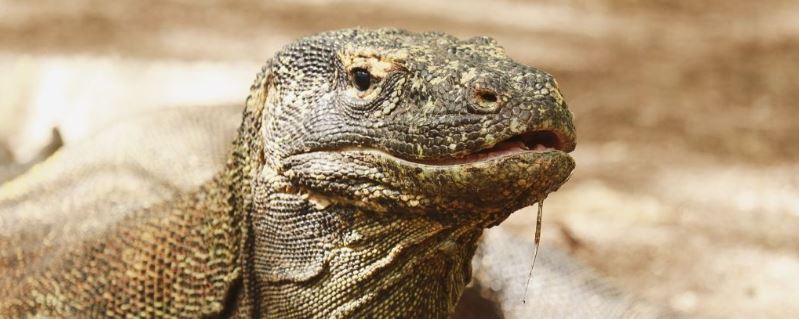
As if komodo dragons weren't amazing enough, these giant lizards literally have teeth of iron.
A new study of these formidable predators' chompers has revealed concentrated deposits of iron along the serrated tearing edges and the tips of their teeth, helping to keep them razor-sharp for tearing the flesh from the prey they devour.
Although many vertebrates have iron enhancements in their teeth, komodo dragons (Varanus komodoensis) and other similar species with serrated teeth, called ziphodonts, represent the most striking examples found to date.
In fact, so much iron is concentrated along the sharp edges of komodo teeth that they are tinted orange.
Never before has iron been found so localized along the cutting edge of a vertebrate tooth. This suggests that a stronger cutting edge confers a competitive advantage, and may yield insights into how some of the fiercest dinosaurs devoured their food.
"Komodo dragons have curved, serrated teeth to rip and tear their prey just like those of meat-eating dinosaurs," says paleontologist Aaron LeBlanc of King's College London.
"We want to use this similarity to learn more about how carnivorous dinosaurs might have ate [sic] and if they used iron in their teeth the same way as the Komodo dragon."
Komodo dragons are, let's just be blunt here, awesome creatures.
Not only is it the largest living lizard species (the largest ever measured was 166 kilograms, or 366 pounds, although they're usually around half that weight), they are strong, fast, cunning, can best prey much larger than themselves, and are wearing full-body bone mail armor under their scaly skins.
They are, indeed, impressive hunters, and their powerful jaws can deliver a nasty bite loaded with anticoagulant venom to exacerbate the rate of blood loss in their prey.
They're also known for their very sharp, serrated teeth, curved like scimitars.
Because komodo dragons are the largest living lizards, and because similar ziphodont teeth have been observed in extinct dinosaurs such as the theropod clade which includes Tyrannosaurus rex, it is thought that the dentition of these marvelous lizards can give us insights into how dinosaurs bit, tore, and ate.
In order to get a bit more insight into komodo dragon dental efficiency, the researchers studied the teeth of a male komodo dragon named Ganas, who lived at London Zoo and was euthanized in February 2023 after being diagnosed with untreatable degenerative arthritis.
Ganas' remains were preserved, and the researchers were able to conduct a thorough examination of his teeth.
They used advanced microscopy and spectroscopy techniques to analyze the composition of Ganas' teeth, and found that orange tint along the serrated edge and at the tip is the result of iron sequestered in that location.
This suggests that dinosaurs may have had a similar adaptation, but when the researchers looked at dinosaur teeth, they were unable to confirm whether this was the case.
"Unfortunately, using the technology we have at the moment, we can't see whether fossilized dinosaur teeth had high levels of iron or not. We think that the chemical changes which take place during the fossilization process obscure how much iron was present to start with," LeBlanc explains.
"What we did find, though, was that larger meat-eating dinosaurs, like tyrannosaurs, did change the structure of the enamel itself on the cutting edges of their teeth. So, while Komodo dragons have altered the chemistry of their teeth, some dinosaurs altered the structure of their dental enamel to maintain a sharp cutting edge."
The researchers hope that a more detailed analysis of komodo dragon teeth might reveal some characteristics associated with the serrated iron edges that would not have been erased by the fossilization process. This could help us better understand how these ancient beasts lived.
And, of course, the findings give us some insight into komodo dragons, the living, breathing animals that still share our planet.
"Komodo dragons are sadly endangered," says herpetologist Benjamin Tapley of the Zoological Society of London, "so in addition to strengthening our understanding of how iconic dinosaurs might have lived, this discovery also helps us build a deeper understanding of these amazing reptiles as we work to protect them."
Reality Of Islam |
|

After spend

A study of

Researchers
 9:3:43
2018-11-05
9:3:43
2018-11-05
10 benefits of Marriage in Islam
7:5:22
2019-04-08
benefits of reciting surat yunus, hud &
9:45:7
2018-12-24
advantages & disadvantages of divorce
11:35:12
2018-06-10
6:0:51
2018-10-16
12:47:1
2022-12-20
11:34:48
2022-06-29
11:11:59
2023-02-01
6:28:21
2022-12-20
the happy life of mankind requirement
6:36:36
2022-01-25
9:50:37
2023-02-28
5:57:34
2023-03-18
5:41:46
2023-03-18
| LATEST |
 HOME
HOME























