الوضع الليلي


 10:13:7
  2024-01-12
  1946
1946
As scientists urgently call for studies on the potential health effects of microplastics that make their way into our bodies, we still don't have any easy and effective way of detecting and identifying the smallest of these polluting particles.
So Columbia University environmental chemist Naixin Qian and her colleagues have developed a new imaging technique to expose the insidious petrochemical fragments for all to see.
"People developed methods to see nanoparticles, but they didn't know what they were looking at," says Qian, explaining that unlike old detection methods which can only provide bulk estimates of present particles, the new technique not only distinguishes individual particles but allows for their identification as well.
Nanoplastics are bits of plastic less than a micrometer in size, produced as a side effect of many industrial processes as well as the degradation of larger plastic products.
"Given the capability of these nanoplastic particles to cross the biological barrier, nanoparticles, despite the seemingly trivial contribution to the mass measurement, might play a predominant role in terms of toxicity evaluation," Qian and her team explain in their paper.
The team used a pair of lasers which can be tuned to resonate with specific molecules – a method called stimulated Raman scattering microscopy. This allowed them to identify the chemical makeup of the target particles by using algorithms to cross-reference databases of chemical resonances.
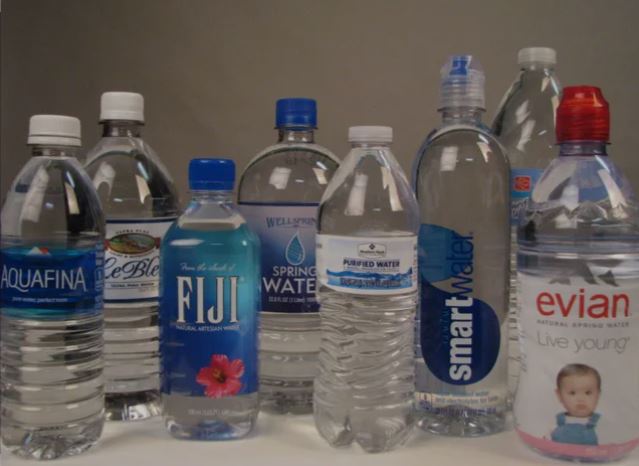
Using this technique the team tested a number bottled water brands popular in the US. They spotted up to 370,000 particles per liter in some of the samples, up to 90 percent of which were nanoplastics.
This amounts to about 240,000 nanoplastic particles in each liter on average, which is up to 100 times greater than previous estimates.
The most common plastic they found was surprisingly not the same material as the bottle, but a compound called polyamide. Ironically this composes the filters used to purify the bottled water.
The plastic bottle material, PET, was also expectedly common.
"It is not totally unexpected to find so much of this stuff," explains Qian. "The idea is that the smaller things get, the more of them there are."
Past estimates mostly only counted larger sized particles, the researchers note, but they've found the smaller particles account for about 90 percent of all the plastic they detected.
While microplastics are not immediately toxic, concerns remain about long-term effects as they accumulate in different tissues within our bodies, from our brains to placentas.
Plastic also has a bad habit of attracting potentially harmful hitchhikers, from antibiotic resistant bacteria to toxic molecules like fire retardants and phthalates and the smaller plastic molecules could then theoretically transport these into our most sensitive tissues.
The new imaging technique is able to directly visualize potentially toxic aggregations and with greater chemical identification data to draw on, may be able to help identify them too. Qian and colleagues hope it can reveal the interactions between these particles and our biological tissues as well.
"Single-particle imaging with nanoparticle sensitivity and plastic specificity provides indispensable information to address the rising toxicity concern," the researchers conclude.
Reality Of Islam |
|

After spend
A study of

Researchers
 9:3:43
2018-11-05
9:3:43
2018-11-05
10 benefits of Marriage in Islam
7:5:22
2019-04-08
benefits of reciting surat yunus, hud &
9:45:7
2018-12-24
advantages & disadvantages of divorce
11:35:12
2018-06-10
6:0:51
2018-10-16
3:43:50
2022-11-05
9:42:16
2022-10-19
7:34:7
2023-02-28
2:13:43
2022-05-27
1:34:8
2022-02-01
7:6:7
2022-03-21
7:32:24
2022-02-14
5:41:46
2023-03-18
| LATEST |
 HOME
HOME