0
EN
1
المرجع الالكتروني للمعلوماتية

Grammar

Tenses

Present

Present Simple

Present Continuous

Present Perfect

Present Perfect Continuous

Past

Past Simple

Past Continuous

Past Perfect

Past Perfect Continuous

Future

Future Simple

Future Continuous

Future Perfect

Future Perfect Continuous

Parts Of Speech

Nouns

Countable and uncountable nouns

Verbal nouns

Singular and Plural nouns

Proper nouns

Nouns gender

Nouns definition

Concrete nouns

Abstract nouns

Common nouns

Collective nouns

Definition Of Nouns

Animate and Inanimate nouns

Nouns

Verbs

Stative and dynamic verbs

Finite and nonfinite verbs

To be verbs

Transitive and intransitive verbs

Auxiliary verbs

Modal verbs

Regular and irregular verbs

Action verbs

Verbs

Adverbs

Relative adverbs

Interrogative adverbs

Adverbs of time

Adverbs of place

Adverbs of reason

Adverbs of quantity

Adverbs of manner

Adverbs of frequency

Adverbs of affirmation

Adverbs

Adjectives

Quantitative adjective

Proper adjective

Possessive adjective

Numeral adjective

Interrogative adjective

Distributive adjective

Descriptive adjective

Demonstrative adjective

Pronouns

Subject pronoun

Relative pronoun

Reflexive pronoun

Reciprocal pronoun

Possessive pronoun

Personal pronoun

Interrogative pronoun

Indefinite pronoun

Emphatic pronoun

Distributive pronoun

Demonstrative pronoun

Pronouns

Pre Position

Preposition by function

Time preposition

Reason preposition

Possession preposition

Place preposition

Phrases preposition

Origin preposition

Measure preposition

Direction preposition

Contrast preposition

Agent preposition

Preposition by construction

Simple preposition

Phrase preposition

Double preposition

Compound preposition

prepositions

Conjunctions

Subordinating conjunction

Correlative conjunction

Coordinating conjunction

Conjunctive adverbs

conjunctions

Interjections

Express calling interjection

Phrases

Sentences

Clauses

Part of Speech

Grammar Rules

Passive and Active

Preference

Requests and offers

wishes

Be used to

Some and any

Could have done

Describing people

Giving advices

Possession

Comparative and superlative

Giving Reason

Making Suggestions

Apologizing

Forming questions

Since and for

Directions

Obligation

Adverbials

invitation

Articles

Imaginary condition

Zero conditional

First conditional

Second conditional

Third conditional

Reported speech

Demonstratives

Determiners

Direct and Indirect speech

Linguistics

Phonetics

Phonology

Linguistics fields

Syntax

Morphology

Semantics

pragmatics

History

Writing

Grammar

Phonetics and Phonology

Semiotics

Reading Comprehension

Elementary

Intermediate

Advanced

Teaching Methods

Teaching Strategies

Assessment

قم بتسجيل الدخول اولاً لكي يتسنى لك الاعجاب والتعليق.

DEGREES OF COMPARISON AND INTENSIFICATION COMPARATIVE AND SUPERLATIVE DEGREES

المؤلف:  Angela Downing

المصدر:  ENGLISH GRAMMAR A UNIVERSITY COURSE

الجزء والصفحة:  P428-C11

2026-07-06

43

+

-

20

DEGREES OF COMPARISON AND INTENSIFICATION

COMPARATIVE AND SUPERLATIVE DEGREES

When we want to express the notion that a person, thing or situation has more or less of a quality, we can mark a gradable adjective for comparative (1) or superlative (2) degree.


This is done grammatically in one of two ways: by inflection, adding -er and -est to the base form, or analytically by the adverbs more and most:

Base form        Comparative                    Superlative

big                     bigger                               biggest                           (inflectional)

comfortable      more comfortable             most comfortable       (analytic)


Inflected forms are used with:

• Short adjectives of one syllable, and disyllabic adjectives ending in –y (hot–hotter hottest; old–older–oldest; easy–easier–easiest; ugly–uglier–ugliest). Exceptions are right, wrong and real.


The ugliest concrete building imaginable.

• Disyllabic adjectives in -ow (narrow, shallow, hollow, mellow) can be inflected, as can other short adjectives ending in weak syllables such as -le (simple, able, noble).


Analytic forms are used with:

• adjectives of more than two syllables (e.g. encouraging); and

• adjectives which are already inflected (e.g. lovable, famous, greenish, pleased).


However, ease of pronunciation and smoothness of sound are important factors, and speakers sometimes improvise if the result sounds acceptable. Lewis Carroll, the creator of Alice in Wonderland, is said to have introduced ‘curiouser and curiouser’, which is still used, though jocularly, by some speakers.


Adjectives in -y which commonly take -er and -est include: happy, lazy, cosy, crazy, dirty, empty, lucky, nasty, pretty, silly, tidy, tricky. The letter ‘y’ is replaced by ‘i’ before an inflection: happier, luckiest.


The following adjectives have suppletive forms for grades 1 and 2:

good, better, best            far, farther, farthest

bad, worse, worst            far, further, furthest


The word further can also be used with the sense of ‘other’, ‘later’, ‘additional’:

The theatre is closed until further notice.


Asking and answering questions about degree

How old is he? He’ll be ten next May. He’s nine years eight months old now.

How old is this church? It must be at least four hundred years old.

Who is taller, you or your sister? I am taller, but James, our brother, is the tallest.


The adjectives elder, eldest (alternative to older, oldest) refer only to persons.


my elder son; our eldest daughter; an elder brother or sister

John is the elder of the two.

I was the second eldest.                                                                     [FY1]


The adjective elderly is not comparative, but refers euphemistically to a person approaching old age. The comparative degree of certain other adjectives has the value of a classifier:

junior rank (= low)                        inferior quality (= bad)               major error (= great)

senior rank (= high)                      superior quality (= good)           minor error (= small)

your upper/lower jaw                   my inner life                                the outer walls (of the city)


There are no inflections of lower and lowest degree corresponding to -er and -est. For this meaning less and least are used as modifiers. The following table summarizes the grading options in English:
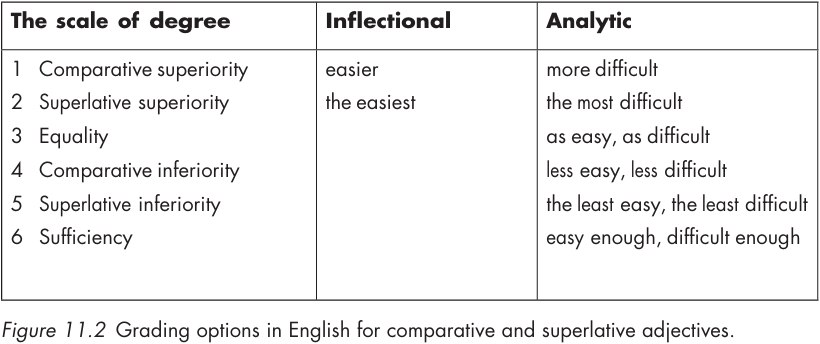
 

Adjectives and adverbs whose meanings are inherently superlative such as unique and perfect are prescriptively banned from comparative and superlative marking. They can be intensified by truly, absolutely, utterly, however, to express the highest degree of a quality:

The feeling is truly unique. It was a truly unique experience.

اخر الاخبار

اشترك بقناتنا على التلجرام ليصلك كل ما هو جديد


