SIMPLE, DERIVED AND COMPOUND ADJECTIVES
The most frequently used adjectives in English are monosyllabic, or disyllabic words of native origin. They tend to be paired as opposites such as good-bad, big-little, large-small, tall-short, black-white, easy-hard, soft-hard, dark-light, alive-dead, hot-cold, which have no distinctive form to mark them as adjectives.
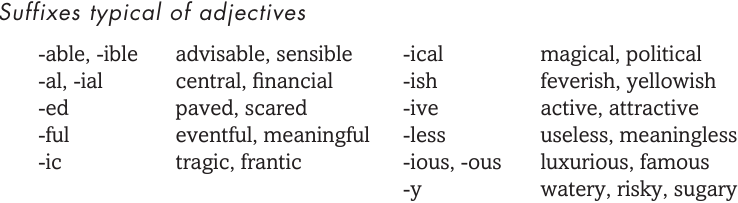
Many adjectives, such as sandy, milky, are derived from nouns, other adjectives or verbs by the addition of certain characteristic suffixes. Some of these are of native origin, as in greenish, hopeful, handsome, handy, foremost, useless, while others are formed on Greek or Latin bases, as in central, secondary, apparent, civic, creative, and yet others via French such as marvelous and readable.
Most adjectival prefixes are added to words which are already adjectives: unhappy, insecure, discourteous, abnormal, irrelevant. Some adjectives were formed by adding the prefix a- to an adjective (asleep, awake, ablaze, alive, alone, alike).
Many adjectives have compound forms composed of various classes of words, for example:
noun + adjective tax-free (goods)
determinative + noun all-American (girl)
number + noun four-wheel (drive)
adverb + participle hard-earned (money, rest)
adverb + adverb well-off (people)
phrase state-of-the-art (stadium)
Adjectives in English are invariable in form. They are not marked for gender or number.
A long-haired dog, long-haired dogs; a tough character, tough characters








