ADJECTIVES AND THE ADJECTIVAL GROUP
STRUCTURE AND CHARACTERISTIC USES OF THE ADJECTIVAL GROUP
The adjectival group is composed potentially of three structural elements: a head (h), a modifier (m) and a post-head element, which will be either a modifier (m) or a complement (c). Post-modifier and complement can occur together in the same AdjG. The basic structures are as follows:
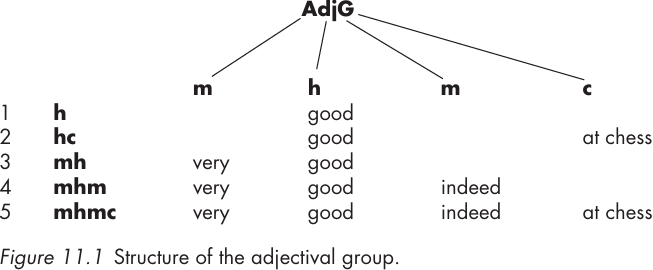
Other examples of full AdjG structures are:
extremely hot for this time of the year (mhm)
very glad that you won the match (mhc)
quite fond of music (mhc)
The difference between a post-modifier and a complement is that the complement is controlled by the adjectival head (good at . . . , fond of . . . , glad that . . . , glad to . . . etc.), whereas the post-modifier is not.
The head of an AdjG is always realized by an adjective, which may function alone in representation of a whole AdjG, as in The food was good.
The following blurb of a novel from The Review contains adjectives of different types. Mostly, they characterize NG referents in evaluative and emotive terms. By contrast, the classifying use is illustrated in best friends and new friend.
For as long as they can remember Ben and Olly have been best1 friends and close2 neighbors. Then Carl moves into their street, Carl is bad.4 Carl is very bad.5 His games are rough,6 dangerous7 and strangely exciting.8 But soon Ben begins to wonder where their new9 friend is leading them.








