Other derivational processes
Acronyms
Acronyms are formed by taking the initial letters of a string of words and combining them to form a new one. In linguistics, speech is generally considered primary and writing secondary, and because acronym formation is dependent on orthography rather than pronunciation, many would consider it to be external to the general phenomenon of lexeme formation or at the very least a special case of lexeme formation that we would expect to find only among literate users of a language. If you question our statement that acronym formation is orthographically based, just say (16c) NATO aloud, followed by North Atlantic Treaty Organization. The pronunciation of the A and O reflects the name of the letters, not the initial sounds of the words.
Speakers may be aware or unaware that a particular form originated as an acronym. How many acronyms on the left would you have been able to break down into their parts on the right?
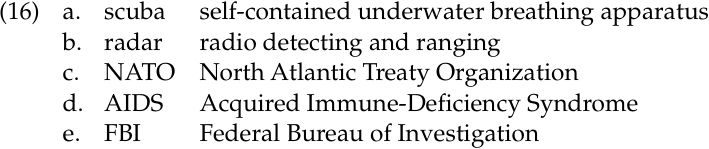
FBI differs from the other acronyms in (16) in being pronounced letter by letter, rather than as a word *[fbi], *[fbaj]. While it is still an acronym, some people prefer to call it an abbreviation or alphabetism for this reason.
The following French words are derived from acronyms, as well:
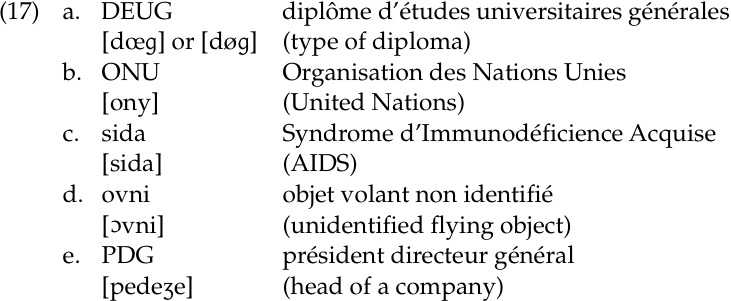
Like FBI, PDG is pronounced letter by letter.
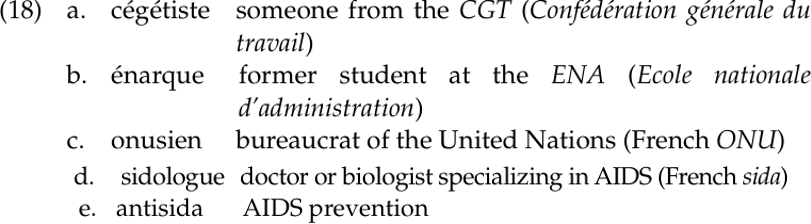
A characteristic of acronyms in some languages is that they can serve as the base for further morphological operations, particularly affixation, as in the following French examples: