Salience and Productivity
We next tackle the oxymoron of productive unproductivity (this last a term we coined just now), the evidence that speakers have unproductive rules or processes at their disposal. For simplicity, we refer simply to rules, since the difference between the two terms is more one of personal preference. The fact that speakers use both unproductive and productive rules is a major reason for including productivity in speakers’ competence. As we will show, speakers can take advantage of the unproductivity of a rule, just as they take advantage of productivity, but to different ends.
When a word is formed from an unproductive rule, that word is more salient than its productively formed counterpart. If we were to use the word coolth in conversation instead of the equivalent productively formed coolness, people would notice, and in some contexts, that could be a useful thing. This brings us back to the novel words, and the fascinating observation that many of them apparently break morphological rules. For example, Latin or Greek suffixes are sometimes attached to Germanic stems, as in smorgsaphobia (heard in an episode of Frasier) or denogginize (from an episode of Seinfeld), and the adjectival prefix un- is sometimes affixed to nouns. Some of our older readers may remember a past 7-Up advertising campaign, where it was referred to as the uncola.
Novel words are called nonce forms or hapax legomenona, and they are particularly common in contexts where salience counts, such as advertising or journalism. One way to create a catchy headline is to include a recognizably novel word. The following examples are all from The Economist (emphasis ours):
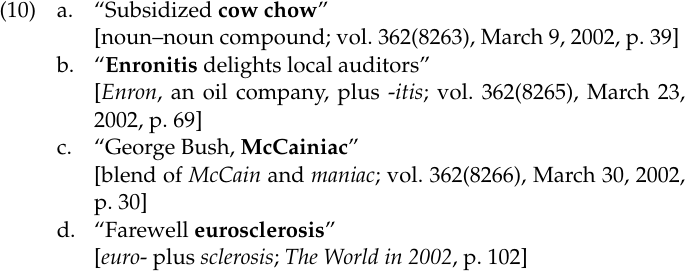
All of these words stand out, because speakers know immediately that they have never seen them before. Words formed by unproductive processes, like uncola, are even more salient. People who hear them stop in their tracks for a moment, trying to put a finger on why they don’t sound quite right.
The relationship between unproductive rules and contexts where there is a need for saliency holds in other languages, too. In Modern Hebrew, many blends are brand names, and are less likely to be created in normal speech (Bat-El 1996). In French, blending is fairly rare, but, again, it can be found in contexts where saliency is important: a flyer advertising Belfort’s Eurockéennes, a blend of Européen ‘European’ and rock, is more eye-catching than one that simply proclaims “European Rock Festival.” The same goes for Irrockuptibles, which happens to be both the title of a French magazine and a rock festival in Spanish-speaking Buenos Aires.
In addition to salience, words formed by unproductive rules have another function: they are useful for coining technical terms, which need to have a distinctive meaning. Take a word from the title, productivity. Why don’t we say productiveness? Research on the two suffixes involved has shown that technical terms are more likely to be formed with -ity than -ness. We don’t talk about Einstein’s theory of relativeness or say to somebody that his analysis lacks objectiveness; we say relativity and objectivity. In pottery, one method of firing is called reduction firing. Reduction involves removing oxygen from the firing atmosphere and results in more interesting colors in the glazing. In order to do reduction firing, you have to use special, reductive clays that will not explode under reduction. Potters call this property reductivity, rather than reductiveness.
To summarize, if a language has two ways of doing something, one of which is less productive, the less productive rule or process has a linguistic purpose. The less productive rule may result in a word that stands out, useful in newspapers, magazines, and advertisements, or it may result in a form that sounds more technical or learned.








