English suffixes
Aronoff and Schvaneveldt (1978) conducted an experiment to verify that productivity figures in individuals’ linguistic competence and to judge its consistency across speakers and words. The experiment focused on -ness, a native English suffix, and -ity, of Latin-Romance origin, which often attach to the same morphological and semantic classes of words. We see this in triplets like the following, where all three members can be found in a dictionary:
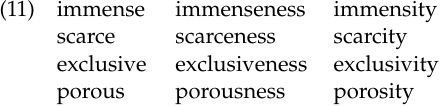
The two suffixes differ, however, in that -ness is more productive overall, especially with certain types of stems like those of the shape X-ive.
Aronoff and Schvaneveldt presented speakers with three sets of words: (i) actual words, like activity or assertiveness, where actual means listed in Webster’s Collegiate Dictionary; (ii) possible words, like effervescivity or affirmativeness, where X-ive occurs in the dictionary, but not the -ness or -ity suffixed form; and (iii) non-words. Here neither X-ive nor X is listed in the dictionary. Examples of non-words are remortiveness and lugativity.
Over the course of the experiment, 141 subjects were asked to judge 40 words, 100 possible words, and 40 non-words, which were presented in randomized lists. For each subject, half of the words were suffixed in -ity and half in -ness. The 40 actual words were the same across all sub jects, but possible words and non-words were counterbalanced so that half of the subjects got, for example, effervesciveness and elaborativity, and the other half elaborativeness and effervescivity. This was done to ensure that judgments would be based on the felicity of the suffix and not some peculiarity of the stem it attached to.
The final variable in the study involved the instructions given to the subjects, who were divided into three groups of 47 each. One group was asked to judge whether the items were in their vocabulary; the second group was asked whether the items were English words; and the third group was asked whether the words were meaningful. As it happened, the instructions had little effect on the subjects’ judgments.
It turned out that English speakers preferred the actual words in -ity (they were balanced for frequency). When it came to the non-words, they didn’t care, and on the potential words, they preferred the -ness words. This shows that speakers can tell the difference between a more productive and less productive rule.
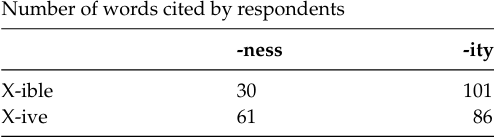
Another experiment yielded even more interesting results. Anshen and Aronoff (1988) tested the productivity of the patterns X-iveness, X-ivity; X-ibility, X-ibleness; and X-ional, X-ionary. We follow them in ignoring the last two, since the most interesting results have to do with the contrast between the behavior of -ity and -ness. Anshen and Aronoff asked their subjects, all native English speakers, to list on paper all the words they could think of that ended in these strings. They expected that speakers would come up with more forms in the more acceptable, and therefore more productive, patterns (X-iveness, X-ibility). In fact, speakers listed more forms for both the X-ibility and X-ivity patterns than for the other two, as shown in the following table (Anshen and Aronoff 1988: 644).
The number of nonce words in the subjects’ lists was much higher for the patterns ending in -ness than those ending in -ity, as shown in the following table.
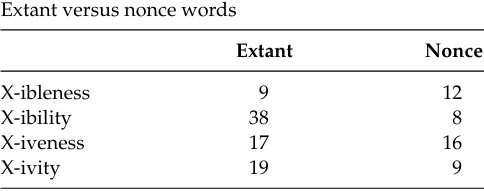
On the basis of their experiment, Anshen and Aronoff hypothesize that -ity forms are stored in the lexicon but that -ness forms are built by rule as they are needed (on the fly, as psychologists say). In other words, there are two ways in which speakers access words: they may find them in the lexicon or create them from existing bases. If speakers create -ness words on the fly, nothing prevents them from using novel forms. If, on the other hand, -ity words are memorized, the forms that the subjects retrieve are likely to exist in other people’s lexicons, as well. This explains the results in the second table immediately above. It is also reasonable to expect a greater variety in the -ness words than in the -ity words, because speakers choose the latter from a defined stored set, but make up the former as they need them. This also turned out to be the case (Anshen and Aronoff 1988: 645).
Anshen and Aronoff’s suggestion that speakers build words in -ness on the fly may also explain why rules that were extremely productive historically leave few or no traces in the modern language. Words in -ness are not stored in the lexicon, so if the productive rule disappears, so will the many forms ending in -ness. Anshen and Aronoff cite Broselow (1977), who notes that the Old English deadjectival nominalizer u- was the most productive such affix in Old English yet has left no reflex in Modern English. Broselow explains this fact by hypothesizing that u- forms were never stored in the lexicon but were instead built by rule when needed. Once the rule is lost, all the forms disappear almost instantaneously.
Anshen and Aronoff propose that -ibleness is like u- in that it was once very productive but is now quite marginal. Other affixes that seem to have gone the same way include be-, as in beware and bedevil, and prep ositional prefixes, like with- or at-. Some of these prepositional prefixes, like at-, have left no trace at all. With- appears on only a few words: withdraw, withhold, withstand. These affixes all serve as evidence for the notion that if a rule dies, people do not remember any of the words that were formed with the rule.
The prediction that highly productive affixes disappear with hardly a trace can be demonstrated quite easily, particularly for prefixes, by using a dictionary. The Oxford English Dictionary is particularly useful for this type of investigation because it lists not only the first recorded time a word appeared, but also the last.
Anshen and Aronoff (1988) discuss a theory of how speakers of a language find words. Put yourself in the position of someone who has to find a word. Let’s say that during a conversation, you need to use a noun that expresses an abstract quality having to do with retaining.
We might assume that speakers have three ways in which they can find a morphologically complex word to use in speech. The first is to search the mental lexicon for words that the speaker has memorized by rote. The second is to build a word by rule. And the last way is to create a word by analogy. The three methods are then rote, rule, and analogy. (For evidence that this goes on, see Kuczaj 1977 and Bybee and Slobin 1982.) Anshen and Aronoff claim that speakers do all three at the same time. If a word is very frequent, it has been reinforced in their memories, so speakers will find it easily. This may be why irregularities tend to persist in the most frequently used words of a language, for example, the paradigm ‘to be’ in English. If speakers do not find a word in the lexicon quickly, then rule or analogy will win out, depending on how quickly each operates, which may vary in a given case, depending on complex factors.
This theory sheds some light on -ibleness words and why English speakers tend not to like them. While the -ness rule is very productive overall, in this particular environment it is not. Speakers can retrieve an -ibility word from their mental lexicons more quickly than they can create a new word in -ibleness.








