Yes–No questions
Since Yes–No questions do not contain a question word, there must be some other means of distinguishing them from simple declarative sentences. The most commonly used devices for marking Yes–No questions are listed, in descending order of frequency, in (15):
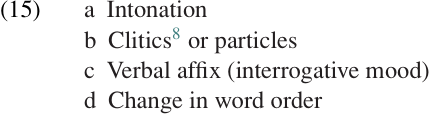
Most languages have a special intonation pattern for Yes–No questions. The question mark“?” is an orthographic device that is used in written language to represent this special intonation. Often the question intonation pattern involves a sentence-final rising pitch, in contrast to a final falling pitch in declarative sentences, but this is by no means universal. In many languages, it is possible to change a declarative sentence into a Yes–No question simply by changing the intonation pattern, and in some languages (e.g. Jacaltec) this is the only available strategy.
In a large number of languages, Yes–No questions must contain a special clitic or particle. Interrogative particles typically occur in one of three positions: sentence initial, sentence final, or as the second element in the sentence. Interrogative clitics may attach to a specific constituent, e.g. the first or last element in the sentence, or to whichever element is “in focus” in the question.
The marking of interrogative mood by an inflectional affix on the verb seems to be much less common than the use of a clitic or particle. An interesting example of a language which does have interrogative mood affixation is Greenlandic, which actually has two different interrogative forms, one for true questions and another for rhetorical questions:

A change in word order to mark questions usually involves the movement of a verbal or auxiliary element toward the front of the sentence, as illustrated in the English examples in (17). This is also a relatively uncommon strategy, though it is found in a number of well-known European languages.
(17) Ken will be working this afternoon.
Will Ken be working this afternoon?
A construction which is closely related to the Yes–No question is the ALTERNATIVE QUESTION. The choice which is offered to the hearer in this kind of question may be between yes and no, as in (18a); or between two (or more) other alternatives, as in (18b):
(18) a Do you want to see the movie or not?
b Do you want coffee or tea?
Another related construction is the TAG QUESTION. Tag questions in English, as illustrated in (19), consist of a copy of the first auxiliary element of the main clause (or do if the clause contains no auxiliary), followed by a pronominal copy of the subject of the main clause. The tag question normally has the opposite POLARITY from the main clause: negative if the main clause is positive, and positive if the main clause is negative.
(19) a You have been studying Russian, haven’t you?
b Bill isn’t going to Paris next week, is he?
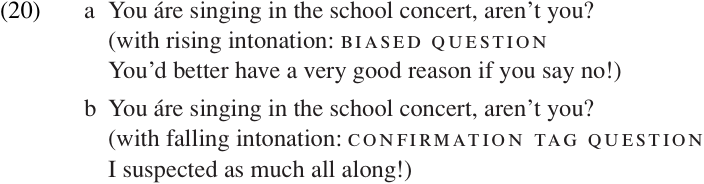
Two different uses of tag questions can be distinguished. The normal use is a request for CONFIRMATION. This construction is much the same as a simple declarative statement, with the tag question serving only as a request for feedback from the hearer. A second use of tag questions in English is to form BIASED QUESTIONS. This construction is a true request for information, in the sense that the speaker requires an answer from the hearer; but it signals an expectation or preference on the part of the speaker for one particular answer to be given.
Biased questions are distinguished from confirmation tags in English primarily by intonation. If the examples in (19) are read with final falling intonation, they have the force of normal confirmation tag questions. If the same sentences are read with final rising intonation, they have the force of biased questions. Also, marked focal stress on the first auxiliary element, as in (20), is more common in biased questions. With confirmation tag questions(20b), this kind of stress pattern may convey a sense of newly discovered and surprising information.
8. A CLITIC can be defined as an element which is phonologically bound to another word, even though it functions as an independent word in the syntax. See Clitics for details.








