Perfect vs. perfective
The terms PERFECT and PERFECTIVE are often confused, or used interchangeably, but there is an important difference between them. The PERFECTIVE is an aspectual category which refers to an entire event as a whole. The PERFECT (e.g. English I have arrived) is used to express a past event which is relevant to the present situation. That is, it signals that some event in the past has produced a state of affairs which continues to be true and significant at the present moment.
To illustrate what this means, compare the pairs of sentences in (23–24). The adverbial clause in (23) specifies a time so long ago that a broken bone should be completely healed by now, and hence no longer relevant. The simple past tense is fine in this context but the perfect is quite unnatural. In the same way, the second clause in sentence (24a) is perfectly natural, but the same clause in (24b) sounds quite odd. (24b) could only be used in the “experiential perfect” sense (see below), e.g. in answer to the question Have you ever lost your glasses?; and in that context it would probably require a slightly marked intonation pattern (I ha̒ve lost my glasses, but ...).
(23) a Simple past: When I was a small boy, I broke my leg.
b Perfect: *When I was a small boy, I have broken my leg.
(24) a Simple past: I lost my glasses, but fortunately my husband found them the next day.
b Perfect: I have lost my glasses (??but fortunately my husband found them the next day).
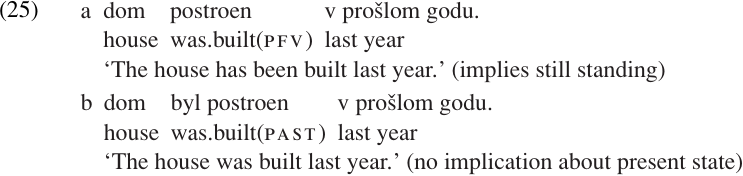
The use of the perfect form in the Russian example (25a) implies that the state of affairs brought about by the described event continues to be true at the present moment: the house is still standing. The use of the simple past in the same context (25b) does not carry any such implication: the house may or may not be standing (Comrie 1976a:54).
The perfect in English cannot be used with a phrase indicating the specific time of a past event (26a, b). It is possible to use phrases indicating the time of relevance (26c) or a span of time within which the past event occurred (26d, e). Note, however, that in some other languages (e.g. Spanish) sentences like (26a, b) would be acceptable.1
(26) a *I have interviewed ten students yesterday.
b *I have arrested 20 drug dealers last Monday.
c I have now arrested 20 drug dealers.
d I have interviewed ten students today.
e I have arrested 20 drug dealers in the past year.
Linguists disagree over whether to classify the perfect as tense or aspect. It seems to have features of both, since it includes both the notions of completion (aspect) and location relative to some temporal reference point (tense).
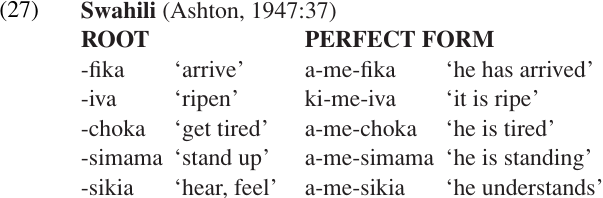
Comrie identifies four major uses of the perfect: (a) perfect of result; (b) experiential perfect; (c) perfect of persistent situation; (d) perfect of recent past. The term “perfect of result” means that a perfect verb is used to describe a result state. For example, if I say The governor has arrived my hearers can normally assume that the governor is here right now. Ashton (1947:37) points out that the Swahili perfect may be used to express either completion of the action or the state resulting from the action. In the latter case (the perfect of result), it is often best translated into English using the verb to be or some other stative predicate (e.g. understand).
The “experiential perfect” indicates that an event has occurred at least once in the past, without specifying any particular time. In English, a simple past tense often implies a specific time reference, whereas the corresponding perfect form does not. So, as illustrated in (28), a person might well give opposite answers depending on the form of the verb used in a question:
(28) a I spent my holidays in Sabah last month.
b Did you climb Mt. Kinabalu? No(, not this time.)
b̒ Have you climbed Mt. Kinabalu? Yes(, many years ago.)
Comrie (1976a:59) uses the pair of sentences in (29) to illustrate the difference between the experiential perfect and the perfect of result. The perfect of result (29b) implies that Bill is still in America, or is still on his way there, whereas the experiential perfect (29a) only implies that he has been there at least once in his life and most likely is back home now.
(29) a Bill has been to America. EXPERIENTIAL PERFECT
b Bill has gone to America. PERFECT OF RESULT
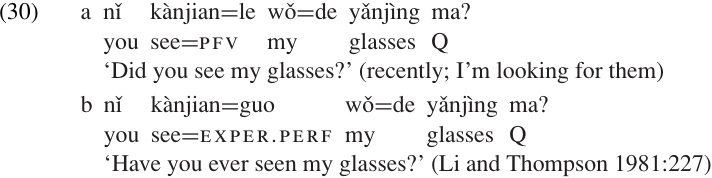
Mandarin Chinese has a specific particle, guo, which is used to mark the experiential perfect. This is illustrated in (30b), in contrast to the perfective construction in (30a). Similarly, Malay has a specific auxiliary verb pernah which is only used to express the experiential perfect.
Comrie’s “perfect of persistent situation” is used to describe a situation that began in the past and continues up to the present moment, e.g. I have known him for 10 years or I have been waiting for hours. (Note that this second example involves a combination of the perfect tense with imperfective aspect. This shows how important it is to distinguish between perfect and perfective.) Time expressions which cover an extended period up to the present moment occur more naturally in English with the perfect than with the simple past tense:
(31) He has lived/?*lived in Canberra since 1975.
In the past four days I have eaten/?*ate three dozen doughnuts.
This usage of the perfect is common in English, but Comrie points out that in some other languages a simple present tense would be used instead. German is one such language, as illustrated in (32).
(32) Ich warte schon drei Tage.
I wait (PRES) already three days
‘I have been waiting for three days.’ (Comrie 1976a:60)
The “perfect of recent past” refers to the use of a perfect form to describe a past event which is relevant to the present situation because it is so very recent. This use of the perfect is often heard in news broadcasts on the radio or television (33), where events are reported within hours or even minutes of their occurrence.
(33) A terrorist has just assassinated the Mayor.
Brazil has won its fifth World Cup championship.
The American president has announced new trade sanctions against the Vatican.
In all of the examples thus far, the reference point to which the situation expressed by the perfect verb has relevance is the present (i.e. the time of the speech event). This form of the verb is called the PRESENT PERFECT. But it is also possible to specify some other reference point to which the perfect form is relevant. The PAST PERFECT (or PLUPERFECT) indicates that a given situation was completed before and relevant to some reference point in the past, as in (34b). The FUTURE PERFECT indicates that a given situation will be completed before and relevant to some reference point in the future, as in (34c).
(34) a Present perfect:
My secretary has destroyed the evidence.
b Past perfect (pluperfect):
When the police arrived, my secretary had (already) destroyed the evidence.
c Future perfect:
Before the police arrive, my secretary will have destroyed the evidence.
The past perfect and future perfect forms can be thought of as combinations of absolute and relative tense. The form of the auxiliary have indicates the absolute time of the reference point (past or future), while the time of the described situation is always past relative to that reference point.
1. Comrie (1976a:61) notes that in several other Romance languages, including French, Italian, and Romanian, the construction that formerly marked the perfect has lost the perfect meaning and is now used simply as a past tense marker.








