Combinations of tense and aspect
Tense and aspect are in principle independent categories, so that a language with three tenses and four aspectual categories could potentially have twelve distinct tense–aspect combinations. In practice, however, there are often restrictions on which combinations are possible in a particular language.
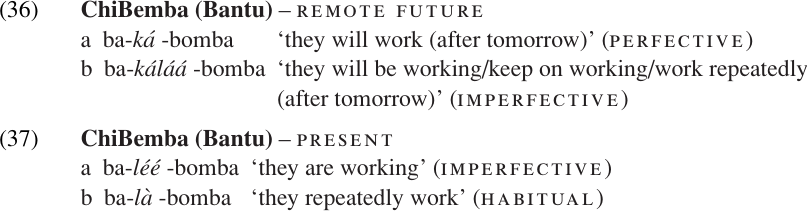
ChiBemba has three morphological aspect categories: perfect, perfective, and imperfective. However, a complete three-way contrast is possible only in some (not all) of the past tenses. Chung and Timberlake (1985:227–228), based on data from Givo̒n (1972), state that perfective is used for events which are completed, perfect for events which have enduring results, and imperfective for continuous or iterative events:

Future tense can combine with perfective (36a) or imperfective (36b) aspect, but not with the perfect. Present tense allows only the imperfective aspect; but a distinction is made between the PROGRESSIVE (37a), which uses the normal imperfective morphology, and ITERATIVE (37b), which uses a special habitual form.
To conclude our discussion of aspect, let us consider some tense–aspect combinations in Tagalog. Each Tagalog verb has three basic finite forms which are often referred to as past tense, present tense, and future tense. But this labeling is misleading. The “present tense” form could be used as a past progressive (“She was singing the Ave Maria when I arrived”) as well as a present progressive (“She is singing the Ave Maria”) or present habitual (“She sings the Ave Maria beautifully”). Similarly, the Tagalog “past tense” form can be used like the English simple past (“she sang”) present perfect (“she has sung”), or past perfect (“she had sung”).1
These three forms involve two different affixes: (1) a nasal infix-in (realized as an initial /n-/ in active voice forms beginning with mag-); and (2) reduplication. The infinitival form of the verb lacks both of these, though it is marked for voice. Some examples of these forms are shown in (38):2
(38) Infinitive “Past” “Present” “Future”
bigy-an b[in]igy-an b[in]i-bigy-an bi-bigy-an ‘to be given’
mag-luto nag-luto nag-lu-luto mag-lu-luto ‘to cook’
gawa-in g[in]awa g[in]a-gawa ga-gawa-in ‘to be made, done’
A number of authors have pointed out that this four-way contrast can be analyzed in terms of two fundamental distinctions.3 The infix-in- marks actions as having been begun, which corresponds nicely to the contrast between REALIS vs. IRREALIS TENSE. CV reduplication marks actions as being non-completed; verbs which lack this reduplication are in COMPLETIVE aspect, while the reduplicated forms are NON-COMPLETIVE.
The following table shows how these two categories combine to produce the forms in (38). The “past tense” forms are those which are both begun and completed, i.e. realis tense and completive aspect. The “present tense” forms are those which are begun but not yet completed, i.e. realis tense and non-completive aspect. The “future tense” forms are those which are neither begun nor completed, i.e. irrealis tense and non-completive aspect. Of course, something which is not begun cannot be completed, so the combination of irrealis tense and completive aspect should be impossible. In fact, this combination, which corresponds to the morphologically unmarked form, is used for “tenseless” categories such as infinitives and imperatives.

1. As this example suggests, certain constructions in Tagalog employ a “relative tense” system. Note the use of the “future” form aalis with past reference in the following example:
Nang aalis na ako, tinawag niya ako.
when leave (FUT) comp 1sg called (PAST) by.him 1sg
‘When I was about to leave, he called me.’
(Schachter and Otanes 1972:477)
2. Notice in the last example that the passive suffix-in does not appear in the presence of the aspect-marking infix-in-. As far as I know, this is true in every Philippine language.
3. Bloomfield (1917); Wolfenden (1961); de Guzman (1978).








