Ergative agreement systems
In most of the languages we have looked at, including English, transitive and intransitive verbs show the same pattern of subject agreement, as illustrated in (26). Agreement in such languages can be said to follow the Nominative–Accusative pattern, because transitive and intransitive subjects trigger the same agreement marking while transitive objects are treated differently (either no agreement, as in English, or a different agreement marker).But the normal way to identify the agreement affixes in these languages is simply “subject agreement ”or“ object agreement,” reserving the terms “nominative” and “accusative” for case markers.
(26) a John runs every morning.
b We run every morning.
c John eats noodles every morning.
d We eat noodles every morning.
However, there are other languages in which verb agreement follows the ergative pattern: in transitive subjects and transitive objects require one kind of agreement marking, while transitive subjects require another. One such language is Tabulahan, an Austronesian language of Sulawesi, Indonesia. The verb in Tabulahan carries two agreement markers in a basic transitive clause (28), but only one in an intransitive clause (27). One set of suffixes is used to agree with the subject of an intransitive clause or the object of a transitive clause, while a distinct set of prefixes is used to agree with the subject of a transitive clause. For example, the suffix-ä՛ is used for a first singular intransitive subject in (27a) and a first singular object in (28a); but the first singular subject of the transitive clause in (28b) requires the prefix ku-.
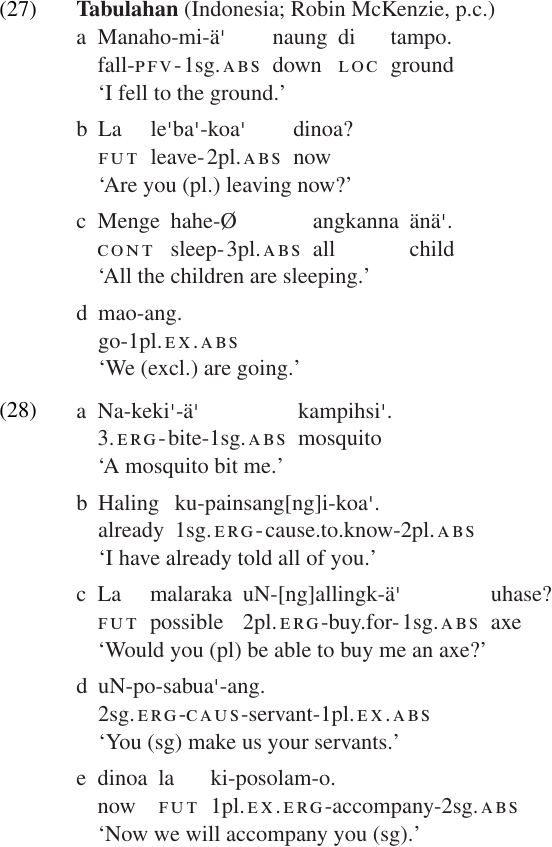
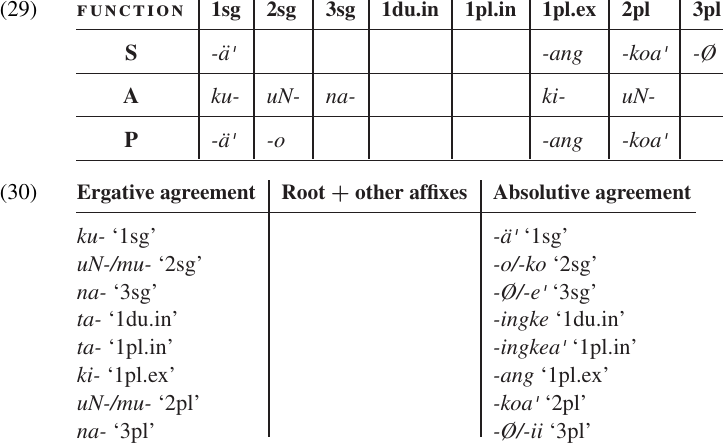
In order to see the patterns in a complex paradigm of this kind, it is often helpful to lay out the forms in some kind of work-chart. The chart in (29) lists the agreement affixes which occur in examples (27–28) according to their functions: S (intransitive subject), A (transitive subject), and P (transitive object). There are gaps in the chart, due to the limited amount of data in these examples, but we can see that wherever we have all three forms for a given person and number, the S and P forms are the same while the A form is different. For this reason, we refer to the two sets of affixes as ergative vs. absolutive agreement, rather than subject vs. object agreement. The complete set of Tabulahan agreement affixes is displayed in the partial position class chart in (30).1
Of course, the terms “absolutive” and “ergative” are also used for case markers. However, in referring to absolutive agreement and ergative agreement, we are not saying that verbs in Tabulahan are marked for case. It is important to remember that case is, by definition, marked on NPs; verbs cannot take case marking unless they have been “nominalized”.
The use of similar labels for case and agreement systems reflects a similarity in function: both case and agreement can be used to distinguish subjects from objects. When either system marks S and P the same but marks A differently, we refer to these markers as “absolutive” and “ergative,” respectively.
1. The 1st person inclusive refers to a group which includes both the speaker and the hearer, while the 1st person exclusive excludes the hearer; see Noun classes and pronouns for further discussion.








