Transitive and intransitive verbs
Take a look at the following questions, each with an action verb.
1. What did you write?
2. Who did you annoy?
3. What did you throw?
These are all perfectly fine questions and easy to answer, e.g. I wrote a letter, I annoyed my neighbor, I threw a ball.
Now compare the first group of questions to the next group, each of which also has an action verb.
4. *What did you sleep?
5. *What did you die?
6. *Who did you arrive?
These questions are all strange and can’t really be answered. That’s because the verbs in this second group are verbs that do not act on anything.
Thus, you can see that there are two kinds of verbs. One kind, such as write, annoy, and throw, acts upon something. The noun (or noun phrase; see The basic structure of noun phrases) that the verb acts up on is called the direct object of the sentence. (You’ll learn more about direct objects in Direct objects.) Those verbs that act on something are called transitive verbs. Typically, in statements, a transitive verb is followed by the noun (or noun phrase) that it is acting upon.
Other verbs, such as sleep, die, and arrive, do not act upon something. In fact, these verbs can’t have a direct object. Notice that you can’t say, for example: *I usually sleep the dog, *They’ll arrive the book. Those verbs that do not act on something and appear in sentences that do not have a direct object are called intransitive verbs.
Quick tip
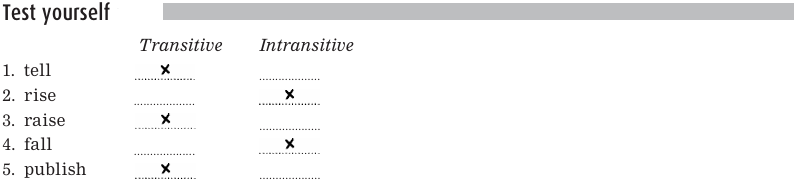
Action verbs that act upon something are called transitive verbs. Action verbs that do not act upon something are called intransitive verbs.
Quick tip
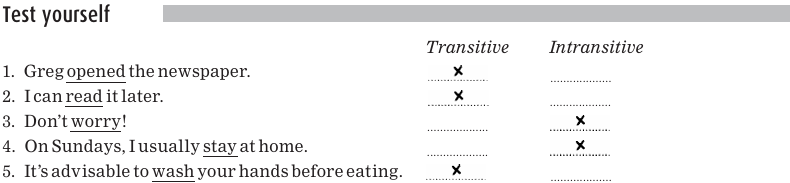
If a verb (in any of its forms) can be put in one of the followings lots, it is transitive: (a) What did you _______ ? (b) Who did you ______? If a verb cannot be put in one of these slots, it is intransitive.
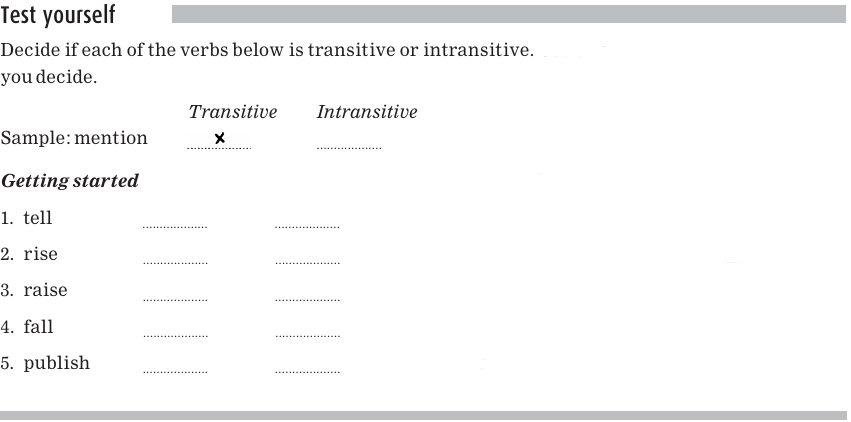
So, which of the following verbs are transitive and which intransitive?
7. What did you discover?
8. *What did you struggle?
9. Who did you meet?
10. *What did you laugh?
Since sentences 7 and 9 are fine questions, discover and meet are transitive verbs. Since sentences 8 and 10 are not acceptable questions, struggle and laugh are intransitive verbs. Note
That although you can say something like, What did you struggle with? or, What did you laugh at?, you can’t ask the questions as they are stated above, and so the verbs are intransitive.
There’s also another way to decide if a verb is transitive or intransitive:
Quick tip
If a verb (in one of its forms) can be put in one of the following slots, it is transitive:
(a)He _________ something. (b)He ______ someone.
Quick tip
If a verb (in one of its forms) can be put in the following slot, it is intransitive: He ______.
Let’s use these Quick tips to decide which of the following verbs are transitive and which are intransitive:
11.He discovered something.
12.He met someone.
13.He struggled.
14.He laughed.
Quick tip helps identify the verb discovered in sentence 11 and the verb met in sentence 12 as transitive. Quick tip helps identify the verb struggled in sentence 13 and the verb laughed in sentence 14 as intransitive.
Answers
Now take a look at a few more sentences:
15a. I ate.
15b. I ate dinner.
16a. She dances well.
16b. She dances the tango well.
17a.Theaudienceleft.
17b.Theaudienceleftthetheater.
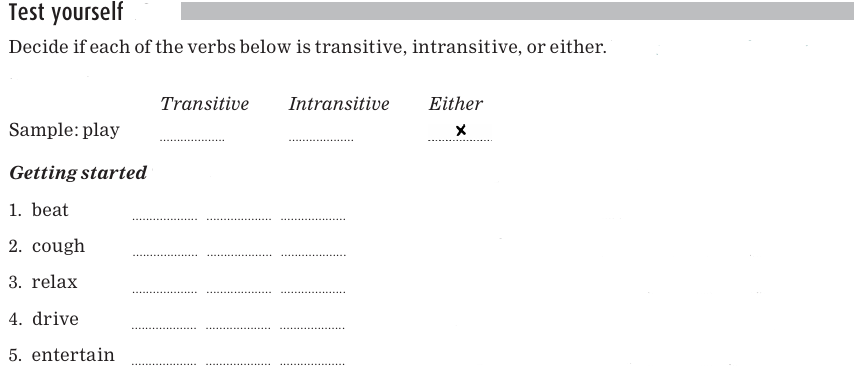
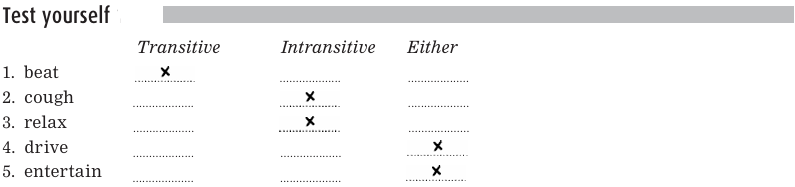
You can see that there are verbs, such as eat, dance, and leave, that can be used as either transitive or intransitive verbs.
Quick tip
Some verbs can be either transitive or transitive. These can occur in both of the following slots: (a) He ______ something/ someone. (b)He ______.
Answers
Answers