0
EN
1
المرجع الالكتروني للمعلوماتية

Grammar

Tenses

Present

Present Simple

Present Continuous

Present Perfect

Present Perfect Continuous

Past

Past Simple

Past Continuous

Past Perfect

Past Perfect Continuous

Future

Future Simple

Future Continuous

Future Perfect

Future Perfect Continuous

Parts Of Speech

Nouns

Countable and uncountable nouns

Verbal nouns

Singular and Plural nouns

Proper nouns

Nouns gender

Nouns definition

Concrete nouns

Abstract nouns

Common nouns

Collective nouns

Definition Of Nouns

Animate and Inanimate nouns

Nouns

Verbs

Stative and dynamic verbs

Finite and nonfinite verbs

To be verbs

Transitive and intransitive verbs

Auxiliary verbs

Modal verbs

Regular and irregular verbs

Action verbs

Verbs

Adverbs

Relative adverbs

Interrogative adverbs

Adverbs of time

Adverbs of place

Adverbs of reason

Adverbs of quantity

Adverbs of manner

Adverbs of frequency

Adverbs of affirmation

Adverbs

Adjectives

Quantitative adjective

Proper adjective

Possessive adjective

Numeral adjective

Interrogative adjective

Distributive adjective

Descriptive adjective

Demonstrative adjective

Pronouns

Subject pronoun

Relative pronoun

Reflexive pronoun

Reciprocal pronoun

Possessive pronoun

Personal pronoun

Interrogative pronoun

Indefinite pronoun

Emphatic pronoun

Distributive pronoun

Demonstrative pronoun

Pronouns

Pre Position

Preposition by function

Time preposition

Reason preposition

Possession preposition

Place preposition

Phrases preposition

Origin preposition

Measure preposition

Direction preposition

Contrast preposition

Agent preposition

Preposition by construction

Simple preposition

Phrase preposition

Double preposition

Compound preposition

prepositions

Conjunctions

Subordinating conjunction

Correlative conjunction

Coordinating conjunction

Conjunctive adverbs

conjunctions

Interjections

Express calling interjection

Phrases

Sentences

Clauses

Part of Speech

Grammar Rules

Passive and Active

Preference

Requests and offers

wishes

Be used to

Some and any

Could have done

Describing people

Giving advices

Possession

Comparative and superlative

Giving Reason

Making Suggestions

Apologizing

Forming questions

Since and for

Directions

Obligation

Adverbials

invitation

Articles

Imaginary condition

Zero conditional

First conditional

Second conditional

Third conditional

Reported speech

Demonstratives

Determiners

Direct and Indirect speech

Linguistics

Phonetics

Phonology

Linguistics fields

Syntax

Morphology

Semantics

pragmatics

History

Writing

Grammar

Phonetics and Phonology

Semiotics

Reading Comprehension

Elementary

Intermediate

Advanced

Teaching Methods

Teaching Strategies

Assessment

قم بتسجيل الدخول اولاً لكي يتسنى لك الاعجاب والتعليق.

Vowel systems GOAT

المؤلف:  Norval Smith and Vinije Haabo

المصدر:  A Handbook Of Varieties Of English Phonology

الجزء والصفحة:  540-31

2024-04-15

1432

+

-

20

Vowel systems GOAT

The GOAT set of words, corresponding to ME /ɔ:/ and /ou/, is represented in Suriname creoles by the English words grow, blow, bow, hold, broke, smoke, soap, clothes, and so on. The normal realization of these words in the Suriname creoles is [o/ç], a short round mid back vowel. When word-final, a diphthongal realization /ow/ is also possible.
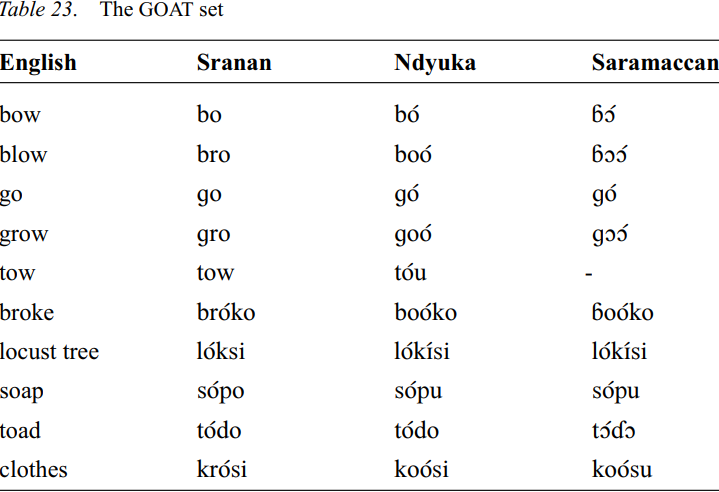
 

Occasionally a vowel /u/ appears in Saramaccan.
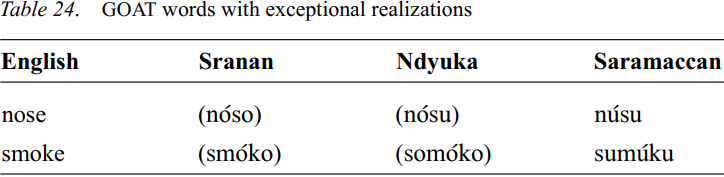
Dobson (1957: 674) does mention an occasional raising in ME of /ɔ:/ to /o:/ which would give /u:/ in EModE: “The raising is not characteristic of Standard English but seems to have been common in Northern and Eastern dialects; but it made its way early into London English, in which it was found chiefly in vulgar but occasionally in educated speech.”


Confusingly, in eighteenth century Saramaccan (Schumann 1778) we find smoko but nusso.

Unusually, for over we have a reflex of the stressed vowel in /a/.

 

This presumably goes back to the form /ɔr/ recorded by orthoepists (Dobson 1957: 482) in the sixteenth and seventeenth centuries. This would naturally give /a/.


The words old and cold display deviant reflexes in the Suriname creoles, even when compared with words like hold. The reflex is the same as in fowl.
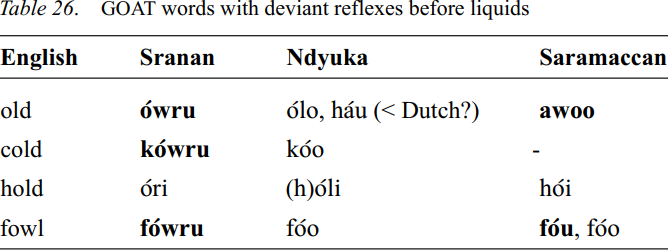
Older recordings such as Van Dyk (ca. 1765) reveal that words like old were originally trisyllabic – ouwere for [o’wuru]. Dobson (1957: 691) infers from the EModE evidence that /ɔ:/ sometimes became /u:/ before /l/, with a subsequent diphthongization to /Λu/ (> /au/), i.e. it joined the MOUTH set. Wells (1982: 312) sees rather an allophonic development before /l/ of London /Λu/ (=EModE /o:/, the GOAT set), to [ɒʊ ~ ɔʊ ~ aɤ] , etc. This has subsequently been involved in a phonemic split. We will not dwell further on this.


لا توجد تعليقات بعد

ما رأيك بالمقال : كن أول من يعلق على هذا المحتوى

اخر الاخبار

اشترك بقناتنا على التلجرام ليصلك كل ما هو جديد

