Zebra Graph
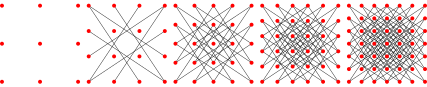
A zebra graph is a graph formed by all possible moves of a hypothetical chess piece called a "zebra" which moves analogously to a knight except that it is restricted to moves that change by two squares along one axis of the board and three squares along the other. To form the graph, each chessboard square is considered a vertex, and vertices connected by allowable zebra moves are considered edges. The graphs above gives the positions on a square chess boards that are reachable by zebra moves. It is therefore a  -leaper graph.
Zebra graphs are bicolorable, bipartite, class 1, perfect, triangle-free, and weakly perfect.
The square ( ) zebra graph is connected for
  and
and  .
.
It is traceable for  , 10, 14, 15, 16, 17, 18, 19, and 20, with the status of 13 open.
The smallest nontrivial square board where a tour exists (i.e., for which the underlying zebra graph is Hamiltonian) is the  board, first solved in 1886 by Frost (Jelliss). There are a total of
  Hamiltonian cycles on this board. For
  , the square board is Hamiltonian for exactly
  , 10, 14, 16, 18, and 20.
Precomputed properties of zebra graphs will be implemented in a future version of the Wolfram Language as GraphData[![<span style=]() {" src="https://mathworld.wolfram.com/images/equations/ZebraGraph/Inline10.svg" style="height:21px; width:6px" />"Zebra",
{" src="https://mathworld.wolfram.com/images/equations/ZebraGraph/Inline10.svg" style="height:21px; width:6px" />"Zebra", ![<span style=]() {" src="https://mathworld.wolfram.com/images/equations/ZebraGraph/Inline11.svg" style="height:21px; width:6px" />m, n
{" src="https://mathworld.wolfram.com/images/equations/ZebraGraph/Inline11.svg" style="height:21px; width:6px" />m, n![<span style=]() }" src="https://mathworld.wolfram.com/images/equations/ZebraGraph/Inline12.svg" style="height:21px; width:6px" />
}" src="https://mathworld.wolfram.com/images/equations/ZebraGraph/Inline12.svg" style="height:21px; width:6px" />![<span style=]() }" src="https://mathworld.wolfram.com/images/equations/ZebraGraph/Inline13.svg" style="height:21px; width:6px" />].
}" src="https://mathworld.wolfram.com/images/equations/ZebraGraph/Inline13.svg" style="height:21px; width:6px" />].
REFERENCES
Cross, H. H. Problem 4709 in Fairy Chess Review. Feb. 1941.
Frost, A. H. Plate VII in M. Frolow. Les Carrés Magiques. Paris, 1886.Jelliss, G. "The Big Beasts: Zebra ![<span style=]() {" src="https://mathworld.wolfram.com/images/equations/ZebraGraph/Inline14.svg" style="height:21px; width:6px" />2, 3
{" src="https://mathworld.wolfram.com/images/equations/ZebraGraph/Inline14.svg" style="height:21px; width:6px" />2, 3![<span style=]() }" src="https://mathworld.wolfram.com/images/equations/ZebraGraph/Inline15.svg" style="height:21px; width:6px" />." §10.31 in Knight's Tour Notes. 2019. http://www.mayhematics.com/p/KTN10_Leapers.pdf
}" src="https://mathworld.wolfram.com/images/equations/ZebraGraph/Inline15.svg" style="height:21px; width:6px" />." §10.31 in Knight's Tour Notes. 2019. http://www.mayhematics.com/p/KTN10_Leapers.pdf
Jelliss, G. Chessics.Jelliss, G. P. "Generalized Knights and Hamiltonian Tours." J. Recr. Math. 27, 191-200, 1995.
Jelliss, G. P. "Longer Leaper Tours with Quaternary Symmetry." The Games and Puzzles Journal 2, No. 2, p. 290, 1999.
Kraitchik, M. 'Mathematical Recreations. New York: W. W. Norton, pp. 70-73, 1942.Willcocks, T. H. Chessics. 1978.








