الوضع الليلي


 12:56:50
  2026-07-29
  26
26
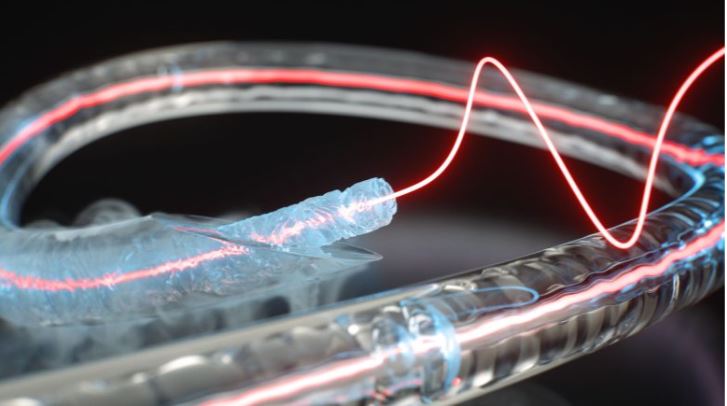
A frozen-core optical fiber has revealed a powerful new way to control interactions between light and sound.
Molten lava hardens into rock as it cools, much as the surface of a lake freezes during a cold winter. In both cases, a liquid becomes a solid, changing physical properties such as density and refractive index, which influence how sound and light travel through the material.
A related process is used to manufacture optical fiber by heating glass preforms until they soften enough to be drawn into thin strands. Light travels through the fiber core, carrying information rapidly across long distances and making these fibers essential to telecommunications.
Specialized designs have also been created for fiber lasers, endoscopes and sensors. Hollow core fibers, for example, can hold gases or liquids, measure temperature patterns or function as miniature chemistry laboratories.
Frozen liquid still guides light
Researchers from the Max Planck Institute of the Science of Light (MPL) in Erlangen, Leibniz University Hannover (LUH) and the Leibniz Institute for Photonic Technologies (IPHT) in Jena created a new kind of optical fiber by placing liquid core optical fibers (LiCOF) in nitrogen at -196 °C. The extreme cooling changed the core from a liquid into a solid.
“The key point is, that the frozen section of the LiCOF retains its ability to guide light. Not only that, but both the liquid and the frozen section of the fiber also guide hypersonic sound waves,” says Simon Seiderer, one of the three lead authors of the article and a researcher in the “Quantum Optoacoustics” research group of Prof. Dr. Birgit Stiller, who leads the project.
The new fiber produces an unusually strong interaction between light and sound through a process called Brillouin-Mandelstam scattering. Although this effect also occurs in conventional optical fibers, freezing the LiCOF creates a dense and highly confined environment that increases optoacoustic coupling by more than 1000 times compared with standard fibers.
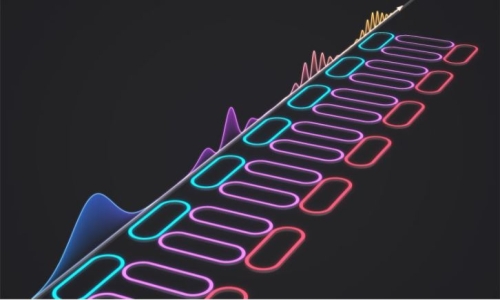
The researchers used this interaction to demonstrate optoacoustic memory, an important component for photonic neuromorphic computing in fibers. Because light travels much faster than sound, information can be transferred from a rapid light wave to a slower sound wave for temporary storage and then converted back into light.
The strong coupling inside the frozen LiCOF could sharply reduce the energy required by photonic computing systems.
One fiber opens several applications
The work built on an established collaboration with Prof. Markus Schmidt and Prof. Mario Chemnitz at IPHT Jena, who helped pioneer research involving liquid core optical fibers. Freezing the LiCOF core added another step that enabled stronger nonlinear effects.
“By freezing the liquid core, we have created an entirely new physical platform that provides extreme nonlinearities while being easy to handle,” says Stiller.
“While demonstrating a highly efficient optoacoustic memory is a fantastic first step, this level of light-sound coupling not only opens up exciting new possibilities for neuromorphic computing, but also for quantum information processing, microwave photonics and high-precision sensing.”
Reality Of Islam |
|
A frozen-co
New technol
The advance
Moving with
 9:3:43
2018-11-05
9:3:43
2018-11-05
10 benefits of Marriage in Islam
7:5:22
2019-04-08
benefits of reciting surat yunus, hud &
9:45:7
2018-12-24
advantages & disadvantages of divorce
11:35:12
2018-06-10
6:0:51
2018-10-16
12:10:56
2022-11-17
3:42:22
2021-12-24
8:4:21
2022-01-08
4:25:57
2023-02-11
1:34:8
2022-02-01
12:47:1
2022-12-20
2:2:13
2022-10-08
5:41:46
2023-03-18
| LATEST |
 HOME
HOME