We recall the definition of a convergent sequence x1,x2,...,xn,....A sequence converges to a limit L if for every ε> 0 there is a positive integer N such that
(1.8) |xn − L| <ε whenever n>N.
| − |
Suppose we are given a sequence and wish to examine the possibility of convergence. Usually the number L is not given, so that condition (1.8) above cannot be verified directly. For this reason it is important to have a technique for deciding convergence that doesn’t employ the limit L of the sequence. Such a criterion, presented below, was given first by Cauchy.
Definition
An infinite sequence {xn} is called a Cauchy sequence if and only if for each ε> 0, there is a positive integer N such that |xn − xm| <ε for all m>N and all n>N.
Theorem 1.1 (Cauchy criterion for convergence)
A necessary and sufficient condition for convergence of a sequence {xn} is that it be a Cauchy sequence.
Proof
We first show that if {xn} is convergent, then it is a Cauchy sequence. Suppose L is the limit of {xn}, and let ε> 0 be given. Then from the definition of convergence there is an N such that

Let xm be any element of {xn} with m>N. We have

Thus {xn} isa Cauchy sequence.
Now assume that {xn} is a Cauchy sequence; we wish to show that it Is convergent. We first prove that {xn} is a bounded sequence. From the definition of Cauchy sequence with ε = 1, there is an integer N0 such that
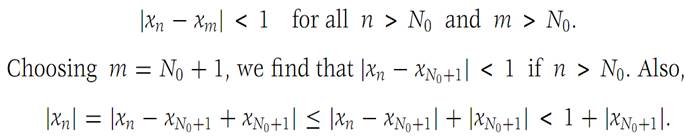
Keep N0 fixed and observe that all |xn| beyond xN0 are bounded by 1 + |xN0+1|, a fixed number. Now examine the finite sequence of numbers |x1|, |x2|,..., |xN0 |, |xN0+1|+ 1
and denote by M the largest of these. Therefore, |xn|≤ M for all positive integers n, and so {xn} is a bounded sequence. We now apply the Bolzano–Weierstrass theorem and conclude that there is a subsequence {xkn } of {xn} that converges to some limit L. We shall show that the sequence {xn} itself converges to L. Let ε> 0 be given. Since {xn} is a Cauchy sequence, there is an N1 such that

Also, since {xkn } converges to L, there is an N2 such that

Let N be the larger of N1 and N2, and consider any integer n larger than N.We recall from the definition of subsequence of a sequence that kn ≥ n for every n. Therefore,

Since this inequality holds for all n>N, the sequence {xn} converges to L.
As an example, we show that the sequence xn = (cos nπ)/n, n= 1, 2,..., is a Cauchy sequence. Let ε> 0 be given. Choose N to be any integer larger than 2/ε. Then we have

If m>n, we may write

However, because n>N, we have n> 2/ε, and so |xn − xm| <ε, and the sequence is a Cauchy sequence.
Basic Elements of Real Analysis, Murray H. Protter, Springer, 1998 .Page(61-63)








