In this section we establish additional basic properties of continuous functions from R1 to R1. The Boundedness and Extreme-value theorems proved below are essential in the proofs of the basic theorems in differential calculus. The Boundedness theorem shows that a function that is continuous on a closed interval must have a bounded range. The Extreme value theorem adds additional precise information about such functions. It states that the supremum and the infimum of the values in the range are also in the range.
Theorem 1.1(Boundedness Theorem)
Suppose that the domain of f is the closed interval I {x:a ≤ x ≤ b}, and f is continuous on I. Then the range of f is bounded.
Proof
We shall assume that the range is unbounded and reach a contradiction. Suppose that for each positive integer n, there isan xn ∈ I such that |f(xn)| >n. The sequence {xn} is bounded, and by the Bolzano–Weierstrass theorem, there is a convergent subsequence y1,y2,...,yn,..., where yn = xkn , that converges to an element x0 ∈ I. Since f is continuous on I, we have f(yn) → f(x0) as n →∞. Choosing ε =1, we know that there is an N1 such that for n>N1, we have
|f(yn) − f(x0)| < 1 whenever n>N1.
For these n it follows that
|f(yn)| < |f(x0)|+ 1 for all n>N1.
On the other hand,
|f(yn)|=|f(xkn ) >kn ≥ n for all n.
Combining these results, we obtain
n< |f(x0)|+ 1 for all n>N1.
Clearly, we may choose n larger than |f(x0)|+ 1, which is a contradiction.
In Theorem 1.2, it is essential that the domain of f is closed. The function f : x → 1/(1 − x) is continuous on the half-open interval I ={x :0 ≤ x< 1}, but isnot bounded there.
Theorem 1.3 (Extreme-value theorem)
Suppose that f has for its domain the closed interval I ={x:a ≤ x ≤ b}, and that f is continuous on I. Then there are numbers x0 and x1 on I such that f(x0) ≤ f(x) ≤ f(x1) for all x ∈ I. That is, f takes on its maximum and minimum values on I.
Proof
Theorem 1.1 states that the range of f is a bounded set. Define
M= sup f(x) for x ∈ I, m = inf f(x) for x ∈ I.
We shall show that there are numbers x0,x1 ∈ I such that f(x0) = m, f(x1) =M. We prove the existence of x1, the proof for x0 being similar. Suppose that M is not in the range of f ; we shall reach a contradiction .The function F with domain I defined by
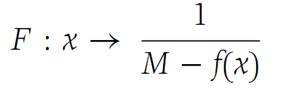
Is continuous on I and therefore (by Theorem 1.2) has a bounded range. Define Ḿsup F(x) for x ∈ I. Then Ḿ> 0 and

This last inequality contradicts the statement that M = sup f(x) for x ∈ I, and hence M must be in the range of f . There is an x1 ∈ I such that f(x1) =M.
The conclusion of Theorem 1.2 is false if the interval I is not closed. The function f : x → x2 is continuous on the half-open interval I ={x : 0 ≤ x< 1} but does not achieve a maximum value there. Note that f is also continuous on the closed interval I1 ={x :0 ≤ x ≤ 1}, and its maximum on this interval occurs at x = 1; Theorem 1.2. applies in this situation.
Basic Elements of Real Analysis, Murray H. Protter, Springer, 1998 .Page(56 -57)








