Difference spectrophotometry
Difference spectrophotometry is a method of compensating for the presence of extraneous materials in a sample that would otherwise inter fere with the spectrum of the drug being determined. It involves the measurement of the absorbance difference, at a defined wavelength, between two samples in one of which a physical or chemical property of the drug has been changed. It is assumed that the spectrum of the drug can be changed without affecting the spec trum of the interfering material. Alternatively, the absorbance difference may be measured between the sample and an equivalent solution without the drug. Difference spectrophotometry is sometimes described as ‘differential spectrophotometry’, but this term is not recommended because of its possible confusion with derivative spectrophotometry. Many suitable methods for physical and chemical modification of the drug absorbance have been reported. For example, the bathochromic effect (also discussed later) is used in the difference spectrophotometric assay of barbiturates. The absorbance of the sample at about pH 10 (A10), to which the mono-anionic species contributes (AB) , is used to compensate for the absorption of interfering endogenous materials (AM) that have been carried through the extraction procedure. The sample absorbance at pH 13 (A13) , to which the di-anionic species (AD) contributes, is measured at about 260 nm with reference to the sample absorbance at pH 10 (A10), so that:
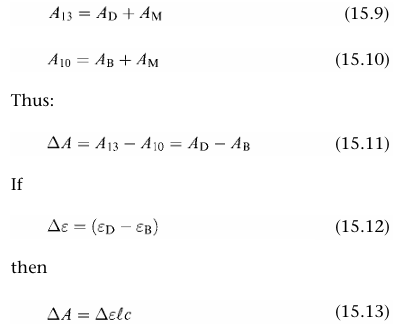
Thus, the difference absorbance can be related readily to concentration by prior calibration of the constant De, or the concentration may be found by simple proportion:

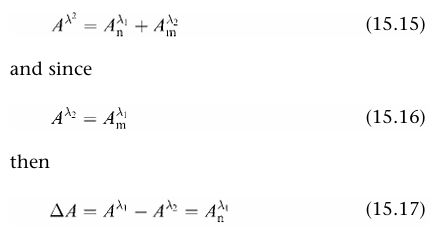
It should, however, be established that DA is a linear function of concentration (c) over the range required. It is convenient to select for the analytical wavelength a value that corresponds to a maximum in the difference spectrum, obtained by scanning the sample and reference solution over an appropriate wavelength range. Difference spectrophotometry can be used for quality control in cases where the interfering material is well defined, because an appropriate dilution of a suitable reference solution can be used in the reference cell. The difference absorbance is, however, susceptible to systematic error when there is uncertainty in the concentration of interfering materials in the samples to be assayed. This error increases in proportion to the ratio of the molar absorptivity of the interference to that of the drug. A further technique to correct for absorptive interferences by difference measurement is based on dual-wavelength spectrophotometry (not to be confused with dual-beam spectrophotometry). In dual-wavelength spectrophotometry, two monochromatic beams at different wavelengths are passed through the same sample. One wave length (λ1) is generally characteristic of the drug, while the other (λ2) is selected carefully so that the absorbance is equivalent to the level of absorptive interference (A λm) anticipated at the analytical wavelength (λ1). Thus, the second radiation beam is analogous to the reference cell employed in conventional difference spectrophotometry, and the difference in absorbance at the two wavelengths (∆A) represents the absorption of drug (A λm) corrected for interference:
A classic application of this method is the correction of Rayleigh scatter in samples of biological origin.








