Multicomponent systems
The absorption spectra of two or more drugs of interest often overlap. Hence if two or more components with overlapping absorption spectra are in the sample matrix, problems can arise. Subject to certain conditions, the Vierordt method of simultaneous equations can be employed to obtain the individual concentrations (Glenn 1960). If each of n drugs obeys the Beer–Lambert law over the concentration range of interest, and if the law of additivity of absorbances applies, then the total absorbance, AkλT, observed at any wavelength k is given by the sum:

where the subscript i denotes each component in the system. The term kλi represents the specific absorbance (A1%1cm) or the molar absorptivity e (L mol–1 cm–1), as determined by the units selected for concentration ci. For a two-component system, two wavelengths λ1 and λ2 are selected (as discussed below) and two corresponding simultaneous equations are set up:
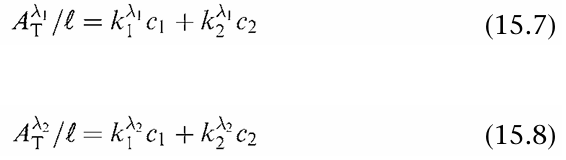
Equations (15.7) and (15.8) readily yield the concentration of each component, c1 and c2, by conventional algebra.
The selection of appropriate wavelengths and the use of accurate absorptivity values are clearly crucial. Generally, λ1 is the λmax for component 1, while λ2 is the λmax for component 2, provided that at these wavelengths the absorptivity of the overlapping component is small. If the spectra of both components are very similar, the errors of the method increase appreciably as the differ ence between the absorptivity ratios tends to zero.
Although this method should apply to the analysis of three or more components, in practice it is often difficult to select wavelengths that fulfil all the requisite conditions. The limit test for amphotericin A (a tetraene, λmax 300 nm) in the antifungal antibiotic am photericin (consisting primarily of amphotericin B, a heptaene, λmax 380 nm) is an example of such a two-component analysis.








