Exponence
Exponence, a term coined by Peter Matthews, refers to the realization of morphosyntactic features via inflection. In the word seas, the morpheme [z] is the exponent of the morphosyntactic feature plural, and in sailed, [d] is the exponent of past tense or past participle (Matthews 1991: 175). In both cases there is a one-to-one relationship between form and meaning, since one morpheme realizes one morphosyntactic feature, a situation that Matthews calls simple exponence.
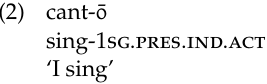
When we go beyond simple exponence, we get into data that have been central to modern theories of morphology. One type is what Matthews first called cumulative exponence. These are cases where more than one morphosyntactic feature maps onto a single form. We find this in Latin verbal inflections. In the Latin first person singular present indicative active form, five features (person, number, tense, mood, voice) are spelled out with a single morpheme, -ō:
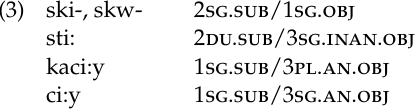
Another example of cumulative exponence is subject–object agreement in Cherokee, an Iroquoian language. Verbs in Cherokee bear prefixes that agree with their subject and object in person, number, and animacy. Some prefixes, including those listed in (3), indicate both subject and object simultaneously (Scancarelli 1987: 71):
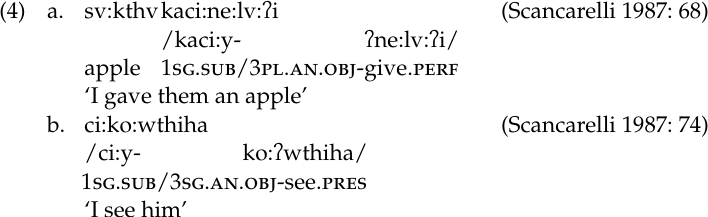
Examples of subject/object prefixes in context are given below (tones are not marked; /v/ is a nasalized central vowel). Following Scancarelli, verbs are given in both their surface and phonemic forms, with the phonemic forms aligned with the glosses:
Lastly, inflection for case, number, and gender in many Indo-European languages involves cumulative exponence. The -os ending of the Greek adjective kalós ‘good’ indicates that it is masculine, nominative, and singular. The -á of Russian stolá ‘table’ denotes both genitive and singular.
Related to cumulative exponence is the notion of a portmanteau, a term coined by Lewis Carroll for words of his own invention that were combinations of other words. For example, slithy is his combination of slimy and lithe.1 In a portmanteau word, two or more historically distinct words (they may still be distinct in some contexts) are fused together. The French definite determiner occurs in two forms, le (masculine) and la (feminine). The feminine form can be preceded by the prepositions à ‘in, to’ or de ‘of, from’, as shown below:

The masculine form, however, may not follow either of these prepositions. Instead, we get a portmanteau word:

The existence of cumulative exponence is very important to a proper characterization of the morphology–syntax interface. Fairly complex syntactic structures may get reduced morphologically.
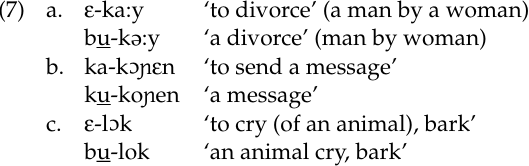
In extended exponence, the opposite of cumulative exponence, a single morphological feature is realized simultaneously on more than one form. One example presented by Matthews (1991) is the Ancient Greek perfective. The verb elelykete ‘you had unfastened’ (stem -ly-) is marked as perfective by reduplication (le-), -k- infixation, and the presence of a special stem (-ly- versus -ly:-). We cannot single out any one of them alone as marking the perfect. They do it together. Likewise, in Kujamaat Jóola, deverbal nouns can be formed from some infinitives by changing the noun class and tensing the vowels (7). One or the other isn’t sufficient. This is another example of extended exponence:
The most complicated cases are those where we get a combination of cumulative and extended exponence. In Latin, the notion perfect is realized by having a special verb stem in addition to a special set of suffixes that encode person, number, and mood (we might also want to list voice, although the perfect is realized periphrastically in the passive):
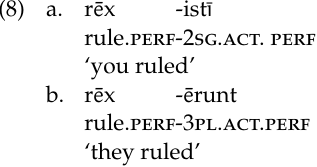
Here the mapping from the syntax to the phonology is both many to one and one to many. First, the stem rēx- is a perfective stem (compare the present stem reg-), and the ending is a perfective ending. This exemplifies extended exponence. Second, the endings -istı̄ and -ērunt simultaneously express second person singular, active voice, and perfective, and third person plural, active voice, and perfective, respectively. This is cumulative exponence.
We now turn to the distinction between context-free and context sensitive inflection. We refer to context-free inflection when there is a simple directional mapping between a morphosyntactic feature and a particular phonological string. Imagine that English has a feature [PRESENT PARTICIPLE] or [PROGRESSIVE]. Because this feature is always realized as /-iŋ/, we refer to context-free inflection: all present participles in English bear the same suffix.2 In context-sensitive inflection, the realization of a morphosyntactic feature varies. For example, the feature [PAST] in English corresponds to several possible phonological realizations, as seen in the following table.
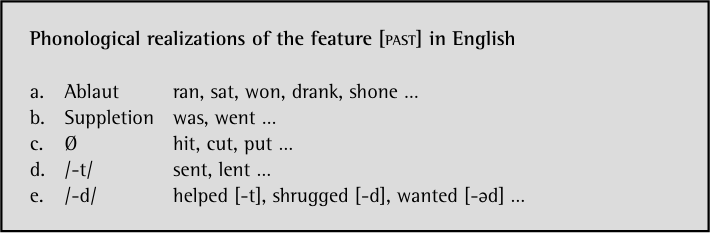
We also find partial suppletion, as with thought and brought, both of which also bear the /-t/ suffix seen in the box above. These exemplify extended exponence. Inflection for past tense in English is context- sensitive in the sense that the feature [PAST] is realized as many things depending on the lexeme it attaches to, with /-d/ suffixation being the default case.3 As you continue to look at morphological data from a variety of languages, you will discover that context-sensitive inflection is much more common than context-free inflection.
1 In Modern English, a portmanteau is a briefcase, borrowed from the French for a carrying case for clothing. Carroll thought of blends like his own slithy as being two meanings packed together into one word, or carrying case.
2 Note that the mapping is directional. We cannot work backwards and pair up every instance of -ing with the feature [PRESENT PARTICIPLE] or [PROGRESSIVE], because there is more than one type of -ing in English. For example, babysitting can be a present participle or a noun.
3 When speaking of default cases in morphology, it is often useful to invoke the Elsewhere Condition (Kiparsky 1982). We could have discussed the Elsewhere Condition here, but instead we have chosen to treat it in the context of blocking.








