0
EN
1
المرجع الالكتروني للمعلوماتية

Grammar

Tenses

Present

Present Simple

Present Continuous

Present Perfect

Present Perfect Continuous

Past

Past Simple

Past Continuous

Past Perfect

Past Perfect Continuous

Future

Future Simple

Future Continuous

Future Perfect

Future Perfect Continuous

Parts Of Speech

Nouns

Countable and uncountable nouns

Verbal nouns

Singular and Plural nouns

Proper nouns

Nouns gender

Nouns definition

Concrete nouns

Abstract nouns

Common nouns

Collective nouns

Definition Of Nouns

Animate and Inanimate nouns

Nouns

Verbs

Stative and dynamic verbs

Finite and nonfinite verbs

To be verbs

Transitive and intransitive verbs

Auxiliary verbs

Modal verbs

Regular and irregular verbs

Action verbs

Verbs

Adverbs

Relative adverbs

Interrogative adverbs

Adverbs of time

Adverbs of place

Adverbs of reason

Adverbs of quantity

Adverbs of manner

Adverbs of frequency

Adverbs of affirmation

Adverbs

Adjectives

Quantitative adjective

Proper adjective

Possessive adjective

Numeral adjective

Interrogative adjective

Distributive adjective

Descriptive adjective

Demonstrative adjective

Pronouns

Subject pronoun

Relative pronoun

Reflexive pronoun

Reciprocal pronoun

Possessive pronoun

Personal pronoun

Interrogative pronoun

Indefinite pronoun

Emphatic pronoun

Distributive pronoun

Demonstrative pronoun

Pronouns

Pre Position

Preposition by function

Time preposition

Reason preposition

Possession preposition

Place preposition

Phrases preposition

Origin preposition

Measure preposition

Direction preposition

Contrast preposition

Agent preposition

Preposition by construction

Simple preposition

Phrase preposition

Double preposition

Compound preposition

prepositions

Conjunctions

Subordinating conjunction

Correlative conjunction

Coordinating conjunction

Conjunctive adverbs

conjunctions

Interjections

Express calling interjection

Phrases

Sentences

Clauses

Part of Speech

Grammar Rules

Passive and Active

Preference

Requests and offers

wishes

Be used to

Some and any

Could have done

Describing people

Giving advices

Possession

Comparative and superlative

Giving Reason

Making Suggestions

Apologizing

Forming questions

Since and for

Directions

Obligation

Adverbials

invitation

Articles

Imaginary condition

Zero conditional

First conditional

Second conditional

Third conditional

Reported speech

Demonstratives

Determiners

Direct and Indirect speech

Linguistics

Phonetics

Phonology

Linguistics fields

Syntax

Morphology

Semantics

pragmatics

History

Writing

Grammar

Phonetics and Phonology

Semiotics

Reading Comprehension

Elementary

Intermediate

Advanced

Teaching Methods

Teaching Strategies

Assessment

قم بتسجيل الدخول اولاً لكي يتسنى لك الاعجاب والتعليق.

Classifier systems

المؤلف:  PAUL R. KROEGER

المصدر:  Analyzing Grammar An Introduction

الجزء والصفحة:  P131-C8

2025-12-30

408

+

-

20

Classifier systems

Classifiers are independent words, often nouns, which occupy a special position in the noun phrase, but do not seem to contribute to the meaning of the NP in any definite way. English has no true classifiers; the closest parallels are probably a few frozen expressions like those in(4a).


The function of a classifier is in some respects similar to that of MEASURE WORDS like those in (4b), which allow us to quantify (or count) mass nouns.


This pattern is quite productive in English, and indeed most languages. But notice that, in terms of grammatical structure, the measure word itself is the head of the NP that contains it. This is not the case with classifiers.

(4) a a pair of scissors

         five head of cattle

     b two pounds of salt

        three liters of juice

        five bushels of wheat

        10,000 barrels of oil


The Chinese noun phrases in (5) show some examples of true classifiers. Li and Thompson (1981) report that classifiers are obligatory when the noun is preceded by a numeral (5a,b), demonstrative (5c,d), or by certain quantifiers including ‘a few,’ ‘a certain,’ ‘every,’ etc. Notice that these classifiers, unlike measure words, are used primarily when the head of the NP is a count noun. Classifiers are not used in Chinese if the NP contains a measure word.
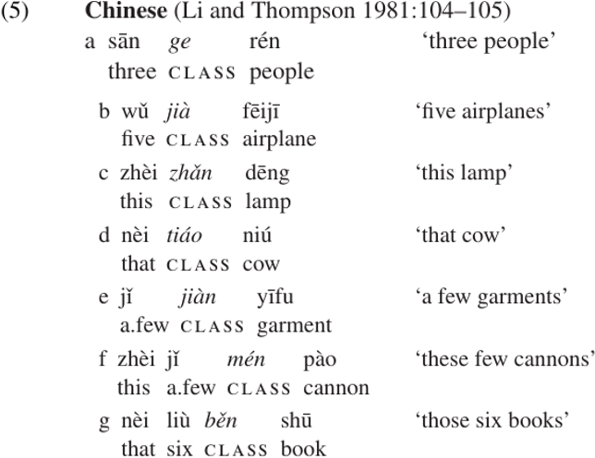
 

The choice of classifier depends on the specific noun that heads the NP. In many cases the nouns which take a particular classifier tend to have some semantic features in common, often relating to size and shape, but there are numerous exceptions. For example, the classifier tia̒o is used primarily for long, thin objects (e.g. ‘snake,’ ‘road,’ ‘river,’ ‘tail’) and four-legged mammals; but it is also used for various other nouns such as ‘news’ and ‘law.’ Moreover, some long thin objects (e.g. ‘brush-pen’ and ‘arrow’) take a different classifier. So, for most nouns, the choice of classifier cannot be predicted but must simply be memorized (and specified in the noun’s lexical entry).


The classifier system of Malay is somewhat similar to that of Chinese. Classifiers must be used with most countable nouns whenever a numeral is present, and also with certain definite quantifiers (e.g. ‘several’). The classifier word, italicized in the following examples, forms a constituent with the numeral or quantifier, and that constituent may occur either before or after the head noun:

(6) Malay (Asmah and Rama 1985)

      a [dua orang] budak                  ‘two children’

          two person child

     or: budak [dua orang]

           child two person

      b [tiga batang] rokok                 ‘three cigarettes’

          three stick    smoke

         or: rokok [tiga batang]

         smoke      three stick


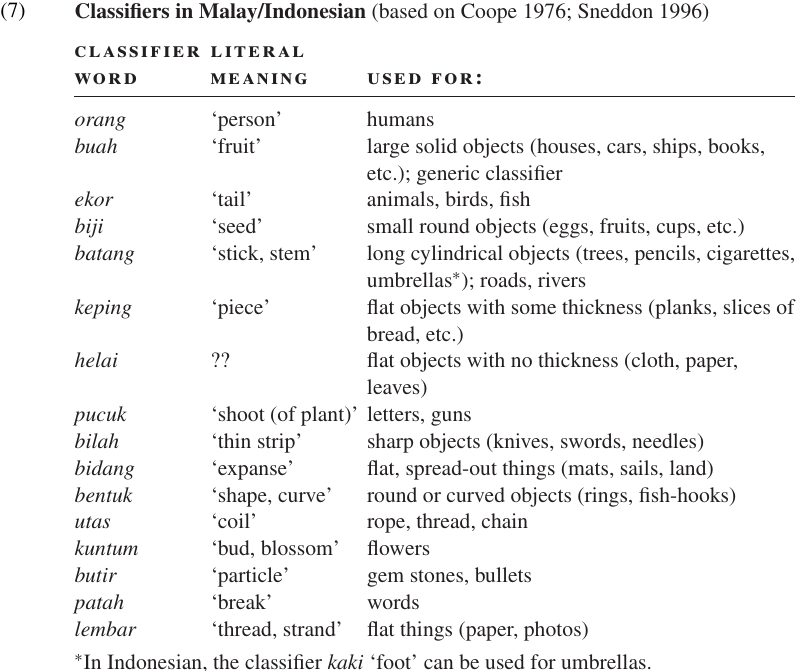
As in Chinese, the choice of classifier is partly determined on the basis of size and shape, but a number of other semantic features are involved as well. Many of the classifiers can also be used as independent nouns, though the meaning of these nouns is sometimes quite different from the semantic features associated with the classifier. The most commonly used classifier words are summarized in (7):
اخر الاخبار

اشترك بقناتنا على التلجرام ليصلك كل ما هو جديد


