PREPOSITIONAL PHRASES
The basic structure of prepositional phrases
What do you notice about the following sentences?
1. The toy is on the red table.
2. We live near him.
3. The cute guy walked Mary to the corner.
4. The Jones family traveled around Arizona.
Each of these sentences contains a preposition, which is underlined. Here again are the common prepositions:
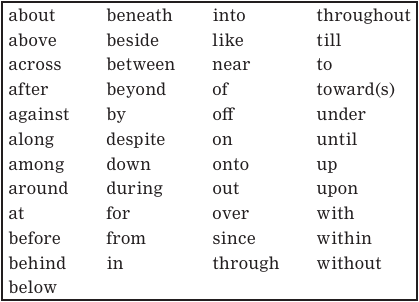
What follows a preposition? In sentences 1-4, the prepositions are followed by:
5. the red table (determiner + adjective + noun)
6. him (pronoun)
7. the corner (determiner + noun)
8. Arizona (proper noun)
As you may remember from The basic structure of noun phrases, each of these is a kind of noun phrase. In fact, a preposition is always followed by a noun phrase, called the object of the preposition, and the preposition and its noun phrase form a unit which is called a prepositional phrase.
Quick tip
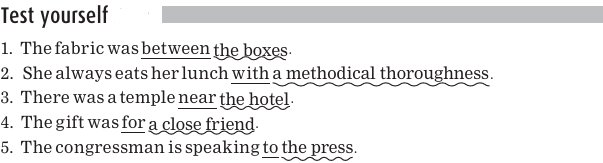
A prepositional phrase consists of a preposition plus a noun phrase, for example in the closet.
We don’t have to list the different kinds of noun phrases in the last Quick tip, because we’ve already identified them earlier; we can just refer to noun phrases in general. So, it’s really useful to have this concept of a noun phrase, and it’s a concept that you’ll see come up again later.
Here are some more examples of sentences with prepositional phrases (underlined):
9. Let’s carry the sofa into the house.
10. That makes sense to us.
11. There was a small lamp on her dresser.
12. Jeanie was living in New York.
13. The boss had no love for his employees.
You can see that each prepositional phrase consists of a preposition and a noun phrase.
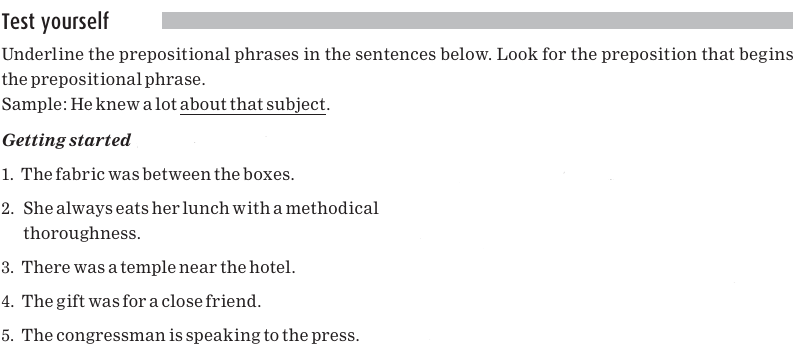
Answers

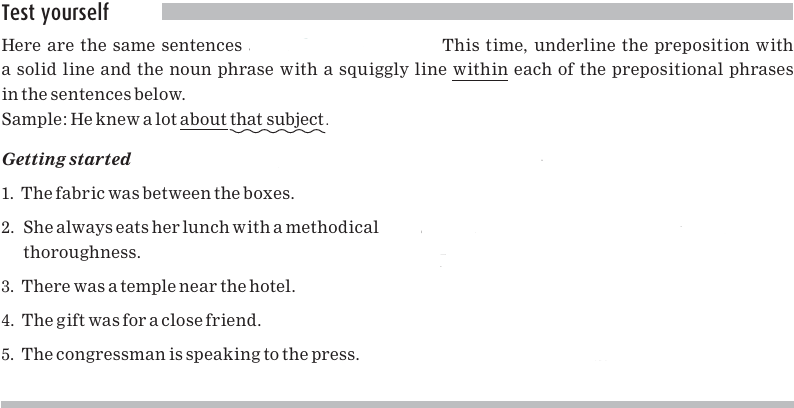
Answers
To enhance your understanding
Let’s compare two sentences with the word up:
14. I looked up your phone number.
15. I walked up the steep hill.
These sentences certainly look very similar. Each has the word up followed by a noun phrase. But in fact, the sentences are different. For one thing, in sentence 14, up can be moved to the other side of the noun phrase without changing its meaning:
16. I looked your phone number up.
In sentence 15, up cannot be moved:
17. *I walked the steep hill up.
Also, in sentence 14, look up is a unit; up feels closely connected to look. In fact, lookup can be replaced by a single verb and still have more or less the same meaning, for example, I researched your phone number. In sentence 14, up is part of the verb and is called a verb particle. You may recall that we talked about these verb plus particle combinations in Phrasal verbs, where we said they were called phrasal verbs. Insentence15, up is not connected to the verb, so it is not a particle; rather, it is a preposition.
Here are some more examples of sentences with verb particles. Notice that in each of these cases, the verb plus particle can be replaced by a single verb and the particle can be moved.
18a. Her husband carried out the garbage. (Her husband removed the garbage.)
18b. Her husband carried the garbage out.
19a. The criminal covered up the crime. (The criminal hid the crime.)
19b. The criminal covered the crime up.
20a. Don’t just brush off her objections. (Don’t just dismiss her objections.)
20b. Don’t just brush her objections off.
In contrast, here are some more examples of sentences with prepositions. Notice that in each case, the preposition cannot be moved to the other side of its noun phrase.
21a. He looked out the door.
21b. *He looked the door out.
22a. The hiker slowly walked up the hill.
22a. *The hiker slowly walked the hill up.
23a. Take the pot off the stove.
23b. *Take the pot the stove off.
As we discussed above, the preposition is tied to the noun phrase following it, forming a prepositional phrase.
Can a sentence contain more than one prepositional phrase? We started our discussion of prepositional phrases with the following sentences, each of which had only one prepositional phrase(underlined):
24.The toy is on the red table.
25.We live near him.
26.The cute guy walked Mary to the corner.
27.The Jones family traveled around Arizona.
We can expand these sentences, adding another propositional phrase(underlined) to each:
28. The toy is on the red table in the living room.
29. We live near him in Manhattan.
30. The cute guy from Argentina walked Mary to the corner.
31. The Jones family traveled around Arizona in a rented minivan.
In theory, there’s no limit to the number of prepositional phrases that a sentence can have. Take a look at one with quite a few prepositional phrases:
32. They landed the plane in a grassy field near the park by the river in San Francisco.
In reality, however, each sentence we say has a finite length – we have to stop talking at some point!

Answers