NOUN PHRASES
The basic structure of noun phrases
There are all kinds of noun phrases and we can discover them by seeing some of the things we can substitute for the noun phrase, the little boy. The underlined portions of the sentences below are all noun phrases and anyone of them can replace the little boy in the sentence The little boy laughed.
1. Audiences laughed.
2. Younger audiences laughed.
3. The girl laughed.
4. The little girl laughed.
5. The cute little girl laughed.
6. John laughed.
7. They laughed.
Of course, there are lots of things that cannot replace the little boy, for example:
8. *My very quickly laughed.
9. *Near his laughed.
10. *Went away laughed.
You’re probably not surprised to learn that My very quickly, Near his, and Went away are not noun phrases.
So, what can be a noun phrase?
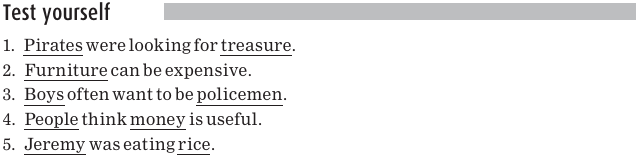
In sentences 1-6, the noun phrases all have something in common: each consists of at least a noun.
Here are the noun phrases again, with the nouns underlined:
audiences
younger audiences
the girl
the little girl
the cute little girl
John
In sentence1, Audiences laughed, and in sentence 6, John laughed, the noun phrase consists of just a noun: audiences in sentence1 and John in sentence 6.
Quick tip
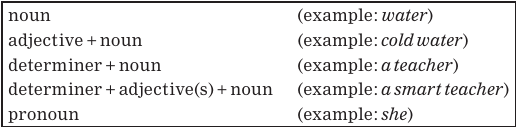
A noun phrase can consist of a noun alone, for example, audiences, John.

Answers
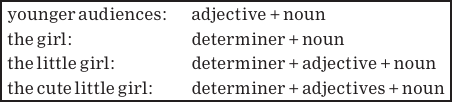
You can also see, in sentences 2-5, that a noun phrase can have other words in addition to just a noun. Let’s see what those other words can be:
Quick tip
A noun phrase can consist of a determiner, one or more adjectives, and a noun. The determiner and adjective(s) are optional.
Answers
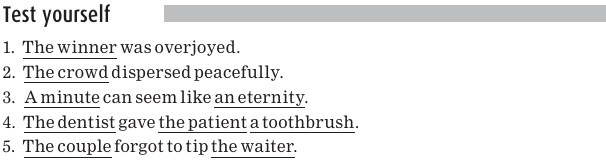
Here are some more examples with different determiners and nouns. (You may recall that the determiner always comes before the noun.) The whole noun phrase is underlined.
11. A man laughed.
12. Her friend laughed.
13. That lady laughed.
14. Many people laughed.
Notice that these noun phrases don’t have to appear only at the beginning of the sentence:
15. The criminal is a man.
16. I looked at her friend.
17. Do you know that lady?
18. The clown made many people laugh.
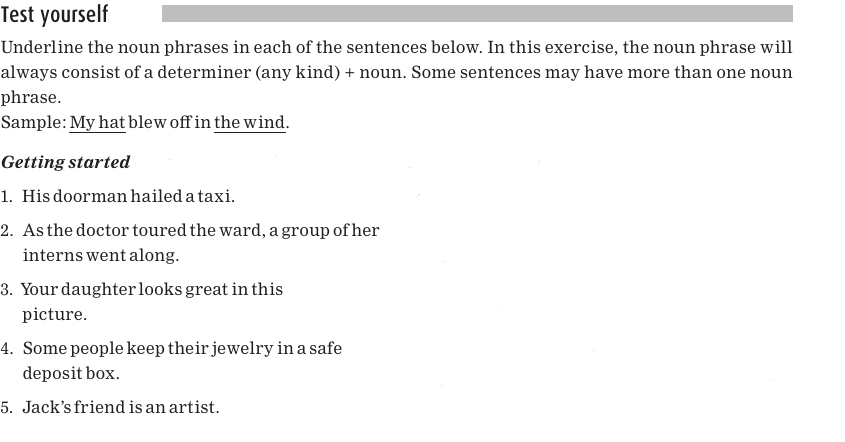
Answers
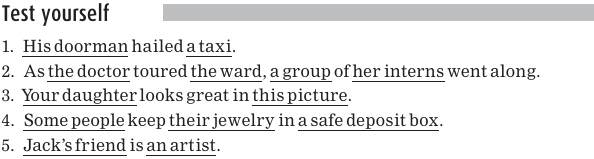
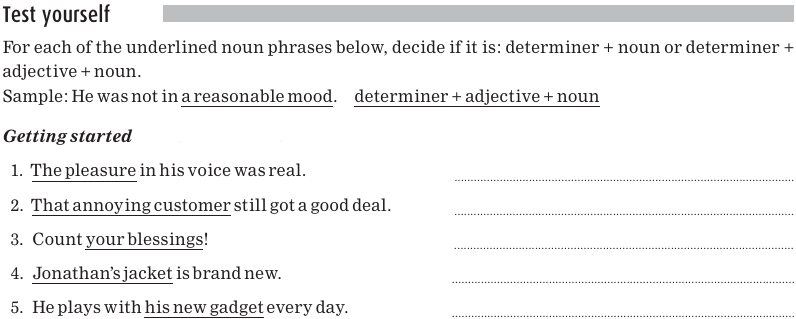
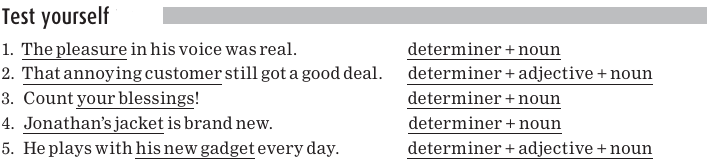
Here are examples of noun phrases consisting of a determiner plus an adjective plus a noun (the whole noun phrase is underlined):
19. The best fruit is grown on the west coast.
20. Our new shoes got completely soaked.
21. That old dog is my favorite one.
22. Every new task is challenging.
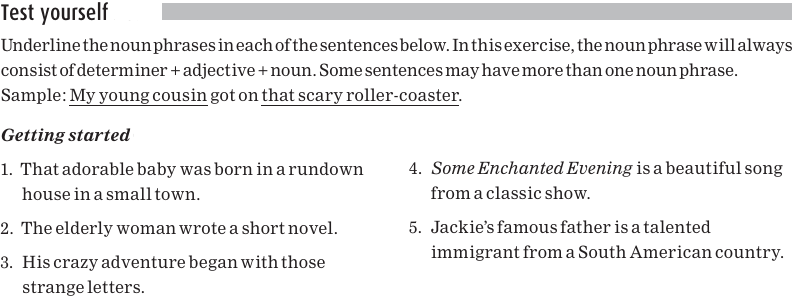
Answers
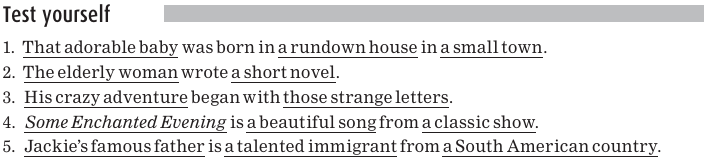
Answers
Here are some examples where the noun phrase consists of a determiner, more than one adjective, and a noun (the whole noun phrase is underlined):
23.The dull brown liquid spilled on to his priceless antique carpet.
24. Elderly, infirm individuals really need that important health benefit.
25.A worn checkered apron hung by the sagging, unpainted kitchen door.

Answers

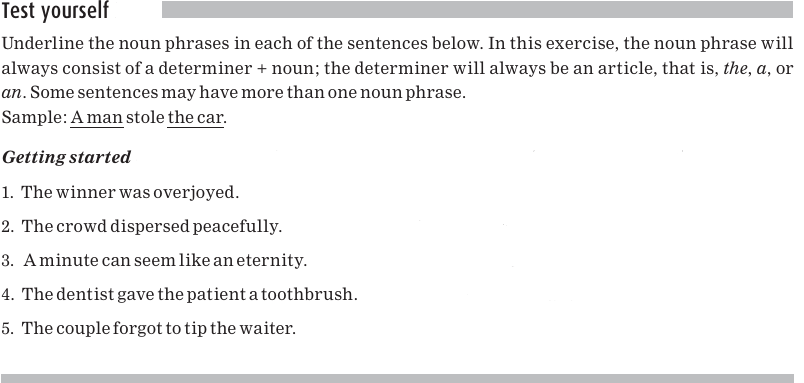
Don’t forget that a noun phrase doesn’t have to have a determiner. Here are some examples in which the noun phrases (underlined) consist only of adjective(s) and a noun:
26. Cold drinks are delicious.
27. Talented, creative actors don’t always become big stars.
28. Individual rights are important to preserve.
Proper nouns generally don’t have adjectives or determiners in front of them. *creative Nicole, for example, is ungrammatical.
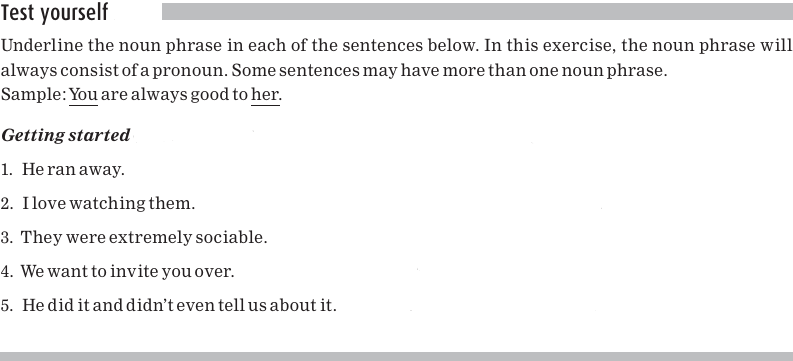
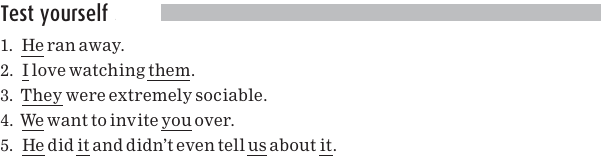
Sentence 7, They laughed, is yet another kind of noun phrase. In this case, the noun phrase consists of just a pronoun, they.
Quick tip
A noun phrase can consist of just a pronoun, for example he or them.
Notice that you can have a determiner before a noun, for example, the monkey, but you’d never put one before a pronoun: *the he, for example, is ungrammatical. We also do not usually put an adjective before a pronoun: *pretty she, for example, is ungrammatical.
Answers
To sum up, the kinds of noun phrases we’ve discussed are listed below. While there are more kinds of noun phrases, what we’ve done here is to show you some basic ones.

Answers

Answers









