Discussion
Review process
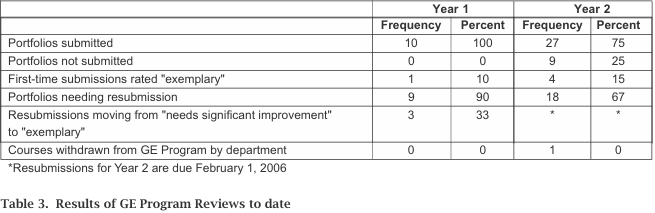
In Year 1 (2003-2004), 100% of the course materials were submitted in a portfolio format as requested (10/10 for Area A). (See Table 3) One of these 10 portfolios was judged to be exemplary and faculty from the other nine courses were asked to resubmit their portfolios one year later with revisions. Of these nine, three moved from "needs significant improvement" to "exemplary" at the resubmission. The remaining six were expected to be submitted in February, 2005. Improvement was generally related to the inclusion of a broader sample of materials, deeper analysis of issues by Area A faculty, and initiation of procedures that produced the intended results in a reasonably short amount of time, e.g. meeting with all course faculty, including part-time instructors, regarding the importance of the student-centred, measurable and/or observable objectives / outcomes. One course, however, was completely redesigned by faculty to align with the stated University GE Area A objectives.
In Year 2 (2004-2005), 75% of the course portfolios from Areas B and C were submitted as requested (27/36). (See Table 3.) Fifteen percent of the first-time submissions were exemplary (4/27). Of the 27 portfolios that were submitted, 18 of them were returned for revision and resubmission, due in February of 2006; one course was voluntarily withdrawn from the GE Program because course faculty decided that it was not a good fit with the University GE Areas B and C objectives. Portfolios for nine courses were not submitted; faculty for these courses were strongly encouraged to submit their portfolios in February 2006; in so doing, they will remain in their original cycle and be reviewed in another four years. If faculty choose not to submit course portfolios by February 2006, the respective courses will be withdrawn from the GE program.
Overall, resubmissions were requested for two main reasons: (1) faculty failed to state and/or align course objectives/outcomes with the University GE objectives as stated on the standard syllabus, and (2) analysis by course faculty lacked sufficient depth and reflection concerning necessary improvement. Additionally, final grades, disaggregated by section for each course, were added to the course portfolio to provide more information for the analysis of commensurability across sections.
Examination of these grades by section was informative and, in some cases, revealed extreme disparity in grading practices among faculty teaching sections of the same course. For courses in which resubmissions improved to "exemplary" status, Course Coordinators took steps to gather faculty for discussion and followed through with systematic efforts to ascertain that all faculty teaching the course understood the GE Program requirements and provided instruction that focused on student learning, via student-centred, measurable and/or observable objectives/outcomes.
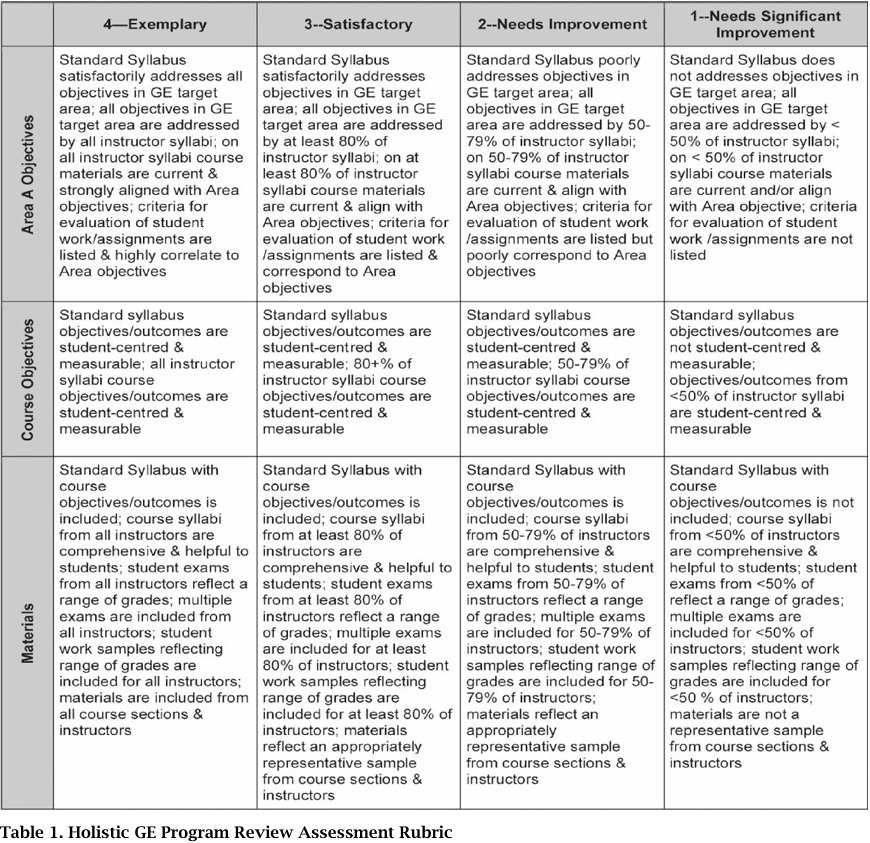
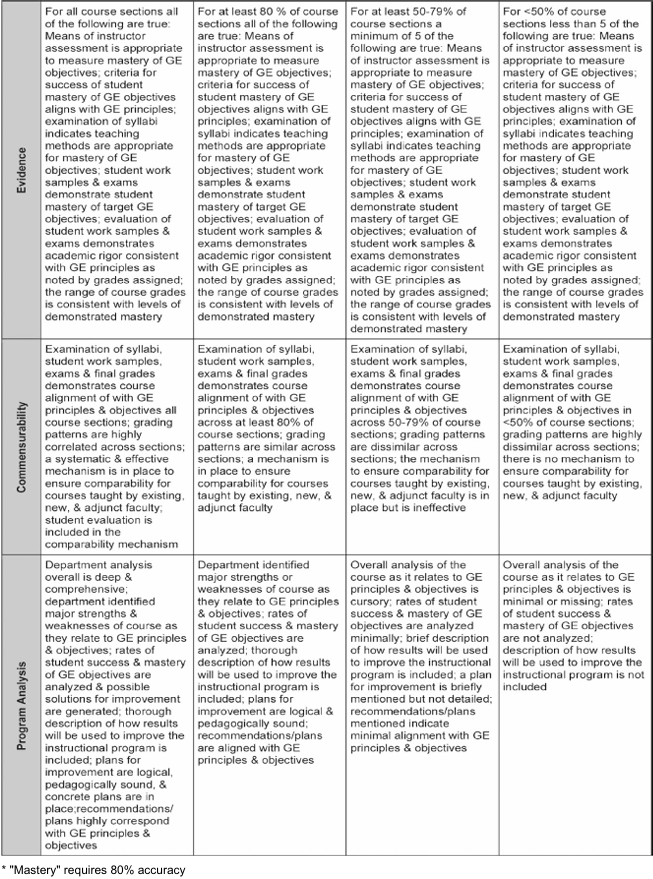
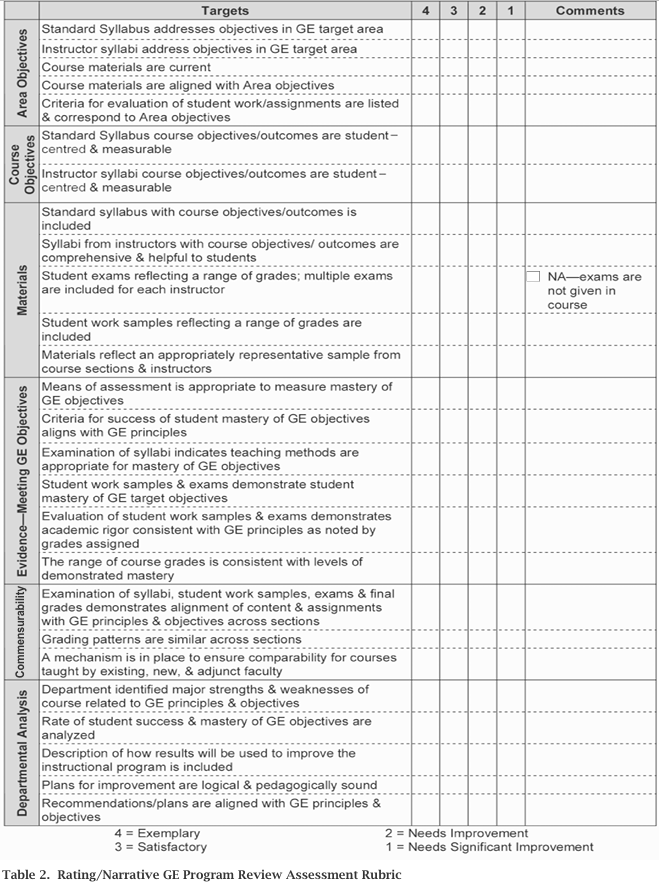
Based on faculty discussion, it was decided by the Review Team that student learning was the most critical factor in the review. In implementing this decision, the Review Team members tried to put themselves into the place of faculty receiving the review results with each type of rubric format: holistic scores, individual scores for each component, or narrative reports. There was concern about how faculty would perceive numerical ratings on reports generated by their colleagues and how their perceptions would affect their response to improve the process which was aimed at student learning. Therefore, a decision was made to omit reporting the rubric scores altogether and focus on a narrative report to the course faculty. The team wanted the reports to be supportive, but firm, about their concerns and decided that a narrative report would be the better way to accomplish this.
Reviewers submitted their analyses to one member of the team for synthesis in written narrative reports, paying special attention to areas of concern. The narrative reports were reviewed by Review Team members prior to submission to the GE Committee. Use of the rubric has provided the common ground by which the Review Team could make recommendations to the GE Committee and guide the discussion of recommendations by the GE Committee to course faculty. The assessment rubric is now included in the packet of materials that is distributed to each faculty member whose course is under review. GE Program faculty, the Area Review Teams, and the GE Committee all find the assessment rubric to be a useful goal-directing document and an important guide for rich discussion, analysis, and decision-making.
A feedback loop is embedded in the Review process: the Review Team makes recommendations to the GE Committee, the Committee discusses recommendations and decides upon action, letters are sent to the Course Coordinator and appropriate faculty, and faculty make recommendations to the GE Committee regarding proposed changes in the University GE objectives. In both years of the review, there was consensus that five years is too long to wait for revisions of some courses in which there was limited evidence of a match between University GE objectives and student achievement. In such cases, resubmissions were requested for one year after the original submission. This allows course faculty time to review the recommendations, make changes to support mastery of the University GE objectives, and collect additional student materials that demonstrate achievement of student-centred, measurable objectives/ outcomes. In cases of resubmission, the course stays in the original cycle and is reviewed again five years from its original submission of materials.
A number of insights gleaned from this undertaking provided direction for improvement and institutionalization of the GE Review Process: (1) Rubrics are important both as an evaluation guide and as a standard by which course faculty can set their goals; providing the rubric to faculty before the process begins is important. (2) Considering the "match" between the type of rubric and the possible perception of faculty about the review process aided in acceptance of the review by course faculty. It was helpful to consider in advance what course faculty would better receive from their colleagues - a holistic score, a rating on various components, or a narrative describing what is working well and what needs to be improved. (3) Verifying agreement among the Re view Team members early in the review process is essential. (4) A five-year cycle is too long to wait for recommended changes; a flexible alternative such as the possibility for course revision and portfolio resubmission in one year facilitates change in a timely manner for the benefit of students. (5) Course Coordinators who were not department chairs generally sub mitted stronger portfolios. (6) Faculty review and analysis prior to portfolio submission is a critical part of the process and needs more emphasis. (7) Inclusion of direct contact with students or information from them should be considered in future reviews. (8) An examination of grades assigned in all sections of courses under review is informative, particularly as it pertains to section commensurability. (9) With some modification, the model for the rubric can be used to review courses applying for approval as a course in the GE Program.








