State verbs
We are concerned with a contrast between the class of event verbs and the class of state verbs, so let us be clear about which verbs we are calling state verbs. Besides the grammatically special have and be, we can list: appear, appreciate, believe, belong, concern, consist, contain, depend, desire, equal, hate, hear, imagine, involve, know, like, love, matter, mean, need, own, owe, perceive, possess, prefer, realize, recognize, remember, resemble, see, seem, smell, taste, tend, think, understand, want, and wish.1 These verbs share a number of syntactic and semantic properties (see Sag 1973, Dowty 1979, and especially Hinrichs 1985 for extensive discussion). To illustrate, we see in (1) that, without additional context, the state verb appreciate is acceptable in simple present tense (1a), but not in the progressive (1b) or the wh-cleft construction (1c).
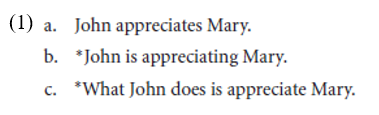
Verbs that behave like appreciate in the above environments will be taken to be state verbs and those that behave like kiss will be taken to be event verbs. If the claim we made in the introduction about the state verb/event verb contrast is correct, then we expect manner adverbs to appear only with kiss-like verbs and not with appreciate-like verbs.
It should be pointed out that a number of the verbs listed above have eventive uses as well as stative uses. This can be illustrated with the verb think: when used in the progressive (as in 2b) or as part of a wh-cleft (as in 2c) it has an eventive reading, while when used in the simple present tense (as in 2a) it has a stative reading.

As expected, on the eventive readings think is compatible with manner adverbial modification while on the stative readings it is not:

We are also uninterested in the frequently miscategorized verbs sleep, hold, and wait (whichMaienborn 2005 has confusingly termed “state” verbs).While these may seem to share many semantic features with statives, they do not behave grammatically as such, as indicated in (4):

These verbs appear naturally with manner adverbs, but this is not of interest to us here, as we fully accept that these verbs have a Davidsonian argument. More problematic, and less readily dismissed, is the sit-stand-lie class, which Dowty (1979) calls “interval statives.” These clearly have both stative and eventive readings (depending, apparently, on the agentivity of the subject):
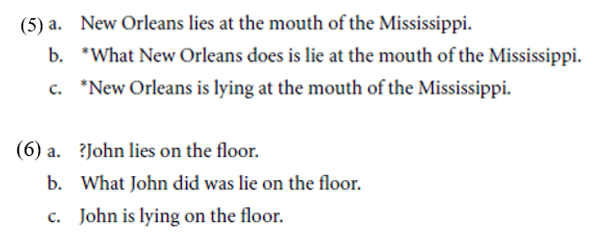
In contrast to the eventive/stative contrast of think-type verbs, these verbs can be modified by manner adverbials on both the stative and on the eventive readings:
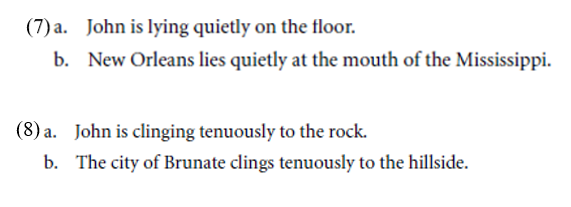
It is not clear whether this indicates ambiguity, or whether the stative interpretations in (7b) and (8b) are some sort of metaphorical extension of the event usage with concomitant metaphorical shift of the adverb meaning (Schafer 2002).
Leaving aside modifiers of non-core state verbs and focusing on the class of core state verbs such as love, know, own, and consist of, which express psychological, legal, or physical states, we are left with the following cases of manner-modified stative verbs:

Our central question, then, is whether the cooccurrence of such core state verbs with manner adverbs indicates that these state verbs have a “Davidsonian” argument. To address this, we turn to a brief discussion of manner adverbials and review why a Davidsonian analysis of event verb manner modification is an appealing one.
1 This list adapted from an online learner grammar of English (www.myenglishteacher.net).








