0
EN
1
المرجع الالكتروني للمعلوماتية

Grammar

Tenses

Present

Present Simple

Present Continuous

Present Perfect

Present Perfect Continuous

Past

Past Simple

Past Continuous

Past Perfect

Past Perfect Continuous

Future

Future Simple

Future Continuous

Future Perfect

Future Perfect Continuous

Parts Of Speech

Nouns

Countable and uncountable nouns

Verbal nouns

Singular and Plural nouns

Proper nouns

Nouns gender

Nouns definition

Concrete nouns

Abstract nouns

Common nouns

Collective nouns

Definition Of Nouns

Animate and Inanimate nouns

Nouns

Verbs

Stative and dynamic verbs

Finite and nonfinite verbs

To be verbs

Transitive and intransitive verbs

Auxiliary verbs

Modal verbs

Regular and irregular verbs

Action verbs

Verbs

Adverbs

Relative adverbs

Interrogative adverbs

Adverbs of time

Adverbs of place

Adverbs of reason

Adverbs of quantity

Adverbs of manner

Adverbs of frequency

Adverbs of affirmation

Adverbs

Adjectives

Quantitative adjective

Proper adjective

Possessive adjective

Numeral adjective

Interrogative adjective

Distributive adjective

Descriptive adjective

Demonstrative adjective

Pronouns

Subject pronoun

Relative pronoun

Reflexive pronoun

Reciprocal pronoun

Possessive pronoun

Personal pronoun

Interrogative pronoun

Indefinite pronoun

Emphatic pronoun

Distributive pronoun

Demonstrative pronoun

Pronouns

Pre Position

Preposition by function

Time preposition

Reason preposition

Possession preposition

Place preposition

Phrases preposition

Origin preposition

Measure preposition

Direction preposition

Contrast preposition

Agent preposition

Preposition by construction

Simple preposition

Phrase preposition

Double preposition

Compound preposition

prepositions

Conjunctions

Subordinating conjunction

Correlative conjunction

Coordinating conjunction

Conjunctive adverbs

conjunctions

Interjections

Express calling interjection

Phrases

Sentences

Clauses

Part of Speech

Grammar Rules

Passive and Active

Preference

Requests and offers

wishes

Be used to

Some and any

Could have done

Describing people

Giving advices

Possession

Comparative and superlative

Giving Reason

Making Suggestions

Apologizing

Forming questions

Since and for

Directions

Obligation

Adverbials

invitation

Articles

Imaginary condition

Zero conditional

First conditional

Second conditional

Third conditional

Reported speech

Demonstratives

Determiners

Direct and Indirect speech

Linguistics

Phonetics

Phonology

Linguistics fields

Syntax

Morphology

Semantics

pragmatics

History

Writing

Grammar

Phonetics and Phonology

Semiotics

Reading Comprehension

Elementary

Intermediate

Advanced

Teaching Methods

Teaching Strategies

Assessment

قم بتسجيل الدخول اولاً لكي يتسنى لك الاعجاب والتعليق.

Stress

المؤلف:  Geoff P. Smith

المصدر:  A Handbook Of Varieties Of English Phonology

الجزء والصفحة:  722-40

2024-04-29

1656

+

-

20

Stress

Wurm (1985) gives an account of stress patterns based on his experience of the rural pidgin spoken in the Eastern Highlands in the late 1950s and 1960s. He notes that there is considerable variability, with stress patterns more closely resembling those of English among speakers more familiar with English. In general, he notes that stress is normally on the first syllable. In some cases, there may be a non-stressed epenthetic vowel, and occasionally this may be re-interpreted by some speakers as a phonemic vowel and given stress. Some words do have stress on other than initial syllables, for example, the following stressed on the second syllable: orait ‘all right, then’, singaut ‘shout, call out’, sekan ‘shake hands’, sanap ‘stand up’ etc. Wurm notes that stress patterns are the basis for the patterns of intonation.


There is the possibility that different stress may disambiguate certain word pairs, although little work seems to have been done on this. Possible candidates would be the pairs 'nating ‘nothing’ and na'ting ‘I think, probably’, and 'palai ‘lizard’ and pa'lai ‘fly’, although I do not have definite evidence to show that this distinction is consistently made.


In the Tok Pisin of first language speakers and fluent second language speakers who use the language as a primary vehicle of communication, considerable reduction of stressed syllables can be observed (Smith 2002). Extreme samples of speech such as the following were encountered among young people:

One effect is the cliticisation of certain words such as long ‘in; on; at’ and bilong (possessive), especially when preceding vowels:
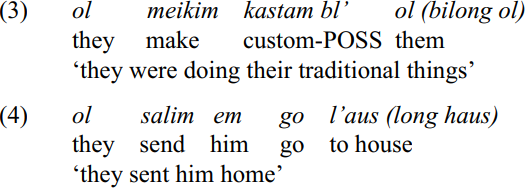
Cliticisation of aspect particles save (sa) ‘habitual’ and laik (la) ‘about to’ also appears to be in progress. Reduction can often be quite drastic, for example, the three-syllable utterance tso l’ sla taim recorded in the Highlands represents tasol long dispela taim ‘but at this time’ (maximally of seven syllables).


لا توجد تعليقات بعد

ما رأيك بالمقال : كن أول من يعلق على هذا المحتوى

اخر الاخبار

اشترك بقناتنا على التلجرام ليصلك كل ما هو جديد

