Vowel changes
The most obvious vowel change taking place in NZE is the merger between the vowels of NEAR and SQUARE, so that ear and air or cheer and chair can no longer be distinguished. Because these two vowels are relatively rare, it is usually only the word pair really and rarely that causes comprehension problems − did they really do something, or was it only rarely? Gordon and Maclagan have followed the progress of this merger for twenty years, and it has now worked its way through most of the social and age groups studied. Most New Zealand speakers pronounce all NEAR and SQUARE words with a close onset  , but some older women of the higher social classes use a more open onset for some NEAR words, as Wendy did for really on the audio clip.
Over the twentieth century the front vowels DRESS and TRAP raised (to  and
and  for the most advanced speakers), and KIT centralized and lowered so that the most advanced NZE speakers now use a vowel more open than schwa [з] . Australian English KIT raised over the same period so that the pronunciation of KIT is one of the most striking differences between the two varieties of English, and one that is commented on by speakers in both countries. New Zealanders accuse Australians of saying feesh and cheeps and Australians accuse New Zealanders of saying fush and chups. Very few New Zealand speakers now use a vowel that is as front as [ɪ] for KIT, though some older Maori or higher social class Pakeha women, i.e. women of European descent, still may. Within New Zealand the changes to the front vowels are not stigmatized, and young women who would not dream of using Broad NZE variants of the closing diphthongs use the most advanced variants of KIT, DRESS and TRAP, leading to what we have called “the white rabbit
 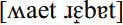 phenomenon”, where the stigmatized PRICE diphthong in white receives a conservative pronunciation but the non-stigmatized TRAP vowel in rabbit receives an advanced pronunciation.
A different sort of change that is increasingly common in NZE is the pronunciation of -own past participles like grown, known and thrown as disyllables /groʊən/ , /noʊən/ and /θroʊən/ , presumably on the model of words like take, taken. There are very few such participles, but the disyllabic pronunciation produces the new minimal pairs of grown, groan, mown, moan and thrown, throne. The disyllabic pronunciation is now used by approximately 50% of all speakers middle-aged and younger, regardless of social class, so that it seems that both the monosyllable grown pronunciations and the disyllable growen pronunciations are now regarded as equally correct within New Zealand.








