The consonant system
Jamaican Creole
The consonants
There are 21 phonemic consonants in JamC. These include the semi-vowels, /w/ [w] and /j/ [j], which are the phonetic vowels [i] and [u] functioning as consonants due to distributional constraints.
The palatal stops /kj/ [c], /gj/ [Ɉ] and /ny/ [ɲ] proposed by Cassidy and Le Page (1980) are not included in our inventory because we consider these phonetic palatals to be sequences of stops and the semi-vowels (cf. Devonish and Seiler 1991).
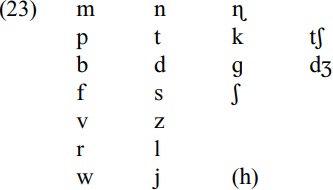
One feature little remarked on in the discussion of JamC consonant phonology over the years is the phonetics of the stop phonemes, /b/, /d/ and /g/. When these occur in the onset of a prominent syllable, they are phonetically realized as ingressive stops,  and [µ]. In other environments, notably in the coda or in the onset of a non-prominent syllable, the egressive [b], [d] and [g] allophones are employed. The distribution of these stops parallels that of the aspirated and unaspirated allophones of the voiceless stops, /p/, /t/ and /k/, with the aspirated allophones, [ph], [th] and [kh] occurring in the onset of prominent syllables, and the unaspirated ones, [p], [t] and [k], elsewhere.
Wells (1973: 12) suggests that /h/ occurs contrastively in the Western varieties of JamC, notably those of Manchester, St. Elizabeth and Westmoreland. This is supported by the intuitions of JamC speakers from the entire range of western parishes. For such speakers, /h/ would serve to distinguish between the following pairs.
(24) a. /an/ ‘and’ /han/ ‘hand’
b. /iar/ ‘air’ /hiar/ ‘hair’
Such contrasts do not exist in the Eastern varieties of JamC, inclusive of that of Kingston. It is not, however, that the phone [h] does not exist in these varieties. Rather, it is employed for a different phonological function. Thus, the items above would, in the eastern varieties, be realized variably as [an] ~ [han] ‘and, hand’ and [iεɹ] ~ [hiεɹ] ‘air, hair’. In items without a lexically specified onset consonant, [h] may variably appear as a marker of emphasis, as an ‘[h]emphatic’ /h/. The phone [h], in the eastern varieties is simply marks off emphatic onsetless word initial syllables from their non-emphatic counterparts.
The consonant phoneme /ŋ/ has an unusual distribution in being the only one which is restricted to occurring in the coda.








