0
EN
1
المرجع الالكتروني للمعلوماتية

Grammar

Tenses

Present

Present Simple

Present Continuous

Present Perfect

Present Perfect Continuous

Past

Past Simple

Past Continuous

Past Perfect

Past Perfect Continuous

Future

Future Simple

Future Continuous

Future Perfect

Future Perfect Continuous

Parts Of Speech

Nouns

Countable and uncountable nouns

Verbal nouns

Singular and Plural nouns

Proper nouns

Nouns gender

Nouns definition

Concrete nouns

Abstract nouns

Common nouns

Collective nouns

Definition Of Nouns

Animate and Inanimate nouns

Nouns

Verbs

Stative and dynamic verbs

Finite and nonfinite verbs

To be verbs

Transitive and intransitive verbs

Auxiliary verbs

Modal verbs

Regular and irregular verbs

Action verbs

Verbs

Adverbs

Relative adverbs

Interrogative adverbs

Adverbs of time

Adverbs of place

Adverbs of reason

Adverbs of quantity

Adverbs of manner

Adverbs of frequency

Adverbs of affirmation

Adverbs

Adjectives

Quantitative adjective

Proper adjective

Possessive adjective

Numeral adjective

Interrogative adjective

Distributive adjective

Descriptive adjective

Demonstrative adjective

Pronouns

Subject pronoun

Relative pronoun

Reflexive pronoun

Reciprocal pronoun

Possessive pronoun

Personal pronoun

Interrogative pronoun

Indefinite pronoun

Emphatic pronoun

Distributive pronoun

Demonstrative pronoun

Pronouns

Pre Position

Preposition by function

Time preposition

Reason preposition

Possession preposition

Place preposition

Phrases preposition

Origin preposition

Measure preposition

Direction preposition

Contrast preposition

Agent preposition

Preposition by construction

Simple preposition

Phrase preposition

Double preposition

Compound preposition

prepositions

Conjunctions

Subordinating conjunction

Correlative conjunction

Coordinating conjunction

Conjunctive adverbs

conjunctions

Interjections

Express calling interjection

Phrases

Sentences

Clauses

Part of Speech

Grammar Rules

Passive and Active

Preference

Requests and offers

wishes

Be used to

Some and any

Could have done

Describing people

Giving advices

Possession

Comparative and superlative

Giving Reason

Making Suggestions

Apologizing

Forming questions

Since and for

Directions

Obligation

Adverbials

invitation

Articles

Imaginary condition

Zero conditional

First conditional

Second conditional

Third conditional

Reported speech

Demonstratives

Determiners

Direct and Indirect speech

Linguistics

Phonetics

Phonology

Linguistics fields

Syntax

Morphology

Semantics

pragmatics

History

Writing

Grammar

Phonetics and Phonology

Semiotics

Reading Comprehension

Elementary

Intermediate

Advanced

Teaching Methods

Teaching Strategies

Assessment

قم بتسجيل الدخول اولاً لكي يتسنى لك الاعجاب والتعليق.

The vowel system Jamaican Creole The main vowels

المؤلف:  Hubert Devonish and Otelemate G. Harry

المصدر:  A Handbook Of Varieties Of English Phonology

الجزء والصفحة:  452-27

2024-04-04

1774

+

-

20

The vowel system

Jamaican Creole

The main vowels

JamC has twelve phonemic oral vowels. These are divided into five simple and seven complex vowels, as in (2) below:
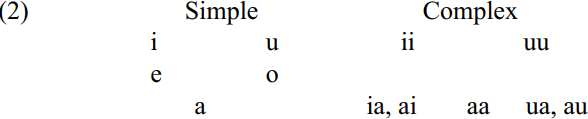
The relationship between the simple vowels and their longer equivalents is primarily one of length rather than that of height or tenseness (Cassidy and Le Page 1980: xlv). Following Cassidy and Le Page, we represent phonetically long vowels by a double vowel, e.g. /ii/, /aa/ and /uu/ rather than the /:/ symbol. The aim here is to avoid obscuring the connection between these double-vowel nuclei and the other complex syllabic nuclei consisting of sequences of non-identical vowels.


Only two features, [back] and [high], are necessary to describe the vowel set. An analysis of the complex vowel set presented above shows that only the extreme vowels in the simple set, the high and the low, i.e. /i/, /a/ and /u/, combine to produce complex vowel phonemes. The combinations, as can be seen, are quite limited. The low vowel phoneme, /a/, neutral for the feature [back], combines either with itself in second position, or with a high counterpart, either the front vowel, /i/ or the back one, /u/. The high vowels either combine with themselves to produce long vowels, /ii/ and /uu/ respectively, or with the low vowel to produce the diphthongs /ia/ and /ua/. The system does not allow, within the same syllable nucleus, for the combination of vowels with different values for the feature, back, i.e. */ui/ or */iu/. Such sequences get realized by the first vowel functioning as a consonant, i.e. a semi-vowel.


The complex vowels, /ia/, /ua/ and /au/, are represented by Cassidy and Le Page (1980: xxxix) as /ie/, /uo/ and /ou/ respectively. However, they describe /ie/ as a diphthong covering the range between [iε] and [iɐ] , /uo/, the range between [uo] and [ua], /ou/, the range between [ɵu] and [iu] , and /ai/ the range between [iɐ] and [ɐε]. They also report that the simple vowel, /a/, covers the range between [a], [ɐ] and [ɑ]. We agree with their phonetic observations, but use these observations to arrive at quite different conclusions about the underlying phonemic representation of JamC diphthongs. Given that [a] and/or [ɐ] are the common denominators in all of the four diphthongs and that both of these are allophones of the simple vowel, /a/, we conclude that it is this same /a/ which appears underlyingly as the low vowel in all diphthongs.
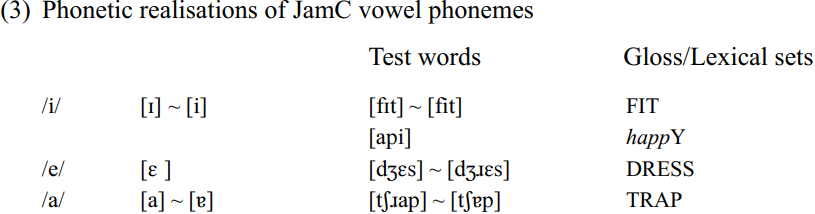
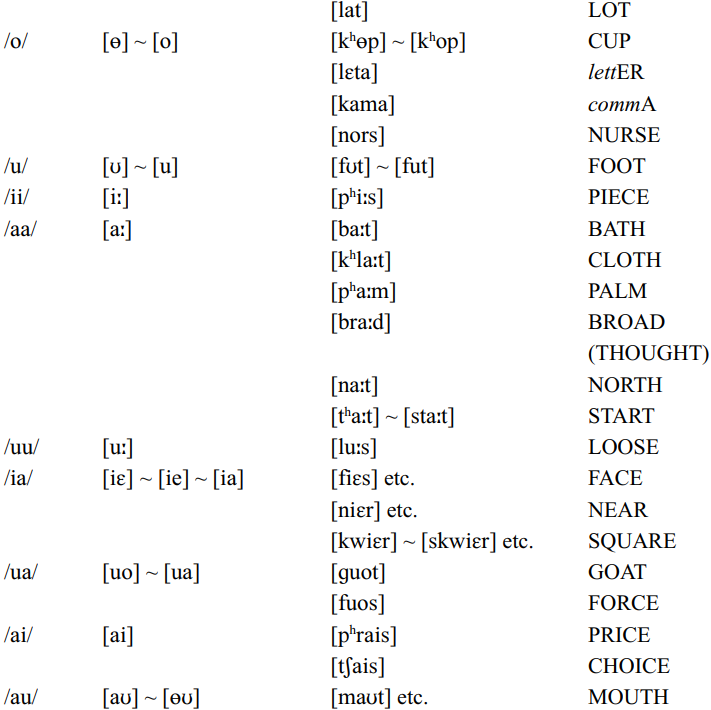
          

In our analysis, the phoneme /a/, when it shares a syllable nucleus with the high front vowel phoneme, /i/, is realized phonetically as the mid-front vowel, [ε]. This gives rise to the phonetic realization, [iε], for the diphthong which we represent as /ia/. Along similar lines, /a/, when it shares a syllabic nucleus with the high back vowel /u/ is phonetically realized as the back vowel [o] in diphthongs /ua/ and /au/ producing the phonetic realizations [uo] and [ou].


لا توجد تعليقات بعد

ما رأيك بالمقال : كن أول من يعلق على هذا المحتوى

اخر الاخبار

اشترك بقناتنا على التلجرام ليصلك كل ما هو جديد

