First-order and second-order perspectives on pragmatics
A first-order perspective encompasses that of users, that is, those persons who are participating in the instance of language in use in question. A second-order perspective encompasses that of observers, that is, those persons who are analyzing the instance of language use in question. The key elements that constitute such instances of language in use, which we briefly alluded to in the introduction and have subsequently discussed in more detail throughout this volume, are summarized in Figure 9.1:
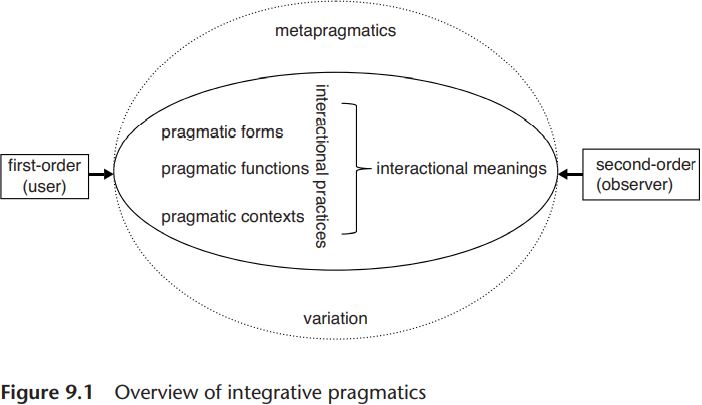
At the heart of all pragmatic phenomena lies a relationship between pragmatic forms, pragmatic functions and pragmatic contexts, and the interactional meanings they give rise to. Interactional meaning, in our account, is a broad concept that refers to what is taken to be meaningful by participants in particular occasions of sequentially situated talk and conduct. These encompass:
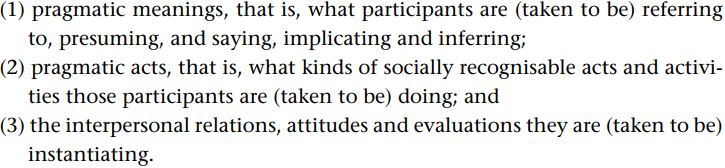
These interactional meanings arise through interactional practices, that is, through regular and recurrent ways in which these pragmatic forms, functions, contexts co-occur in meaningful ways for participants. Pragmatic forms, in our account, constitute any linguistic (or indeed non-linguistic) unit that can be linked to a particular pragmatic function, where the latter refers to some purpose or activity for which the form is fitted or employed to accomplish. Given it is now well accepted that there is almost never a straightforward relationship between pragmatic forms and functions, we acknowledge, as does pragmatics more broadly, that this relationship is inevitably mediated through pragmatic contexts. Pragmatic contexts refers to broader discourse and social elements that together underpin the recognisability for participants (and observers) of those (non-)linguistic units as pragmatic forms, the recognisability of particular purposes or activities as pragmatic functions, and the recognisability of the (sometimes complex) relationships between those pragmatic forms and functions. It is, of course, important to remember that pragmatic contexts are the cornerstones by which we connect the use of language to the real world. Not only do we draw from contexts in understanding the interactional meanings arising through the use of language, but language itself is also shaped through the use of language, as sociolinguists and others have long noted (Hymes 1974; Gumperz 1982; Goodwin and Duranti 1992). Finally, the issue of recognisability leads us, in turn, to consider both the awareness of users (and observers) vis-à-vis those interactional meanings, and the interactional practices through they are constituted (i.e. what is termed metapragmatics), and the inevitable variation in awareness, understandings and instantiation of these pragmatic forms, functions and contexts, and thus interactional practices and meanings across participants (and observers).
Such an approach naturally has implications for the range of methods we might employ in studying pragmatic phenomena. Our view has been that there is a wide range of methods and disciplinary approaches that are relevant to the analysis of language in use.








