Metapragmatics and reflexivity
The prefix meta, which comes from the Greek μετά meaning “above”, “beyond” or “among”, is normally used in English to indicate a concept or term that is about another concept or term. For example, metadata is data about data, meta-language is language about language, while metapragmatics refers to the use of language about the use of language. In order for participants to talk about their use of language they must, of course, have some degree of awareness about how we use language to interact and communicate with others. This type of awareness is of a very particular type, however, in that it is almost inevitably reflexive. What this means is that awareness of a particular interpretation on the part of one participant, for instance, is more often than not interdependently related to the awareness of interpretations (implicitly) demonstrated by other participants. In other words, in using language to interact or communicate with others, participants must inevitably think about what others are thinking, as well as very often thinking about what others think they are thinking, and so on. And not only do participants engage in such reflexive thinking in using language, they are also aware of this reflexivity in their thinking, albeit to varying degrees. We can thus observe various indicators of such reflexive awareness in ordinary language use.
Consider, for instance, the following excerpt from an episode of the HBO comedy, Flight of the Conchords. The two characters, Brett and Jermaine, have just met a lady in the park who was looking for her lost dog. They start singing a song, at the conclusion of which they realize they are singing about the very same lady they have just met. Much of the song involves a back and forth between the two characters as they attempt to establish who they are referring to:
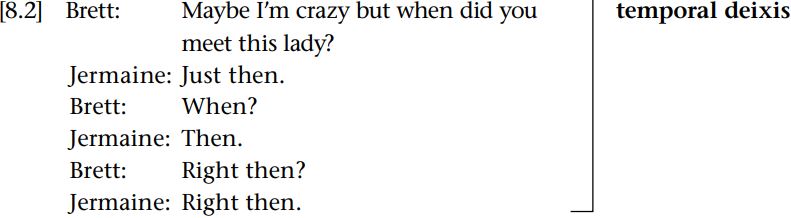
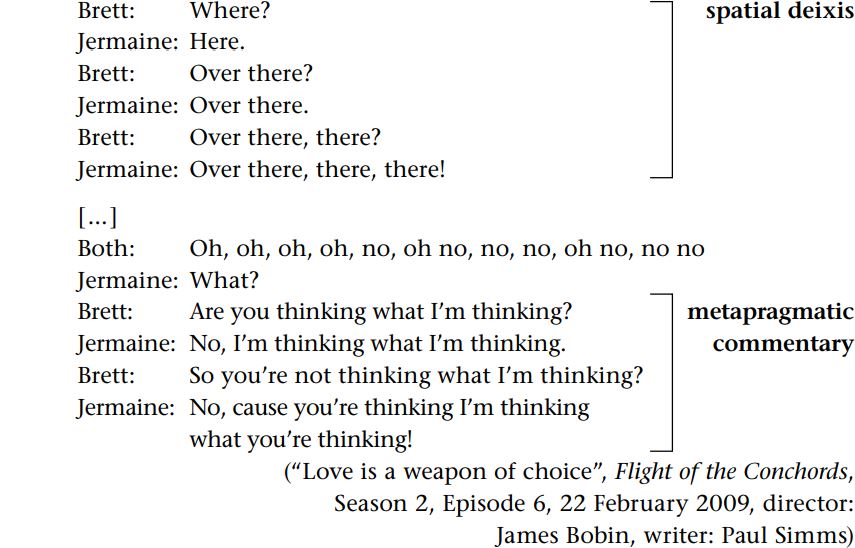
In the course of this excerpt Brett and Jermaine attempt to establish the real world. They begin by attempting to establish the time they met (temporal deixis), then move to discussing where they met her (spatial deixis). Eventually, they start to realize they might be singing about the same girl. This metapragmatic discussion breaks down, however, when Brett’s suggestion that they might be referring to the same girl (Are you thinking what I am thinking?) is treated literally by Jermaine. What happens here is that while Brett implies that they are talking about the same girl, Jermaine only responds to what is said by Brett (that Brett is thinking what Jermaine is thinking). In that sense, Jermaine’s response to the reformulation of the question by Brett is strictly speaking correct (No, cause you’re thinking I’m thinking what you’re thinking). However, since it is a very complex utterance – about Jermaine’s belief about Brett’s belief about Jermaine’s thought in relation to Brett’s thought – it becomes almost impossible to follow in the context of the song. Nevertheless, while up until this point in the song they have not yet successfully established the referent in question, it is clear that they are reflexively aware of the other’s use of language and, moreover, that this reflexive awareness enters into the language they use in the form of explicit metapragmatic commentary.
Such reflexive awareness does not, however, always surface so explicitly in language use. As Niedzielski and Preston (2009) point out, participants may not always be able to articulate their reflexive understandings of language use, despite such understandings being inherent in that very same usage. It is also apparent that such awareness may be more or less salient across different situated contexts. Thus, while metapragmatics often involves the study of instances where participants attend to communication, that is, where language is used to “evoke some kind of communicative disturbance” (Hübler and Bublitz 2007: 7) or “to intervene in ongoing discourse” (ibid.: 1), it is not restricted to instances that are explicitly recognized by participants, as we shall see in the remainder.








