0
EN
1
المرجع الالكتروني للمعلوماتية

Grammar

Tenses

Present

Present Simple

Present Continuous

Present Perfect

Present Perfect Continuous

Past

Past Simple

Past Continuous

Past Perfect

Past Perfect Continuous

Future

Future Simple

Future Continuous

Future Perfect

Future Perfect Continuous

Parts Of Speech

Nouns

Countable and uncountable nouns

Verbal nouns

Singular and Plural nouns

Proper nouns

Nouns gender

Nouns definition

Concrete nouns

Abstract nouns

Common nouns

Collective nouns

Definition Of Nouns

Animate and Inanimate nouns

Nouns

Verbs

Stative and dynamic verbs

Finite and nonfinite verbs

To be verbs

Transitive and intransitive verbs

Auxiliary verbs

Modal verbs

Regular and irregular verbs

Action verbs

Verbs

Adverbs

Relative adverbs

Interrogative adverbs

Adverbs of time

Adverbs of place

Adverbs of reason

Adverbs of quantity

Adverbs of manner

Adverbs of frequency

Adverbs of affirmation

Adverbs

Adjectives

Quantitative adjective

Proper adjective

Possessive adjective

Numeral adjective

Interrogative adjective

Distributive adjective

Descriptive adjective

Demonstrative adjective

Pronouns

Subject pronoun

Relative pronoun

Reflexive pronoun

Reciprocal pronoun

Possessive pronoun

Personal pronoun

Interrogative pronoun

Indefinite pronoun

Emphatic pronoun

Distributive pronoun

Demonstrative pronoun

Pronouns

Pre Position

Preposition by function

Time preposition

Reason preposition

Possession preposition

Place preposition

Phrases preposition

Origin preposition

Measure preposition

Direction preposition

Contrast preposition

Agent preposition

Preposition by construction

Simple preposition

Phrase preposition

Double preposition

Compound preposition

prepositions

Conjunctions

Subordinating conjunction

Correlative conjunction

Coordinating conjunction

Conjunctive adverbs

conjunctions

Interjections

Express calling interjection

Phrases

Sentences

Clauses

Part of Speech

Grammar Rules

Passive and Active

Preference

Requests and offers

wishes

Be used to

Some and any

Could have done

Describing people

Giving advices

Possession

Comparative and superlative

Giving Reason

Making Suggestions

Apologizing

Forming questions

Since and for

Directions

Obligation

Adverbials

invitation

Articles

Imaginary condition

Zero conditional

First conditional

Second conditional

Third conditional

Reported speech

Demonstratives

Determiners

Direct and Indirect speech

Linguistics

Phonetics

Phonology

Linguistics fields

Syntax

Morphology

Semantics

pragmatics

History

Writing

Grammar

Phonetics and Phonology

Semiotics

Reading Comprehension

Elementary

Intermediate

Advanced

Teaching Methods

Teaching Strategies

Assessment

قم بتسجيل الدخول اولاً لكي يتسنى لك الاعجاب والتعليق.

Reflection: Recognitional deixis or thingamy

المؤلف:  Jonathan Culpeper and Michael Haugh

المصدر:  Pragmatics and the English Language

الجزء والصفحة:  40-2

26-4-2022

1091

+

-

20

Reflection: Recognitional deixis or thingamy

A specific phenomenon that it is strongly dependent on common ground concerns nominal expressions such as thingamy, thingamajig, thingamabob, whojar, whatsit, what’s-his-name, what-d’you-call-it, and you-know-what. Such expressions, unlike the definite noun phrases discussed earlier, provide little descriptive information to help one work out what is being talked about. Yet, in the shared context of a dinner, an expression such as thingamy is likely to be taken as a reference to the pepper mill on the table, and was equally likely to have been used in the expectation that this reference would be assigned. Recognitional deixis is a label coined by Enfield (2003) for such items. It acknowledges that they behave like deictic expressions picking out items relative to the speaker’s here and now, but also that they rely heavily on common ground to be successfully “recognized”.

Why might we use such words? Consider these examples of recent usage of thingamy taken from the Oxford English Corpus:
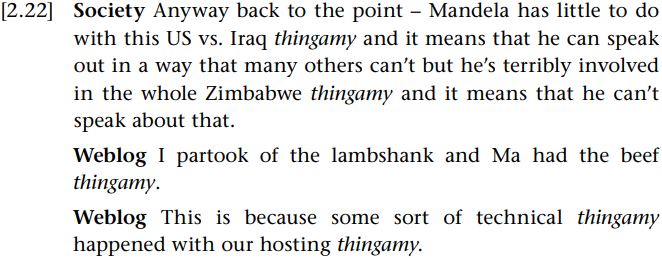
Although you do not have access to the full context, it is quite easy to see that they are often used in contexts where specialized lexis would be required (e.g. technical items or specialized cuisine), or where there may be difficulty in identifying an appropriate word (e.g. dealing with the sensitivities of a diplomatic wrangle), or where there are restrictions on the obvious term (e.g. labelling a cleaning product without actually using the trademark name). In context, it is highly likely that these will present few difficulties, because the participants have a common ground. Additionally, it is not the case that such expressions present participants with no descriptive information at all; in fact, they offer constraints on interpretations. This point is spelt out by Enfield (2003). He suggests, for example, that the speaker’s message in using what’s-his-name could be defined as: someone (male); I can’t say this person’s name now; by saying what’s-his-name I think you’ll know who I’m thinking of (2003:105). This contrasts with, for example, you-know-what, which “may have both ‘avoidance’ and ‘conspiratorial’ functions, whereby a speaker deliberately avoids saying a certain word, either to prevent potentially overhearing third parties from understanding, and/or to create exclusive air between interlocutors” (2003:106).


اخر الاخبار

اشترك بقناتنا على التلجرام ليصلك كل ما هو جديد

