The passive
We can choose to mention the person(s) attacked, the Patient(s), but to leave out the attacker(s). This is done by using the passive construction, in which the Patient noun, here Emma and Harriet, is the subject.

If we want to make sure that our addressee gets all the details, we mention the Agent and the Patient, and we have a choice of construction, as in (22).

Example (20) is an instance of what is called the existential construction, so-called because speakers use it to talk about the existence of people, things, ideas and whole events. We say nothing more about it here. We pass on to two of the three major constructions that are our concern. Consider the passive in (21). This is the main use of the passive both in speech and in writing: to mention only the Patient and to omit the Agent. From passives such as (21), listeners can infer an Agent, and adverbs can be inserted, such as deliberately in (23), which bring the Agent very close without actually mentioning who played that role.

Examples (21) and (23) are instances of the ‘short passive’, while (22a) is an example of the ‘long passive’. Even in the long passive, the Agent noun is in an optional prepositional phrase and is presented as peripheral.
Other languages, such as Latin, also have a construction which allows speakers to omit Agents. The major difference between English and Latin is that Latin verbs take different suffixes in the passive whereas English employs a syntactic construction with an auxiliary verb and a passive participle. A Latin example is given in (24b).
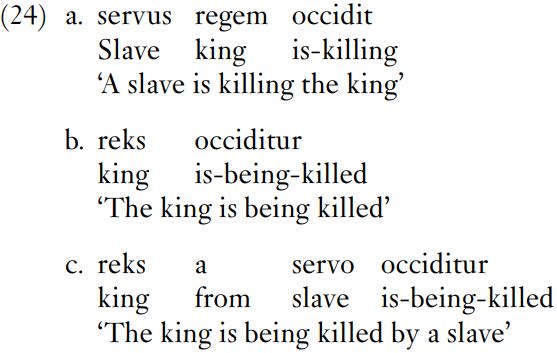
The case suffixes in Latin have already been discussed on syntactic linkage; in fact (24a) is taken from it. The phrase a servo in (24c) is a prepositional phrase and optional, as shown by (24b) without it. The passive suffix (third person singular present tense indicative mood) is -itur as opposed to -it in (24a).
English has another passive construction with the auxiliary verb get, as shown in (25).

The get passive is dynamic. An example such as The vase was broken is ambiguous; it can be interpreted either as describing an event in which someone broke the vase or as describing the state in which the vase is – the speaker might point to the bits of the vase lying on a table. The vase got broken can only be used to describe an event. This difference comes largely from the fact that be is a colorless verb that relates to states and locations and membership of groups, while get is basically a verb of movement – We got to Cupar in an hour – which has been extended to changes in state – The sky got dark, We got cold.
There has been some controversy over the get passive. Some analysts see a contrast in meaning between (26), with were, and (27), with got, and treat (28) as unacceptable.
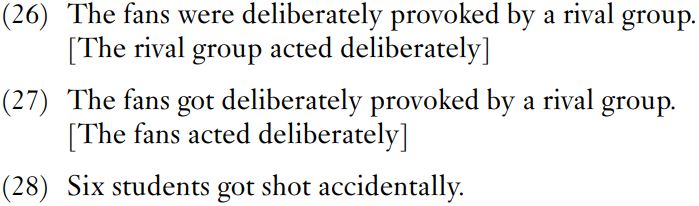
Example (28) is allegedly unacceptable because of a mismatch between the use of got and the use of accidentally. Got can supposedly be used only if the students acted deliberately. There is no support for this analysis in any British corpus. The get passive is simply a major passive in spontaneous spoken English. One sample of conversation recorded in Edinburgh had eighteen be passives and eleven get passives; another had fifty-seven get passives and three be passives.
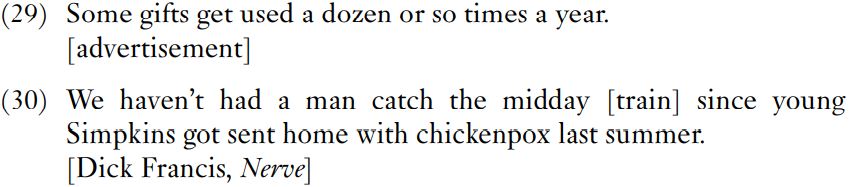
Interestingly, examples of get passives can be found in written English in which it is quite clear that there is no question of the Patient acting deliberately to cause an action, either because the Patient is inanimate, as in (29), or because the event cannot be controlled by the Patient, as shown by (30).
 Where speakers do want to indicate that a Patient acted deliberately, they use the reflexive pronoun himself, as in (31), from spontaneous conversation.
 We have focused on Agents not being mentioned, but some lexical verbs allow Patients not to be mentioned, as in (32).
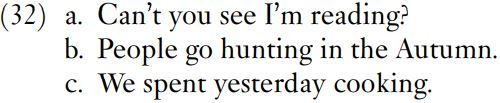
The Patients can be omitted in (32) because they are closely connected with the activity denoted by the verb. People read books and newspapers, they hunt foxes, pheasants or deer and they cook food. Patient NPs can also be omitted in clauses describing habitual actions. The best examples relate to tasks or posts within organizations, as in (33a), but any transitive can occur without its Patient NP provided the clause describes a habitual event, as in (33b).









