Annotated Phrase Structure trees
The well-formedness conditions above speak of assigning Grammatical Relations to phrases which occur in particular Phrase Structure positions, specifically to clause-mates of V. But there is no indication in our Phrase Structure diagrams of which Grammatical Relation is assigned to which constituent, thus no way to be sure whether or not a particular tree structure satisfies the well-formedness conditions. It would be helpful to add this information to our PS trees in some way. The simplest approach is to add an ANNOTATION to the appropriate nodes in the tree structure, as in (32).
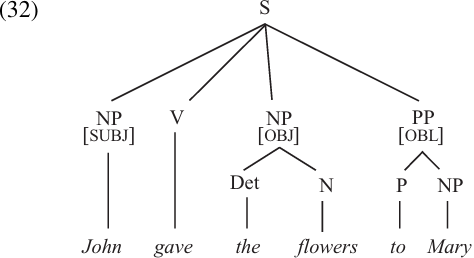
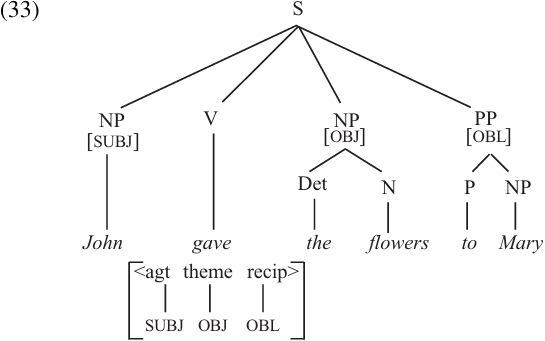
To see whether the well-formedness conditions are satisfied, we need to compare the subcategorization properties of the verb with the Grammatical Relations (GRs) assigned to its clause-mates. Although we normally write only a single word for each terminal element in our tree diagrams, this is just a short-hand notation which actually represents the full lexical entry. The rest of the information contained in the lexical entry, including (at least for verbs) the argument structure, is also assumed to be available. By making some of this information explicit in the tree diagram, as in (33), we can immediately check for completeness and coherence.
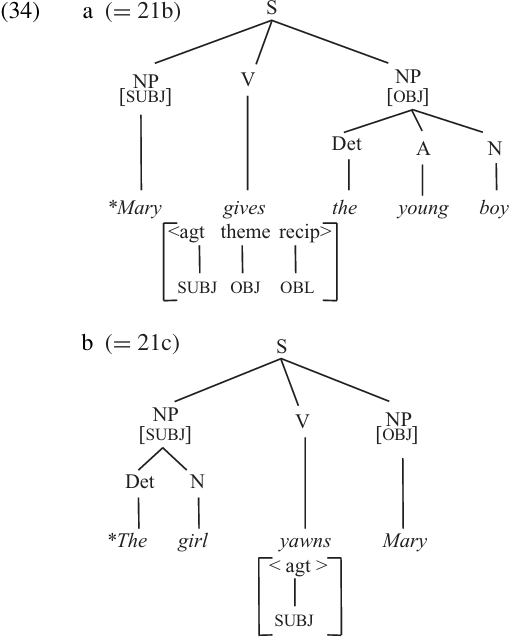
This kind of annotated tree diagram allows us to see at once what is wrong with the ungrammatical examples in (21) above: (21b) is incomplete, as demonstrated in (34a), while (21c) is incoherent, as demonstrated in (34b).
In a language like English, word order (or position in the Phrase Structure) is the most important signal for identifying the GR of a constituent: subjects normally come before the verb, direct objects immediately after the verb, etc. One way in which the grammar can specify the regular association of position with GR is by adding annotations to the PS rules themselves, as in (35). This rule will license tree structures like that shown in (33). The annotations can be thought of as extra units of information which must be true of the constituent that occupies a given position in the tree. The node labels for these constituents now specify not only syntactic category but also the GR which must be assigned.

In some other languages, word order is quite free and GRs are distinguished primarily by morphological features (specifically case marking and/or agreement). In these languages, the rules which assign GRs to phrases must be stated in terms of the relevant morphological features.
GRs form a crucial link in the association between individual phrases and semantic roles. They are associated with semantic roles in the argument structure of the verb, and with NPs or PPs in the Phrase Structure representation. (Both of these associations are illustrated in (33).) This linkage between a specific phrase and the semantic role which it bears is what allows the grammar to specify who did what in a particular situation. But the linkage is indirect, mediated by the GR.








