الوضع الليلي


 12:56:15
 2026-11-25
 40
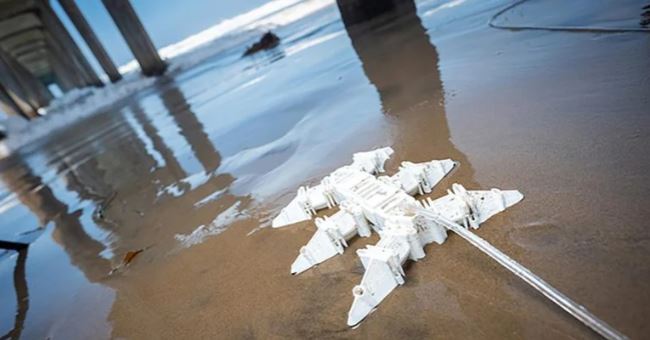
A robot powered entirely by air could offer a new way to explore dangerous environments where radiation or strong magnetic fields threaten conventional electronics.
A six-legged robot made entirely of soft materials can run at speeds of up to 10.6 miles per hour (4.72 meters per second), making it the fastest soft robot of its kind.
Built by engineers at the University of California, San Diego, the machine can race across sand, gravel, and concrete, run down stairs, and even swim. Perhaps most remarkably, the entire robot is 3D-printed in one piece using a single material, and it needs no electronics to move.
The breakthrough, described in Science Robotics, takes inspiration from a centuries-old invention, the steam engine. By adapting the way steam engines make efficient use of pressure, researchers found a way to make their soft robot run more than 100 times faster than an earlier version.
The speed limit of soft robots
The project began with a much slower machine. In 2022, researchers at the UC San Diego Jacobs School of Engineering developed a 3D-printed, air-powered robot that could walk at just 4 centimeters (about 1.6 inches) per second. Described in a 2025 paper in Advanced Intelligent Systems, the original design demonstrated that a robot could move using nothing more than a network of air-filled chambers and valves built directly into its soft body. Its speed, however, was limited by how much air pressure and airflow the internal structures could withstand.
“Our first walking robot demonstrated what was possible, but it was too slow. We hoped to overcome this limitation, and we were fortunate to find a solution to make the new robot 100 times faster,” said Yichen Zhai, a former postdoctoral researcher in Professor Michael T. Tolley’s Bioinspired Robotics and Design Laboratory at UC San Diego.
Making compressed air work twice
Zhai and Tolley’s team knew that increasing the air pressure could make the robot move faster. Inside the machine, a connected network of chambers, valves, and tubes directs compressed air to move its legs. Making those structures larger and stronger would allow more air to flow through at higher pressures, but there was a catch. At high speeds, the robot could exhaust pressurized air before using much of its remaining energy, wasting the very power needed to keep it running.
The researchers found their solution in the compound steam engine, which extracts more useful energy by allowing steam to expand through multiple chambers rather than releasing it all at once. They incorporated a similar arrangement into the robot, giving compressed air two jobs as it moves through the body. First, it passes through smaller, high-pressure chambers to operate the valves. It then travels into larger, low-pressure chambers, where it drives the legs.
This two-stage system allows the robot to make better use of its compressed air while achieving speeds far beyond those of its predecessor. It also preserves one of the design’s most appealing features: the entire network of moving parts can be printed together without requiring separate electronic controls.
The researchers described the engineering challenge this way, “The key challenge was to implement a time-tested solution (the compound steam engine) in a soft running robot that can be printed in a single piece out of a single material. We see this as a step towards complex and powerful robots that can be printed on the desktop using inexpensive materials.”
To see what their creation could handle, the team tested it across concrete, gravel, lawns, mulch, and sand. The robot successfully navigated these different surfaces, ran down stairs, swam in water, and continued functioning underwater. Its ability to move through such varied environments demonstrates what can be accomplished with a relatively simple, flexible design powered entirely by air.
Still tethered to an air supply
There is still one major limitation. Although the robot operates without electronics, it remains tethered to an external source of compressed air, such as a conventional air compressor. The researchers hope to reduce its air consumption enough that future versions could carry a portable supply, potentially using a small cartridge of compressed air instead. They also want to develop more sophisticated movements that would allow the robot to steer and manipulate objects.
Eventually, inexpensive robots that can be printed in a single piece and operate without electronics could prove useful in places where conventional machines struggle. The researchers envision applications ranging from disaster response and space exploration to scientific reconnaissance in environments with intense radiation or magnetic fields, where electronic equipment may be unable to function.
Reality Of Islam |
|

By filling

Scientists

A simple ch
 9:3:43
2018-11-05
10 benefits of Marriage in Islam
7:5:22
2019-04-08
benefits of reciting surat yunus, hud &
9:45:7
2018-12-24
advantages & disadvantages of divorce
11:35:12
2018-06-10
6:0:51
2018-10-16
2:5:14
2023-01-28
8:19:41
2018-06-21
7:6:7
2022-03-21
10:47:11
2022-11-22
2:42:26
2023-02-02
10:55:53
2022-06-13
9:30:2
2021-11-12
5:41:46
2023-03-18
| LATEST |
 HOME