The EPP and the Subject Criterion
The classical EPP of the GB framework expresses the obligatoriness of the subject position of clauses.
(1)
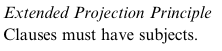
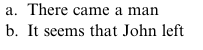
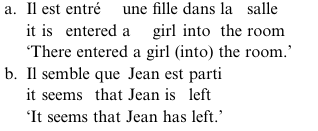
Direct evidence for this principle is provided by the very existence of expletives of various kinds. In structures in which there is no external argument, the subject position must be expressed by a nonreferential pronominal element (overt in non-null-subject languages).
(2)
(3)
The EPP remained an isolated principle within the GB framework, and minimalism has not significantly changed things (apart from the terminological choice of generalizing the label EPP to the c-selection of a Spec potentially targeted by movement, a property more perspicuously renamed OCC(urrence) in Chomsky 2004; in what follows, I continue to use the term in its classical sense (1)). In this section, I would like to capitalize on the results of the analysis of A ¯-chains to propose a new way to integrate the EPP within an independent theoretical structure. I would also like to use this approach to reanalyze the subject-object asymmetries, classically ascribed to the ECP.
Under the VP-internal subject hypothesis, the EPP position is typically filled by the external argument, if there is one, raised from its y-position.
(4)
John has [t seen Mary]
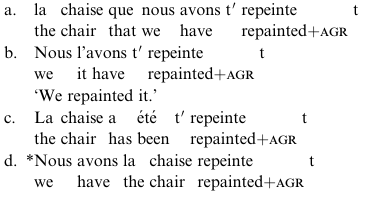
The EPP position differs from other A-positions, such as the position determining past participle agreement, in that the EPP position typically is a final target of movement, while the participial agreement position is not (see (5d)); the latter can only be the target of intermediate movement, with the relevant phrase further moved to an A ¯-position (as in the relative construction in (5a)), or a clitic position (as in (5b)), or the EPP position itself (as in a passive construction like (5c)).
(5)
Under ‘‘movement as a last resort’’ guidelines, the EPP position must be associated to an interface effect, morphological (Case-related), interpretive (some kind of criterial effect), or both. Nominative Case assignment is often offered as a morphological motivation for subject movement. But various considerations suggest an at least partial dissociation between the EPP position and the Case-agreement system (here I rely in part on Cardinaletti’s (2004) discussion). One is the existence of quirky (nonnominative) subjects illustrated here in Italian, with the preverbal subject position filled by an inherently Case-marked phrase and agreement construed with an internal argument, as in (6a), alternating with the canonical nominative-dative order, as in (6b).
(6)
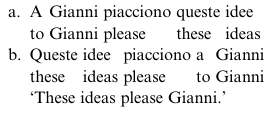
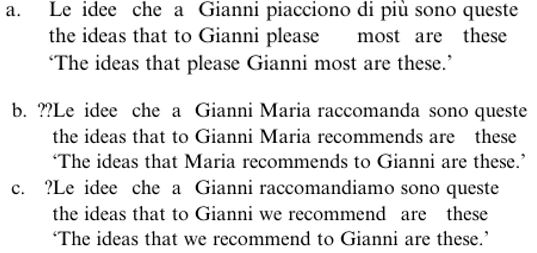
That the dative experiencer actually is in a subject position is suggested by the fact that it does not induce any sort of island effect, contrary to the effect determined by a topic PP (the effect is mild in Italian, further weakened if the subject is null; but even in this case there is a detectable difference, for example, between (7a) and (7c)).
(7)
As the element satisfying the EPP and the agreeing element can be dis sociated, I will assume two distinct heads as in (8), each related to a dis tinct DP position. (This follows from the natural assumption that a single head cannot carry a complex feature specification, allowing it to enter into an Agree relation with a phrase and at the same time attract another phrase. That distinct subject positions should be postulated in different zones of the IP space is argued for by Belletti (2001, 2004), Cardinaletti (1997, 2004), and Shlonsky (2000) for reasons independent from the EPP; I will not discuss here how the positions they argue for relate to the EPP. I use the label Agr to designate the head carrying the agreement features, without committing myself to the existence of an independent Agr head; see Chomsky 1995, 2001, 2004 for discussion.)
(8)

At this point, we should inquire how the two heads can relate to dis tinct nominals without violating locality (in the sense of Rizzi 1990 and Chomsky 1995). Many options come to mind, but for concreteness I will assume that no minimality effect arises in the derivation of (6a–b) because with the relevant verb class (the core of which consists of experiencing verbs), the small VP (containing the theme) can be scrambled past the (dative-marked) experiencer.
(9)

As the two DPs now belong to disjoint c-domains in (9b), Agree can relate Agr and DPTheme, and DPExp can be attracted to EPP, which gives rise to no Relativized Minimality violation.
If the EPP position and the Case-agreement system are dissociated along these lines, we are naturally led to explore the possibility that the EPP position is a criterial position. In fact, it is often mentioned in the literature that some special interpretive property goes with the EPP position (a conclusion supported, for instance, by the intuition that an active and a passive sentence do not sound fully interchangeable).
What special interpretive property could be associated with the EPP position? One frequently mentioned idea is that subjects are ‘‘topiclike’’
in some sense. A complete assimilation of subjects and topics is much too coarse for many reasons: even in a null subject language like Italian, pre verbal subjects are possible in ‘‘out of the blue’’ contexts (e.g., as answers to ‘‘What happened?’’-type questions), in both active and passive structures ((10b) and (10b’)), while in such contexts bona fide topics, expressed by clitic left-dislocation in Italian, are not felicitous (10b’’).
(10)
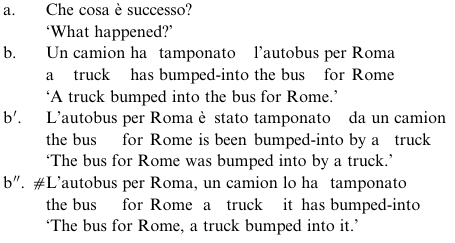
Still, subject and topic have something in common: some kind of predication is involved in both cases, a process selecting an argument as the starting point of the event description and expressing the event as somehow involving that argument. Following a rather standard terminology, I will call this relation aboutness. So, the crashing event expressed in (10b) and (10b’) is presented as being ‘‘about’’ a truck in (10b) and ‘‘about’’ the bus to Rome in (10b’); in neither case does the nominal have the full topic in terpretation of a left-dislocated phrase.
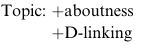
Subject and topic share aboutness, but the two notions differ in that D(iscourse)-linking is a necessary component of topics (whence the ill formedness of (10b’’)) but not of subjects (on the notion of D-linking, see Pesetsky 1987, Cinque 1990, and much subsequent work).
(11)
(12)
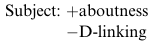
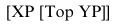
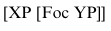
I will then assume that the EPP is a manifestation of a Subject Criterion. To implement this hypothesis, I will follow Cardinaletti (2004) in assuming a nominal head in the higher functional field, which attracts a nominal expression and determines the subject-predicate articulation, much as other dedicated heads determine topic-comment, focus-presupposition, and so on.
(13)
(14)
(15)
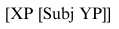
Subj occurs in the higher part of the inflectional field, higher than Agr, or whatever head carries the agreement features if independent agreement heads do not exist (Chomsky 1995).
(16)

One may speculate that a morphological realization of the Subj head is the subject clitic, an obligatory component of the clausal structure in some systems such as certain Northern Italian dialects, a position that appears to be distinct from, and higher than, the position occupied by the tensed verb, also carrying agreement features.
(17)

The Subject Criterion may be satisfied in an interpretively vacuous way by the insertion (or movement) of an expletive as the specifier of Subj. The possibility of such a purely formal satisfaction is sometimes considered a stumbling block for any approach to the EPP based on special interpretive properties of the subject position. I don’t think it is. It’s typical of natural languages to introduce interpretively motivated devices that, as it were, acquire a formal life of their own and operate blindly in special cases even in the absence of the interpretive conditions. Grammatical gender is a case in point—related to natural gender, but extending well beyond natural gender in determining formal nominal classes. So, expletive insertion corresponds to the case in which the speaker chooses not to present an event as being about a certain argument (an option limited by formal conditions that vary considerably across languages). See Chomsky 2002, 117, for discussion specifically related to the EPP.








