Pre-Service ESL Teachers’ Knowledge about Language and its Transfer to Lesson Planning
FINDINGS
Application of KAL in the Assignments
What Language is Targeted and How Often?
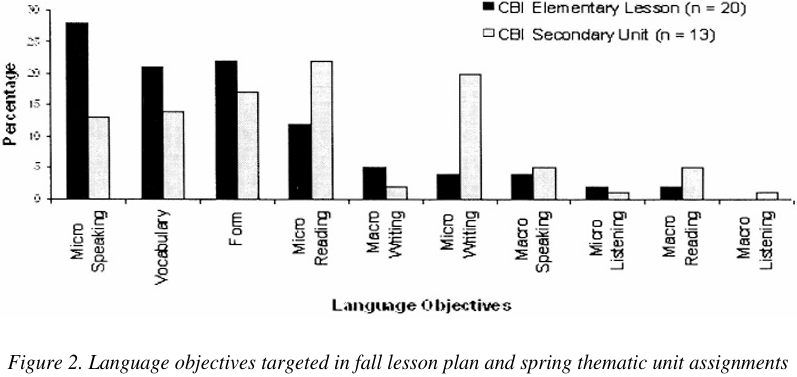
We analyzed the two CBI assignments in two ways: first to find out what general language objectives participants chose to include in their planning and second, the forms they chose to target when grammar was included in an objective. It was important to examine the types of language objectives participants chose to target because this is how language development is guided and tracked in CBI. Additionally, these are assignments following Path 2, where planning begins with content materials and we were curious about how beginning with the content might matter in terms of integrating language.
Figure 2 illustrates that the language objectives that participants wrote changed during the academic year and according to the context of different assignments. In the elementary level CBI lesson, participants targeted speaking skills, followed by vocabulary and form most often. Beyond macro-level skills, least targeted were the writing and listening modalities. The thematic unit differed somewhat from the lesson plan. Reading and writing were targeted most often, followed by form, vocabulary and speaking, respectively. Like the earlier lessons, macro-level objectives were few, and listening was virtually ignored. We would like to note that we urged our students to formulate micro-level objectives, because we believe such objectives tend to focus the lesson better and are more observable/assessable. From our perspective, the fact that participants wrote few macro-level objectives was positive because it showed that they were able to conceptualize clear and precise language objectives.
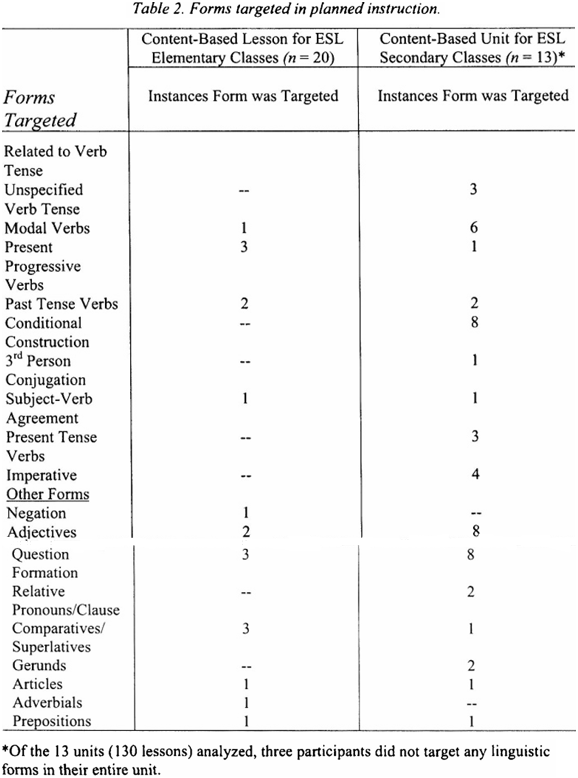
Our final analysis was conducted to examine more thoroughly participants’ choice of linguistic form in the two CBI assignments (Path 2). If participants were developing and applying KAL as we hoped they would, we would anticipate a healthy range of forms chosen besides the micro- and macro-level objectives targeting the modalities seen in Figure 2. This was not what we found (Table 2). Note that Grammar lessons were not included in this analysis because the forms were assigned by the instructor (Ranney) and therefore are not representative of the participants’ KAL. In the CBI lesson plan for elementary ESL, only 11 different forms were targeted and only 16 form-related objectives were written by 9 different participants. Therefore, more than half the participants did not choose to include any grammar objectives in their CBI lesson. In the secondary thematic units including 130 lessons, one in four of the lessons included a grammar objective and while 16 different forms were targeted in 52 form-related objectives, the frequency of a grammar focus in such a large quantity of planned instruction seems low. Of the grammatical forms targeted, verb tenses received much attention, especially in the thematic units.
In summary, participants included form-related objectives fairly infrequently, and when they did, the range of forms they chose was limited, compared to all they had learned in their grammar class. In a post hoc analysis, we found that there was a weak, but insignificant, correlation between scores on the metalinguistic task and number of form-related objectives integrated into content-based lessons. KAL, as the ability to identify metalinguistic terminology in a passage, had very little to do with how many linguistic objectives appeared in the lesson plans. Finally, while we are not claiming that there is an ideal number of linguistic aims in a unit, nor that syntax should always be the primary language focus, it is of some concern that linguistic development is given so little attention and that the range of forms targeted is so narrow.