0
EN
1
المرجع الالكتروني للمعلوماتية

Grammar

Tenses

Present

Present Simple

Present Continuous

Present Perfect

Present Perfect Continuous

Past

Past Simple

Past Continuous

Past Perfect

Past Perfect Continuous

Future

Future Simple

Future Continuous

Future Perfect

Future Perfect Continuous

Parts Of Speech

Nouns

Countable and uncountable nouns

Verbal nouns

Singular and Plural nouns

Proper nouns

Nouns gender

Nouns definition

Concrete nouns

Abstract nouns

Common nouns

Collective nouns

Definition Of Nouns

Animate and Inanimate nouns

Nouns

Verbs

Stative and dynamic verbs

Finite and nonfinite verbs

To be verbs

Transitive and intransitive verbs

Auxiliary verbs

Modal verbs

Regular and irregular verbs

Action verbs

Verbs

Adverbs

Relative adverbs

Interrogative adverbs

Adverbs of time

Adverbs of place

Adverbs of reason

Adverbs of quantity

Adverbs of manner

Adverbs of frequency

Adverbs of affirmation

Adverbs

Adjectives

Quantitative adjective

Proper adjective

Possessive adjective

Numeral adjective

Interrogative adjective

Distributive adjective

Descriptive adjective

Demonstrative adjective

Pronouns

Subject pronoun

Relative pronoun

Reflexive pronoun

Reciprocal pronoun

Possessive pronoun

Personal pronoun

Interrogative pronoun

Indefinite pronoun

Emphatic pronoun

Distributive pronoun

Demonstrative pronoun

Pronouns

Pre Position

Preposition by function

Time preposition

Reason preposition

Possession preposition

Place preposition

Phrases preposition

Origin preposition

Measure preposition

Direction preposition

Contrast preposition

Agent preposition

Preposition by construction

Simple preposition

Phrase preposition

Double preposition

Compound preposition

prepositions

Conjunctions

Subordinating conjunction

Correlative conjunction

Coordinating conjunction

Conjunctive adverbs

conjunctions

Interjections

Express calling interjection

Phrases

Sentences

Clauses

Part of Speech

Grammar Rules

Passive and Active

Preference

Requests and offers

wishes

Be used to

Some and any

Could have done

Describing people

Giving advices

Possession

Comparative and superlative

Giving Reason

Making Suggestions

Apologizing

Forming questions

Since and for

Directions

Obligation

Adverbials

invitation

Articles

Imaginary condition

Zero conditional

First conditional

Second conditional

Third conditional

Reported speech

Demonstratives

Determiners

Direct and Indirect speech

Linguistics

Phonetics

Phonology

Linguistics fields

Syntax

Morphology

Semantics

pragmatics

History

Writing

Grammar

Phonetics and Phonology

Semiotics

Applied Linguistics

Reading Comprehension

Elementary

Intermediate

Advanced

Teaching Methods

Teaching Strategies

Assessment

قم بتسجيل الدخول اولاً لكي يتسنى لك الاعجاب والتعليق.

LANGUAGE CORRECTNESS AS AN APPLIED LINGUISTICS PROBLEM Social class markers

المؤلف:  Alan Davies

المصدر:  An Introduction to Applied Linguistics

الجزء والصفحة:  P99-C5

2026-07-27

23

+

-

20

LANGUAGE CORRECTNESS AS AN APPLIED LINGUISTICS PROBLEM

Social class markers

When parents say of their teenage children that they don’t understand their language, what they probably mean is that young people use somewhat different vocabulary; also perhaps that the topics they talk about are not those current among their parents’ generation. This difference is an example of the general case that different groups mark their speech in ways that distinguish it from that of others, sometimes in grammar, more often in vocabulary and most of all in pronunciation. At the same time these different groups share the same common language, which allows them to communicate readily with one another, but in subtly different ways, recognized by everyone, salient socially not linguistically.


One of these group distinctions is that of the linguistic markers of social class, which in English has been satirized as marking the U(pper)–non-U(pper) dis tinction. Examples from Ross (1978) include:
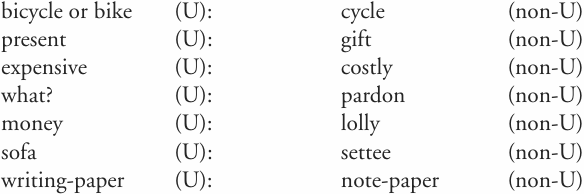
 

Does it makes any sense to regard the U usages as more correct than the non-U? This is indeed what Ross suggests. He uses the terms ‘upper class (abbreviated U), correct, proper, legitimate, appropriate … to designate usages of the upper class; their antonyms (non-U, not proper, not legitimate etc.) to designate usages which are not upper class’ (ibid: 91).


Surely these examples are so unimportant that the argument must be fatuous. But that of course is Ross’s point, that these variants are linguistically trivial and therefore do not hinder communication across the class divide but at the same time mark the social distinction very clearly. Ross calls them ‘philologically trivial and, apparently, almost all of a very ephemeral nature’ (ibid: 104). Socially, however, they are not at all trivial because, if Ross’s argument is to be accepted, the non-U speaker can never convincingly become a U speaker. The non-U speaker may learn to use U usages but always too late since new ones emerge to maintain the social difference.


This is not, however, the case with the use of non-discriminatory language, since the campaigns in its favor take for granted that it is possible to become nondiscriminatory language users. In so doing, we are also choosing what may be regarded as more ‘correct’.


اخر الاخبار

اشترك بقناتنا على التلجرام ليصلك كل ما هو جديد

