Function and type
Since there is rarely a one-to-one relationship between function and type, many words can realize more than one syntactic function, with the position of the adverb varying according to its function. This is illustrated by the adverbs ‘altogether’ and ‘later’:
Altogether: He owes me a hundred dollars altogether (adjunct)
I think you are altogether wrong (modifier of adj.)
There were a lot of interesting people there, so altogether we had a
very good time. (connective)
Later : There will be another performance later. (adjunct)
The performance later will be a better one. (post-modifier of noun)
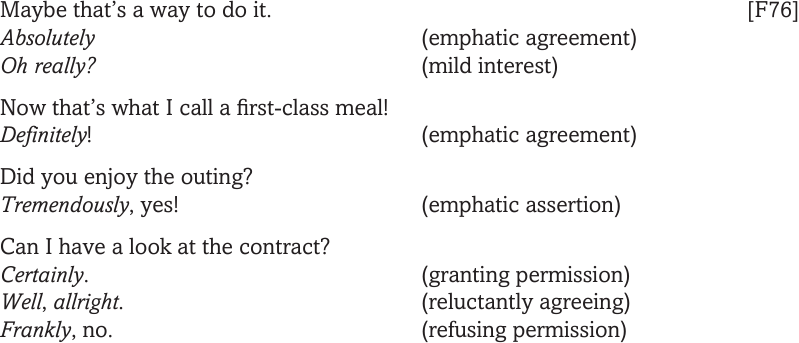
In conversation, adverbs sometimes occur alone, as responses to something said by the previous speaker. In such cases the adverb can carry out such discourse functions as agreeing emphatically, expressing mild interest, asserting strongly or granting permission in particular contexts: