Indefinite quantifiers
Some, any, no, (none)
Some specifies a quantity (with mass nouns) or a number above two (with count nouns) as in some money, some time, some friends, some details. Other quantifiers are used to express very small or very large amounts. The word some is pronounced in two ways, according to its function. It has a weak form when used non-selectively as an indefinite determiner, but it is strong when used as a selective quantifier:
non-selective /səm/ We’re spending some days by the sea.
selective /sΛm/ Some days it’s hot, other days it’s cold.
Stressed some can also be used with various types of evaluative force:
quantifying: I haven’t seen you for some time. (= a long time)
appreciative: That really was some meal! (= a wonderful meal) >
Any has two meanings, as illustrated in the following examples:
1 Have you any change/any coins? I haven’t any change/any coins.
2 Any information would be useful.
In 1, any specifies an indeterminate amount or number of something. It occurs in non- affirmative clauses, that is, in negative and interrogative clauses mainly. It is typically unstressed.
In 2, any is equivalent to ‘no matter which or what’. It occurs typically in affirmative clauses and is stressed. Compare this use of any with anything and either:
You can choose any of the main courses on the menu. (it doesn’t matter which)
You can choose anything on the menu. (it doesn’t matter what)
You can choose either meat or fish. (one or the other, not both)
The negative determinative no has mass, count, singular and plural references: no time, no change, no changes.
There is no need to worry. No changes will be made. None (pronoun) will be made.
Some and any – but not no – can function as elliptical heads of the NG. Instead of no, the pronoun none is used, as in the previous example, and also for the partitive (‘none of the men’).
Have you any change? Yes, I have some. No, I haven’t any. I have none.
Did you have any difficulties with your papers? No, none. (= no difficulties)
Note that not is a negative particle, and does not function as a determinative or a pronoun. It can precede the quantifiers much and many in ellipted responses.
Isn’t there anything to eat? Not much.
Haven’t you any friends? Not many.
Much, little, a little, many, few, a few
These quantifiers are used with both indefinite and definite NGs. With definite reference they are followed by of and have partitive reference: that is, a part, rather than the whole of a previously selected set is being referred to:
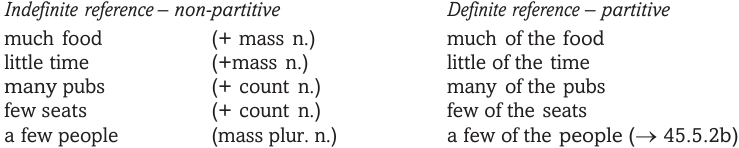
Is there much food? There’s very little. There’s a lot. *There’s much. There’s not much. There aren’t (very) many people.
Much and many are used mainly in negative and interrogative clauses, as illustrated above. In speech and dialogue much, little and few are replaced by a lot, not very much and not many, respectively; but they occur in formal written styles, together with no rather than not . . . any, as in the following extracts from T. Givón, Downfall of a Jesuit:
No enemy troops can be seen.
In the narrow confines between the town walls and the church-topped rise, little room is left for the mounted Dragoons to maneuver.
No sound is coming from the high ground on which they are advancing.
‘How are you doing?’ ‘Don’t feel much . . . Better leave me be . . . ’
A lot of, lots of, plenty of, a great deal of, a number of a lot of/lots of
These quantifiers are determinatives with noun heads followed by a PP complement. They range from the informal (a lot/lots of) to the formal (a great deal/a number of). Some of them admit both mass and count nouns, others do not:
Singular mass and a lot of, plenty of lots of a lot of/lots of/plenty of money
plural count: a lot of/lots of/plenty of friends
Singular mass only a great deal of a great deal of money
Plural count only: a number of a number of policemen
More informal combinations of this type which function like a lot/lots of include loads of, heaps of, masses of.
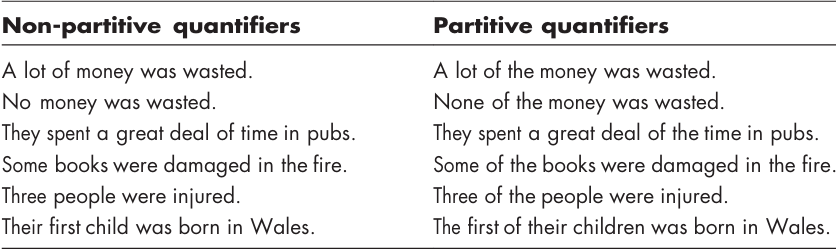
These phrasal quantifiers are not partitives even though they contain the preposition of. Partitives have definite reference and represent sub-sets from already selected sets. Here is a selection of examples of non-partitive quantifiers, together with their partitive counterparts: