Selected classes of non-count nouns
As non-count nouns are the most problematic for students of English, a selection is listed here according to type, starting with singular only or plural only.
1 Non-count singular nouns: The news is good
(a) Food, substances, natural phenomena:
bread butter coffee rice spinach fruit spaghetti rain mud snow hail sand soil water weather
The notion of substance is useful and may be extended to oxygen, heat, light, electricity, cocaine and so on.
Abstractions:
advice anger fun information love silence peace music knowledge health childhood
(b) Nouns which end in -ics and appear to be plural, but are in fact singular:
Aerobics athletics logistics mathematics ethics linguistics pragmatics phonetics physics politics
(c) Nouns which refer to a number of items conceptualized as an aggregate:
baggage luggage cutlery jewellery furniture
(d) Activities:
research work homework housework travel
Travel, which has a generic meaning, is not to be confused with journey, which is a count noun:
It is best to book through a travel agency these days, especially for long journeys.
2 Non-count plural nouns: pyjamas and jeans, scissors
(a) Clothes and artefacts:
These nouns have the plural morpheme ‘s’ but do not combine with numerals. They have no singular form. In English such items consisting of two equal parts are individuated by ‘a pair of’ (trousers, jeans, shorts). AmE and BrE sometimes differ, though many American words gradually become current in the UK.
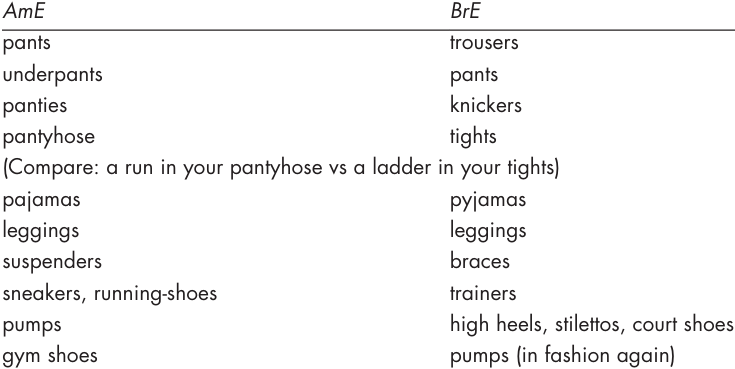
Artefacts for the eyes and tools of two joined pieces are a second type of plural only noun, indivuated by ‘a pair of’:
glasses sunglasses binoculars goggles; scissors shears
(b) Miscellaneous
belongings earnings goods riches savings remains
surroundings outskirts premises (buildings) proceedings
In addition to the collective plural baked goods, AmE, but not BrE, has the individuated singular a baked good.
More problematic are people, police and cattle. All three are singular in form but plural in meaning. In other ways, however, they differ. People and police can be numerated: two or three people, six police. People generally replaces persons with definite reference (The people who live in our street).
Police is a collective (the police) and can be individuated by a noun compound policeman /policewoman /police officer /police constable, all count nouns.
Cattle is individuated by ‘head’: sixty head of cattle, used in specific registers.
3 Nouns with count and non-count uses: some coffee, two coffees
Many mass nouns can be interpreted as count when they refer to conventional instances or quantities of the mass referent:
One baked good vs baked goods (AmE)
One beef and two chickens, please (restaurant or in-flight context)
In other cases, shape matters. Eatable entities visualized as having a definite shape are count: a cheese, a cake, a ham, an egg, a potato, while the substance or flesh is conceptualized as mass: (some) cheese, (some ham) etc.
You’ve got egg on your tie.
The kitchen smells of fried fish.
The non-count is lexicalized differently in pairs such as cow (count) vs beef (mass). The animal itself is count, the flesh is mass: pig-pork, sheep-mutton, calf-veal, deer- venison. Shellfish is always non-count.








