PAST EVENTS AND PRESENT
TIME CONNECTED
Present Perfect and Past Perfect
PRESENT PERFECT ASPECT AND PAST TENSE
COMPARED: ANTERIORITY VS DEFINITE TIME
The Perfect construction in English relates a state or event to a relevance time. This is speech time for the Present Perfect, some point in time prior to speech time for the Past Perfect and some point in time after speech time for the Future Perfect.
The Present Perfect is a subtle retrospective tense-aspect which views states or events as occurring in a time-frame leading up to speech time. Expressed by have + past participle, the have element is present, the participle is past. The event is psycho logically connected to the present as in the following example:
________________________________________speech time
His marriage has broken down and he has gone to live in another part of England
These and other features contrast with those of the Past tense:
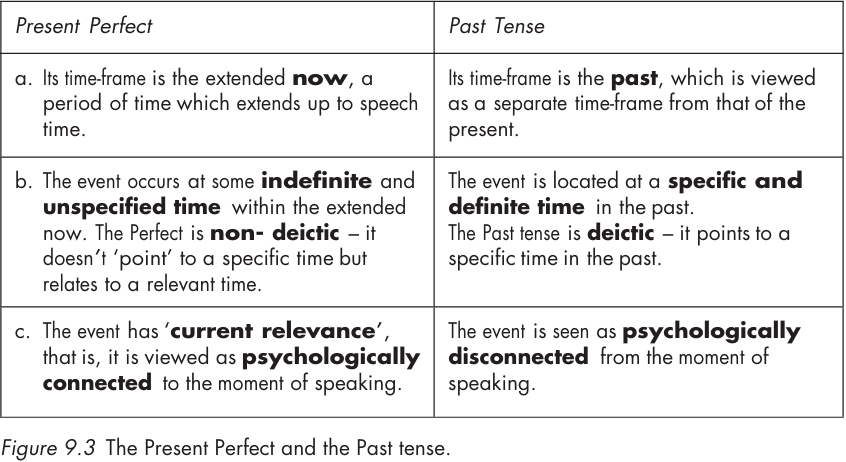
Within the extended now, the Present Perfect is used in English when the speaker wishes to refer, not to a definite moment of occurrence of the event, but simply to the anteriority of the event. This is in marked contrast with the definite time use of the Past tense. Compare:
They have left for New York.
They left for New York an hour ago.
Similarly, the Present Perfect is not normally used in main clauses with interrogative adverbs, which imply definite time and require the Past tense.
We can say Have they started? Have they finished? (Present Perfect)
Or When did they start? At what time did they finish? (Past tense)
But not *When have they started? *At what time have they finished?
When a definite time is not implied by the verb the Present Perfect is possible:
Where have you most enjoyed working? [BNA]
In subordinate clauses, with future reference, the Present Perfect can follow when, since this use refers to an unspecified time: When I have finished, I’ll call you.
Furthermore, the Present Perfect operates in a time-frame that is still open, blocking examples such as 1a and 2a. By contrast the b examples are grammatical, as are 3 and 4:
1a *James Joyce has been born in Dublin. 1b James Joyce was born in Dublin.
2a *He has lived in Ireland until 1904. 2b He lived in Ireland until 1904.
3 Michael has lived in Ireland all his life (implying that he still lives there).
4 Generations of writers have been influenced by Joyce (and are still influenced).
In 1a and 2a the Perfect is blocked because Joyce’s life-span is over. In 3 this is not the case. In 4 the plural subject ‘generations of writers’ allows for a time-frame that is open.
The perspective of the ‘extended now’ time-frame in contrast with that of the Past tense is illustrated in this passage from Penelope Lively’s Moon Tiger:
I’ve grown old with the century; there’s not much left of either of us. The century of war. All history, of course, is the history of wars, but this hundred years has excelled itself. How many million shot, maimed, burned, frozen, starved, drowned? God only knows. I trust He does; He should have kept a record, if only for His own purposes. I’ve been on the fringes of two wars; I shan’t see the next. The first preoccupied me not at all; this thing called War summoned Father and took him away for ever. I saw it as some inevitable climatic effect: thunderstorm or blizzard. The second lapped me up but spat me out intact. Technically intact. I have seen war; in that sense I have been present at wars, I have heard bombs and guns and observed their effects.








